
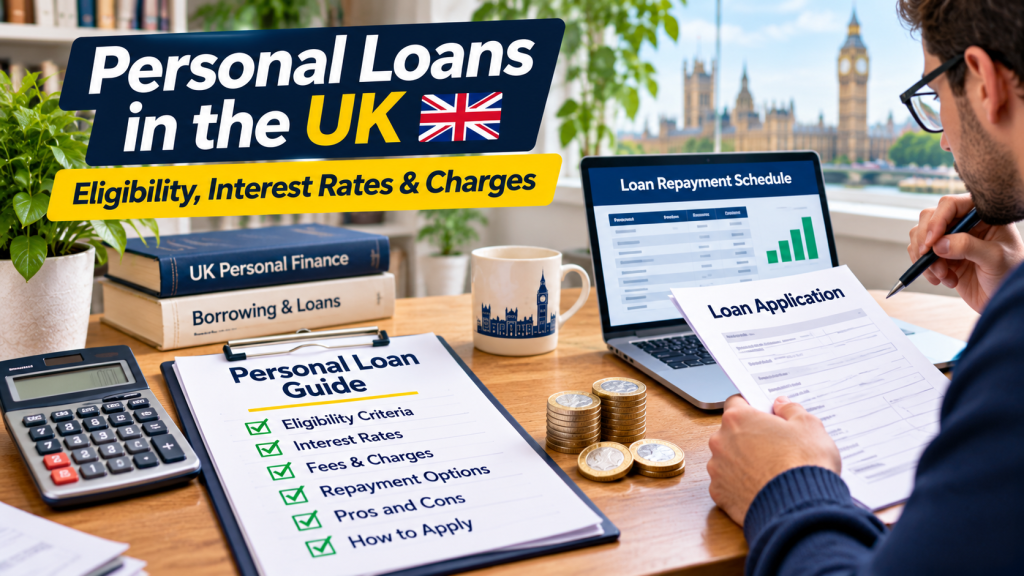
A personal loan can help you pay for a major expense, manage a planned purchase or cover an unexpected financial need. In the United Kingdom, banks, building societies and other authorised lenders offer personal loans with different interest rates, repayment periods and eligibility requirements.
However, borrowing money is a financial commitment. Before applying, it is important to understand how personal loans work, how much they cost and whether you can comfortably afford the repayments.
Your credit history, income, existing debts and monthly expenses may all influence a lender’s decision.
In this guide, we explain personal loans in the UK, including eligibility criteria, interest rates, APR, fees, repayment examples and tips for choosing a suitable loan.
1. What Is a Personal Loan?
A personal loan is money borrowed from a lender that you agree to repay over a specified period, usually through fixed monthly instalments.
Most standard personal loans are unsecured. This means you do not normally have to provide an asset, such as your home or car, as security.
You may use an unsecured personal loan for purposes such as:
- Home improvements
- Buying furniture or household appliances
- Car-related expenses
- Paying for a planned event
- Combining certain existing debts
- Covering a large planned purchase
The lender will explain whether the loan has any restrictions on how the money can be used.
A personal loan is not free money. You must repay the amount borrowed, plus interest and any applicable charges.
2. How Do Personal Loans Work in the UK?
The process is generally straightforward.
- You decide how much money you need to borrow.
- You compare lenders and loan terms.
- You check your eligibility.
- You submit an application.
- The lender assesses your creditworthiness and affordability.
- If approved, you receive a loan offer and agreement.
- You review the terms and accept the agreement.
- You repay the loan through the agreed instalments.
For example, suppose you borrow £5,000 over three years.
The lender will calculate your monthly repayment based on the interest rate, loan term and any applicable charges.
You will normally make payments by Direct Debit or another agreed payment method.
If you miss payments, you may face additional charges, damage to your credit history and further collection action.
3. Personal Loan Eligibility Criteria in the UK
Every lender has its own eligibility requirements. Meeting the basic requirements does not guarantee approval.
Common factors include:
Age Requirement
You generally need to be at least 18 years old to apply for a regulated personal loan.
Some lenders may set a higher minimum age.
UK Residency
Many lenders require applicants to live in the UK and have a UK residential address.
Some may also require a minimum period of UK residency.
Regular Income
Lenders may assess your income to understand whether you can afford the monthly repayments.
Income may come from:
- Full-time employment
- Part-time employment
- Self-employment
- Pension income
- Certain benefits or other accepted sources
The types of income accepted vary between lenders.
Credit History
Your credit report may help a lender understand how you have managed borrowing in the past.
They may consider:
- Previous loan repayments
- Credit card payment history
- Missed or late payments
- Defaults and CCJs
- Existing credit commitments
- Recent credit applications
A strong credit history may improve your chances of qualifying for competitive rates, but it does not guarantee approval.
Affordability
Lenders must assess creditworthiness, including the risk that repayments may be unaffordable.
They may consider your income, regular expenses, existing debts and other relevant financial circumstances.
A lender should not approve borrowing simply because you meet a minimum income requirement.
4. What Is APR on a Personal Loan?
APR stands for Annual Percentage Rate.
It is a measure used to show the annual cost of borrowing, including interest and certain compulsory charges, expressed as a percentage.
APR can help you compare different loan offers.
For example:
| Loan Offer | Advertised APR |
|---|---|
| Loan A | 7.9% APR |
| Loan B | 11.9% APR |
| Loan C | 16.9% APR |
These figures are hypothetical examples, not current offers from lenders.
Generally, a lower APR means a lower borrowing cost, assuming the amount, repayment term and other conditions are comparable.
However, always compare the total amount repayable, not just the advertised APR.
5. What Is Representative APR?
You may see the term “representative APR” in personal loan advertisements.
Under UK consumer credit advertising rules, a representative APR generally must be offered to at least 51% of customers who are expected to enter into the agreement as a result of the advertisement.
This means not everyone who applies will necessarily receive the advertised rate.
For example, a lender might advertise a representative APR of 8.9%.
Depending on your credit history and financial circumstances, you could receive:
- The advertised rate
- A higher interest rate
- A different loan amount or term
- A declined application
Some lenders may show personalised or guaranteed rates after an eligibility assessment, but always read the conditions carefully.
6. Personal Loan Interest Rates in the UK
Personal loan interest rates vary between lenders and applicants.
There is no single interest rate that every borrower receives.
Your offered rate may depend on:
- Your credit history
- Your income
- Your existing financial commitments
- The amount you want to borrow
- The repayment period
- The lender’s assessment criteria
- The lender’s current pricing
Some lenders offer fixed interest rates, while others may offer variable-rate products.
Fixed Interest Rate
A fixed-rate personal loan generally keeps the interest rate unchanged during the agreed period.
This can make monthly repayments easier to plan.
Variable Interest Rate
A variable-rate loan may have an interest rate that changes according to the agreement.
If the rate increases, your repayments or total borrowing cost may increase.
Before choosing a variable-rate loan, consider whether you could manage higher repayments.
7. Example: How Much Does a Personal Loan Cost?
Let’s consider a hypothetical example.
Suppose you borrow £10,000 for three years at a fixed annual interest rate of 8%, with no additional fees.
The approximate repayment figures would be:
| Detail | Amount |
|---|---|
| Loan amount | £10,000 |
| Loan term | 36 months |
| Illustrative annual interest rate | 8% |
| Approximate monthly repayment | £313.36 |
| Approximate total repayment | £11,280.96 |
| Approximate interest cost | £1,280.96 |
These figures are illustrative calculations, not a lender quotation or a representative APR offer. Actual repayments depend on the lender’s APR calculation, payment dates, fees and agreement terms.
The example shows why it is important to check the total amount you will repay before accepting a loan.
8. Documents You May Need to Apply for a Personal Loan
Lenders may request information to verify your identity, income and financial circumstances.
Commonly requested details include:
- Full name
- Date of birth
- Current residential address
- Previous addresses
- UK bank account details
- Employment information
- Income details
- Monthly expenses
- Contact information
Some lenders may also request supporting documents, such as:
- Payslips
- Bank statements
- Proof of address
- Self-employment income records
- Identification documents
The exact requirements depend on the lender and your circumstances.
Only submit personal documents through the lender’s secure official website or application process.
9. Personal Loan Fees and Charges in the UK
Interest is not the only cost you should consider.
Check the loan agreement for any additional charges.
Arrangement or Administration Fees
Some loans may include fees for setting up or administering the agreement.
Check whether the fee is added to the loan balance or deducted from the money you receive.
Late Payment Charges
If you miss a repayment, the lender may charge a fee if permitted by the agreement.
Late payments may also affect your credit history.
Early Repayment Charges
You may be able to repay some or all of your loan early.
However, an early repayment charge may apply in certain circumstances.
Check the agreement and ask the lender for a settlement figure before making an early repayment.
Other Charges
Depending on the agreement, there may be charges for particular services or events.
Always ask the lender to explain any charge you do not understand.
10. Secured vs Unsecured Personal Loans
Personal borrowing can be secured or unsecured.
Unsecured Personal Loan
An unsecured loan does not normally require you to provide an asset as security.
Key features:
- No specific asset is usually pledged as security.
- Approval depends on the lender’s creditworthiness and affordability checks.
- Interest rates may vary according to the borrower’s circumstances.
- Failure to repay can still lead to debt collection and legal action.
Secured Loan
A secured loan is linked to an asset, often a property.
Key features:
- The lender takes security over an asset.
- Interest rates and terms depend on the agreement.
- The lender may have rights over the secured asset if you fail to repay.
- Your home could be at risk if it is used as security and you do not keep up repayments.
A secured loan is not automatically cheaper or better. Consider the consequences carefully before putting an asset at risk.
11. How to Compare Personal Loans in the UK
Do not choose a loan only because it advertises a low interest rate.
Compare the complete borrowing cost.
1. Compare APR
Look at the APR offered to you rather than relying only on the advertised representative APR.
2. Compare Monthly Repayments
Make sure the monthly instalment fits comfortably within your budget.
3. Check the Total Amount Repayable
A longer loan term may reduce monthly payments but increase the total interest you pay.
4. Review All Fees
Check arrangement fees, late payment charges and early repayment terms.
5. Check Eligibility First
Use a soft-search eligibility checker where available to understand your chances of acceptance before making a full application.
6. Check the Lender
Verify the lender’s identity and regulatory status before sharing personal or financial information.
12. How to Apply for a Personal Loan in the UK
Follow these steps before applying.
Step 1: Decide How Much You Need
Borrow only the amount required for your planned purpose.
Avoid borrowing extra money simply because a lender offers a higher limit.
Step 2: Review Your Budget
Calculate your monthly income and expenses.
Make sure the repayment will not affect rent, food, household bills or other essential commitments.
Step 3: Check Your Credit Report
Review your credit reports and correct any errors before applying.
Step 4: Compare Loan Offers
Compare APR, loan terms, monthly instalments and total repayment amounts.
Step 5: Use an Eligibility Checker
A soft-search eligibility checker can help you assess your chances without leaving a hard-search footprint in the usual way.
Step 6: Complete Your Application
Provide accurate information about your identity, income and financial circumstances.
Step 7: Read the Loan Agreement
Check the interest rate, fees, repayment schedule, cancellation rights and early repayment conditions.
Only accept the agreement if you understand the costs and can afford the repayments.
13. Can You Get a Personal Loan with a Poor Credit History?
It may be possible to obtain a personal loan with a poor credit history, but approval is not guaranteed.
Some lenders consider applicants with previous missed payments or limited credit history.
However, you may face:
- Higher interest rates
- Lower borrowing limits
- Shorter repayment terms
- Additional eligibility requirements
- A declined application
Be careful with high-cost loans. A loan that is technically available may still be unsuitable if the repayments are unaffordable.
Before applying, consider improving your credit profile and reviewing alternative borrowing options.
14. Can You Repay a Personal Loan Early?
In many cases, you can repay a personal loan early, either partially or in full.
However, the agreement may allow an early repayment charge in certain circumstances.
Before making an overpayment:
- Contact your lender.
- Request an early settlement figure.
- Ask whether an early repayment charge applies.
- Compare the interest you could save with any charge.
- Keep enough savings for essential expenses and emergencies.
Under relevant UK consumer credit rules, borrowers generally have a right to repay regulated credit agreements early, subject to applicable terms and legal limits.
15. What Happens If You Miss a Personal Loan Payment?
Missing a loan payment can create additional financial problems.
Possible consequences include:
- Late payment charges where applicable
- A negative mark on your credit file
- Contact from the lender
- Increased difficulty obtaining credit
- Debt collection action
- Legal action in serious cases
If you think you will miss a payment, contact your lender as early as possible.
Explain your financial situation and ask whether they can offer a suitable repayment arrangement.
Do not ignore letters, emails or calls about missed payments.
If you are struggling with several debts, seek free and impartial debt advice from a recognised UK organisation.
16. How to Borrow Safely and Avoid Loan Scams
Online loan advertisements can sometimes be misleading.
Be especially careful if a company promises guaranteed approval or asks for money before releasing a loan.
Follow these safety tips:
- Check the lender on the Financial Conduct Authority (FCA) Financial Services Register.
- Use the lender’s official website.
- Avoid lenders promising guaranteed approval regardless of circumstances.
- Do not pay an unexpected upfront fee to release loan funds.
- Never share banking passwords or one-time passcodes.
- Read the loan agreement before accepting.
- Check the full cost of borrowing.
- Be cautious of pressure to make an immediate decision.
A genuine lender should provide clear information about the loan, its costs and your repayment obligations.
17. Alternatives to Personal Loans
A personal loan is not always the best borrowing option.
Depending on your circumstances, you may want to consider:
Credit Union Loans
Credit unions are member-owned financial organisations that may offer loans to eligible members.
Terms, interest rates and membership requirements vary.
Credit Card
A credit card may be suitable for some purchases if you can manage repayments responsibly.
Check the interest rate, fees and any promotional period conditions.
0% Purchase Credit Card
Some credit cards offer an introductory 0% interest period on eligible purchases.
You must understand when the offer ends and what interest rate applies afterwards.
Overdraft
An arranged overdraft may provide short-term flexibility, but it can be expensive.
Check the interest rate and charges before using it.
Saving Before Buying
If the purchase is not urgent, saving money first may help you avoid interest and debt.
Compare the cost of borrowing with the benefit of making the purchase now.
18. Frequently Asked Questions (FAQs)
Q1. What is the minimum age to get a personal loan in the UK?
You generally need to be at least 18 years old to apply for a regulated personal loan. Individual lenders may have additional age requirements.
Q2. What credit score do I need for a personal loan in the UK?
There is no universal UK credit score required by every lender. Each lender has its own assessment criteria and may use information from one or more credit reference agencies.
Q3. Can I get a personal loan without a credit check?
Most regulated lenders carry out creditworthiness checks. Be cautious of advertisements claiming guaranteed loans with no checks, as they may be misleading or linked to scams.
Q4. How much can I borrow with a personal loan in the UK?
The amount depends on the lender, your income, credit history, existing debts and affordability assessment. Some lenders offer small loans, while others may offer larger amounts.
Q5. How long does it take to get a personal loan?
The time varies by lender and application. Some applications may be assessed quickly, while others require additional checks or documents. Approval and payment are not guaranteed immediately.
Q6. Can I get a personal loan if I am self-employed?
Some lenders accept self-employed applicants. They may ask for tax calculations, tax year overviews, bank statements or other evidence of income.
Q7. Does applying for a personal loan affect my credit score?
A full application may involve a hard credit search, which can affect your credit score. Checking eligibility through a soft-search tool generally does not affect your score.
Q8. Can I cancel a personal loan after accepting it?
For many regulated consumer credit agreements, you have a 14-day withdrawal right. If you withdraw, you generally need to repay the amount borrowed within 30 days and may have to pay interest for the period you had the money.
Check your agreement and the applicable rules.
Q9. Is it better to choose a shorter or longer loan term?
A shorter term usually means higher monthly repayments but less interest overall, assuming the same rate and fees. A longer term can reduce monthly payments but may increase the total amount you repay.
Q10. Are personal loans safe in the UK?
Borrowing from a properly authorised lender and understanding the agreement can reduce risks. However, every loan creates a financial obligation, so check affordability and total costs before accepting.
Conclusion
Personal loans can help you manage planned expenses, but choosing the right loan requires careful research.
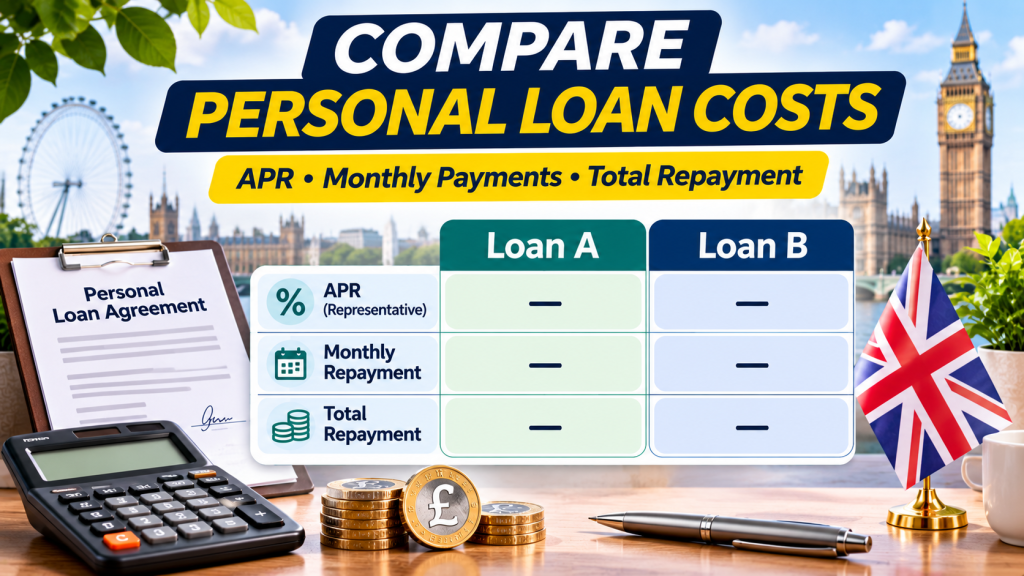
Before borrowing, compare APRs, monthly repayments, total repayment costs, eligibility requirements and additional charges.
Check your credit history, use eligibility tools where available and make sure you can afford the repayments without compromising essential household expenses.
Always verify that the lender is authorised and read the agreement before signing.
The best personal loan is not necessarily the one offering the largest amount or the lowest advertised rate. It is the one that meets your needs at a cost you can comfortably afford.
Disclaimer: This article is for educational and informational purposes only. It is not personalised financial or lending advice. Loan rates, eligibility criteria and charges vary by lender and applicant. Always check the lender’s current terms and consider independent financial or debt advice before borrowing.