

Saving money is an important part of building financial security. Whether you are planning a holiday, buying a home, preparing for emergencies or saving for retirement, choosing the right savings option can make a difference.
In the United Kingdom, two popular ways to save money are Individual Savings Accounts (ISAs) and standard savings accounts.
Both can help you earn interest on your money, but they work differently when it comes to tax, contribution limits, access and flexibility.
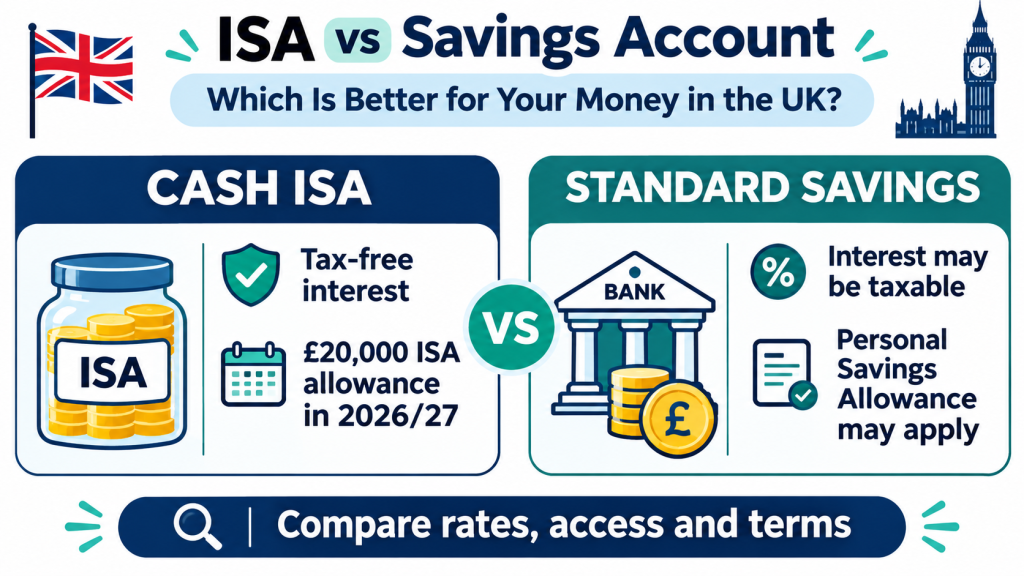
A Cash ISA allows you to earn interest tax-free, while interest from a standard savings account may be taxable if it exceeds your available tax-free allowances.
So, which option is better?
The answer depends on how much you save, your tax position, the interest rate available and when you may need your money.
This guide explains ISA vs savings accounts in the UK, including their benefits, drawbacks, tax rules and practical examples to help you make an informed decision.
1. What Is an ISA in the UK?
ISA stands for Individual Savings Account.
It is a UK government-supported account that offers tax advantages on eligible savings or investments.
Depending on the type of ISA, you can earn interest, investment income or capital gains without paying UK tax on those returns within the ISA.
There are four main types of ISA:
- Cash ISA
- Stocks and Shares ISA
- Innovative Finance ISA
- Lifetime ISA
Each type has different rules and is designed for different financial goals.
For people who want to save money without taking investment risk, a Cash ISA is usually the most direct comparison with a standard savings account.
What Is a Cash ISA?
A Cash ISA is a savings account where the interest you earn is tax-free.
For example, if you deposit £10,000 into a Cash ISA and earn £400 in interest, you do not pay Income Tax on that ISA interest.
Cash ISAs may offer:
- Easy-access savings
- Fixed-term savings
- Notice accounts
- Variable interest rates
- Fixed interest rates
The features depend on the provider and account.
2. What Is a Standard Savings Account?
A standard savings account is an account offered by a bank, building society or credit union where you deposit money and earn interest.
Unlike a Cash ISA, interest from a standard savings account may count towards your taxable income.
However, many people can earn some savings interest without paying tax because of the Personal Savings Allowance and other tax allowances.
Standard savings accounts may include:
- Easy-access savings accounts
- Regular savings accounts
- Fixed-rate savings accounts
- Notice savings accounts
- Children’s savings accounts
Some accounts allow flexible withdrawals, while others may restrict access or require advance notice.
3. ISA vs Savings Account: Key Differences
Here is a simple comparison of a Cash ISA and a standard savings account.
| Feature | Cash ISA | Standard Savings Account |
|---|---|---|
| Interest tax | Tax-free | May be taxable above available allowances |
| Annual deposit limit | ISA allowance applies | Usually set by provider, not a general ISA limit |
| Interest rate | Fixed or variable | Fixed or variable |
| Access to money | Depends on account | Depends on account |
| Tax reporting | ISA interest is tax-free | Tax may apply above allowances |
| Account types | Easy access, fixed, notice | Easy access, fixed, notice, regular |
| Joint account | Cannot be held jointly | Some can be held jointly |
| Investment risk | Cash ISA does not have market investment risk | Standard cash savings do not have market investment risk |
Both can be suitable for saving money. The main difference is the tax treatment and the rules attached to each account.
4. How Much Can You Save in an ISA in 2026/27?
The UK ISA allowance for the 2026/27 tax year is £20,000.
The tax year runs from 6 April 2026 to 5 April 2027.
You can use your annual allowance across eligible ISA types, subject to the rules for each account.
For example, you could allocate your allowance as follows:
| ISA Type | Contribution |
|---|---|
| Cash ISA | £10,000 |
| Stocks and Shares ISA | £7,000 |
| Innovative Finance ISA | £3,000 |
| Total | £20,000 |
These are illustrative allocations. A Lifetime ISA has its own £4,000 annual contribution limit, and contributions to it count towards the overall £20,000 ISA allowance.
Important Cash ISA Rule from April 2027
The government has announced a change that will take effect from 6 April 2027.
Under the published policy:
- People aged under 65 will have a £12,000 annual Cash ISA allowance.
- People aged 65 or over will retain a £20,000 annual Cash ISA allowance.
- The overall ISA allowance will remain £20,000.
This means savers under 65 will need to consider how they divide their ISA allowance between cash and other eligible ISA types.
Always check the latest HMRC guidance before making decisions based on future tax-year rules.
5. What Is the Personal Savings Allowance?
The Personal Savings Allowance (PSA) is the amount of interest you can earn from certain savings accounts without paying Income Tax.
For the 2026/27 tax year, the allowance is:
| Income Tax Band | Personal Savings Allowance |
|---|---|
| Basic-rate taxpayer | £1,000 |
| Higher-rate taxpayer | £500 |
| Additional-rate taxpayer | £0 |
This allowance applies to eligible savings interest outside tax-free accounts such as Cash ISAs.
Example of the Personal Savings Allowance
Suppose you are a basic-rate taxpayer and earn £1,300 in savings interest during a tax year.
Your Personal Savings Allowance is £1,000.
Therefore:
- First £1,000: Tax-free
- Remaining £300: Taxable
At a 20% tax rate, the tax on the remaining £300 would be £60.
This is a simplified example. Your actual tax position can depend on your total income and other allowances.
What About the Starting Rate for Savings?
Some people with lower incomes may qualify for an additional tax-free starting rate for savings of up to £5,000.
The amount available depends on your other income. Every £1 of other income above your Personal Allowance reduces the starting rate for savings by £1.
You may be eligible for both the starting rate for savings and the Personal Savings Allowance.
6. Cash ISA vs Savings Account: Which Offers Better Interest?
Interest rates are an important factor when choosing between a Cash ISA and a standard savings account.
A standard savings account may sometimes offer a higher interest rate than a Cash ISA. However, this is not always the case.
The best choice depends on the interest rate, your tax position and the amount you plan to save.
Example: Comparing Two Savings Options
Suppose you have £20,000 to save.
You find these two illustrative accounts:
| Details | Cash ISA | Standard Savings |
|---|---|---|
| Deposit | £20,000 | £20,000 |
| Annual interest rate | 4% | 4.2% |
| Interest earned | £800 | £840 |
| Tax on interest | £0 | Depends on your allowance |
If you are a basic-rate taxpayer with a £1,000 Personal Savings Allowance and no other savings interest, the £840 interest from the standard savings account would fall within your allowance.
In this example, the standard savings account earns £40 more interest.
However, if you are an additional-rate taxpayer, you have no Personal Savings Allowance. The interest may therefore be taxable, making the Cash ISA more attractive.
Important: These rates and calculations are illustrative, not live savings offers or personalised tax advice. Actual interest depends on the provider’s terms and how interest is calculated and paid.
7. Benefits of a Cash ISA
A Cash ISA can be useful for people who want to earn interest without worrying about tax on that interest.
Here are some important benefits.
1. Tax-Free Interest
The biggest benefit is that interest earned inside a Cash ISA is free from UK Income Tax.
There is no need to use your Personal Savings Allowance for that interest.
2. Useful for Higher Earners
Higher-rate taxpayers have a smaller Personal Savings Allowance, while additional-rate taxpayers have none.
A Cash ISA can therefore be useful if you have substantial savings and expect to earn interest above your available tax-free allowance.
3. Different Account Options
You can choose between different Cash ISA products, depending on your needs.
For example:
- Easy-access Cash ISA
- Fixed-rate Cash ISA
- Notice Cash ISA
4. Tax-Efficient Long-Term Saving
You can keep eligible savings inside an ISA and continue benefiting from tax-free interest, subject to ISA rules.
This can be helpful if you plan to build savings over several years.
5. No Tax on ISA Interest
Cash ISA interest does not use up your Personal Savings Allowance.
This can make tax planning simpler.
8. Disadvantages of a Cash ISA
Although Cash ISAs offer tax advantages, they are not always the best option.
1. Limited Annual Allowance
You can only contribute up to your available ISA allowance each tax year.
For 2026/27, the overall annual ISA allowance is £20,000.
2. Interest Rates May Be Lower
Some standard savings accounts may offer better interest rates than Cash ISAs.
You should compare the actual returns before opening an account.
3. Withdrawal Rules Can Vary
Easy-access Cash ISAs generally allow withdrawals, but fixed-term accounts may restrict access or charge an early withdrawal penalty.
4. Transfer Rules Matter
If you want to move your ISA savings to another provider, use the official ISA transfer process.
Withdrawing the money yourself and depositing it into a new account can affect its tax-free status and your available allowance.
5. Not Every ISA Is Flexible
Some Cash ISAs are flexible, while others are not.
With a flexible ISA, eligible withdrawals can generally be replaced in the same tax year without using additional allowance, subject to the provider’s rules.
Do not assume every ISA offers this feature.
9. Benefits of a Standard Savings Account
Standard savings accounts can be a good option for people who want straightforward saving arrangements.
1. No General ISA Contribution Limit
Unlike an ISA, a standard savings account does not have the same government-set annual contribution allowance.
The provider may still set account-specific deposit limits.
2. More Account Choices
Banks and building societies offer a wide range of savings products.
You can compare easy-access, fixed-rate, regular and notice accounts.
3. Potentially Competitive Interest Rates
Some standard savings accounts may offer attractive rates, particularly regular savings or fixed-term products.
Always check minimum deposits, maximum balances and withdrawal conditions.
4. Suitable for Everyday Savings
A standard easy-access savings account may be convenient for emergency funds or short-term goals.
5. Joint Account Options
Some providers allow two people to open a joint savings account.
This can be useful for couples or families saving towards a shared goal.
10. Disadvantages of a Standard Savings Account
Standard savings accounts also have some limitations.
1. Interest May Be Taxable
If your interest exceeds your available tax-free allowances, you may need to pay Income Tax on the excess.
2. Tax Rules Can Become Complicated
People with several savings accounts may need to keep track of the interest they receive and whether it exceeds their allowance.
3. Withdrawal Restrictions
Some fixed-rate and notice savings accounts do not allow unrestricted access to your money.
4. Interest Rates Can Change
Variable-rate accounts can change their interest rates.
A competitive rate today may not remain competitive in the future.
11. What Are the Different Types of ISAs?
Before opening an ISA, it is important to understand the different types available.
Cash ISA
A Cash ISA is designed for cash savings.
You earn tax-free interest, and your money is not exposed to stock market movements simply because it is held in a Cash ISA.
Stocks and Shares ISA
A Stocks and Shares ISA allows you to hold eligible investments such as shares, funds and bonds.
Any eligible investment returns within the ISA are generally free from UK Income Tax and Capital Gains Tax.
However, investments can fall in value, and you could lose money.
A Stocks and Shares ISA is not the same as a savings account and is generally more suitable for people who can accept investment risk and have a longer time horizon.
Lifetime ISA
A Lifetime ISA is designed to help eligible people save for their first home or later life.
Key rules include:
- You generally need to be aged 18 to 39 to open one.
- You can contribute up to £4,000 each tax year.
- The government adds a 25% bonus on eligible contributions.
- The maximum annual government bonus is £1,000.
Withdrawals are generally permitted without the withdrawal charge when used for a qualifying first home, after age 60, or in specified circumstances such as terminal illness.
Other withdrawals normally attract a 25% government withdrawal charge, which can mean you receive back less than you originally contributed.
Innovative Finance ISA
An Innovative Finance ISA can hold eligible peer-to-peer loans and certain other qualifying investments.
These products involve different risks from cash savings. Your capital may be at risk, and returns are not guaranteed.
12. Is Your Money Safe in an ISA or Savings Account?
Safety is an important consideration when choosing where to keep your money.
Eligible deposits held with UK-authorised banks, building societies and credit unions are protected by the Financial Services Compensation Scheme (FSCS).
From 1 December 2025, the FSCS deposit protection limit increased to £120,000 per eligible person, per authorised firm.
This protection can apply to eligible deposits in both Cash ISAs and standard savings accounts.
However, remember:
- The limit applies per authorised firm, not necessarily per banking brand.
- Different brands may share the same banking licence.
- Eligible temporary high balances may receive additional protection under specific rules.
- FSCS deposit protection does not protect you against ordinary changes in interest rates or inflation.
A Stocks and Shares ISA is different. Investments can fall in value, and FSCS protection does not cover normal investment losses.
Before depositing a large amount, check the provider’s authorisation and the FSCS protection arrangements.
13. How to Choose Between an ISA and a Savings Account
The right account depends on your financial situation.
Consider these factors before making a decision.
1. Check Your Tax Band
If you are a basic-rate taxpayer and your total savings interest is below £1,000, a standard savings account may be suitable.
If you are a higher-rate taxpayer, your Personal Savings Allowance is only £500.
If you are an additional-rate taxpayer, you have no Personal Savings Allowance.
A Cash ISA may be more useful if your taxable savings interest would exceed your allowance.
2. Compare Interest Rates
Do not assume that a Cash ISA always offers a better return.
Compare the interest rate on the ISA with the rate on standard savings accounts.
Also check whether the rate is fixed or variable and whether any introductory bonus applies.
3. Consider When You Need Your Money
If you need regular access to your savings, look at easy-access accounts.
If you can leave your money untouched for a fixed period, a fixed-rate account may be worth considering.
Always read withdrawal conditions before opening an account.
4. Think About Your Savings Amount
If you have a large amount of savings, tax may become more important.
Calculate your expected annual interest and compare it with your Personal Savings Allowance.
5. Check the Provider
Before opening an account, check:
- Whether the provider is authorised
- Whether deposits are FSCS protected
- Minimum and maximum deposits
- Withdrawal conditions
- Interest payment frequency
- Account fees or penalties
14. Can You Have Both an ISA and a Savings Account?
Yes. You can have both a Cash ISA and one or more standard savings accounts.
In fact, using both can be a practical way to organise your money.
For example:
- Keep emergency savings in an easy-access savings account.
- Use a Cash ISA for savings where tax-free interest is valuable.
- Consider a fixed-rate account for money you do not need immediately.
- Consider a Stocks and Shares ISA only if you understand investment risk and have an appropriate time horizon.
You do not have to choose only one type of account.
Your decision should be based on your savings goals, tax position and access requirements.
15. How to Open a Cash ISA in the UK
Opening a Cash ISA is generally straightforward.
Follow these steps:
Step 1: Compare Providers
Compare Cash ISA interest rates, access conditions and account features.
Step 2: Check Eligibility
Check the provider’s age, residency and other eligibility requirements.
Step 3: Choose the Account Type
Decide whether you want easy access, a fixed-term account or a notice account.
Step 4: Prepare Your Details
The provider may ask for:
- Full name
- Date of birth
- UK address
- National Insurance number, if required
- Identity and address verification documents
- Bank account details
Requirements vary between providers.
Step 5: Apply Online or Through the Provider
Complete the application using the provider’s official website or app.
Step 6: Deposit Your Money
Pay into the account while staying within your available ISA allowance.
Step 7: Keep Track of Your Savings
Review your interest rate, account terms and ISA allowance regularly.
16. Common Mistakes to Avoid
Many savers make avoidable mistakes when choosing between ISAs and savings accounts.
Here are some common examples.
- Choosing an account without comparing interest rates.
- Ignoring the Personal Savings Allowance.
- Depositing more than the available ISA allowance.
- Withdrawing ISA money without understanding the transfer rules.
- Assuming every Cash ISA is flexible.
- Ignoring early withdrawal penalties on fixed-rate accounts.
- Forgetting that variable interest rates can change.
- Keeping all savings with providers that share one banking licence without checking FSCS limits.
- Choosing a Stocks and Shares ISA without understanding investment risk.
- Failing to review savings accounts when introductory rates end.
Avoiding these mistakes can help you make better decisions and manage your savings more effectively.
17. ISA vs Savings Account: Which Is Better for Different People?
There is no single answer for everyone.
Here is a simple guide:
| Saver Type | Option Worth Considering |
|---|---|
| Basic-rate taxpayer with low savings interest | Standard savings account |
| Higher-rate taxpayer with substantial savings | Cash ISA |
| Additional-rate taxpayer | Cash ISA |
| Person saving for a short-term emergency | Easy-access savings account or easy-access Cash ISA |
| Person saving for a fixed period | Compare fixed-rate Cash ISA and fixed savings |
| First-time homebuyer who meets the rules | Lifetime ISA |
| Long-term investor comfortable with risk | Stocks and Shares ISA |
These are general pointers, not personal financial recommendations. Compare actual rates, account terms and your tax position before choosing.
18. Frequently Asked Questions (FAQs)
1. Is an ISA better than a savings account in the UK?
An ISA can be better if you want tax-free interest, especially when your savings interest may exceed your Personal Savings Allowance.
A standard savings account may be better if it offers a higher interest rate and your interest remains within your available tax-free allowance.
2. Is Cash ISA interest tax-free?
Yes. Interest earned within an eligible Cash ISA is free from UK Income Tax.
3. How much can I put into an ISA in 2026/27?
The overall annual ISA allowance is £20,000 for the 2026/27 tax year, which runs from 6 April 2026 to 5 April 2027.
4. Will the Cash ISA limit change in 2027?
Yes. From 6 April 2027, the announced Cash ISA limit will be £12,000 for people under 65. People aged 65 or over will retain a £20,000 Cash ISA limit.
5. Can I have multiple Cash ISAs?
Yes. You can pay into more than one Cash ISA in the same tax year, subject to your overall ISA allowance and the applicable rules.
6. Can I withdraw money from a Cash ISA?
Yes, if your account allows withdrawals. Easy-access Cash ISAs generally allow withdrawals, while fixed-term accounts may impose restrictions or penalties.
7. What happens if I withdraw money from a Cash ISA?
A withdrawal does not automatically restore your annual ISA allowance.
If your ISA is flexible, you may be able to replace eligible withdrawals within the same tax year without using additional allowance. Check the provider’s rules.
8. What is the Personal Savings Allowance in the UK?
For 2026/27, the Personal Savings Allowance is £1,000 for basic-rate taxpayers, £500 for higher-rate taxpayers and £0 for additional-rate taxpayers.
9. Are savings accounts tax-free in the UK?
Not necessarily. Interest may be taxable if it exceeds your available Personal Savings Allowance and any other applicable savings tax-free allowance.
10. Is my Cash ISA protected by FSCS?
Eligible deposits in a Cash ISA with a UK-authorised bank or building society can be protected by FSCS, up to £120,000 per eligible person, per authorised firm.
11. Can I transfer my Cash ISA to another bank?
Yes. You can transfer an ISA to another provider using the official ISA transfer process. Check whether the new provider accepts transfers and whether any charges or restrictions apply.
12. Should I choose a Cash ISA or a Stocks and Shares ISA?
A Cash ISA is designed for cash savings and pays interest. A Stocks and Shares ISA holds investments that can rise or fall in value.
Your choice depends on your goals, time horizon and ability to accept investment risk.
Conclusion
Choosing between an ISA and a standard savings account depends on your savings goals, tax position, interest rates and need for access.
A Cash ISA can be a useful option if you want tax-free interest, particularly if your savings interest may exceed your Personal Savings Allowance.
A standard savings account can also be a good choice, especially if it offers a competitive interest rate and your interest remains within your available tax-free allowances.
You do not necessarily need to choose just one. Many people can benefit from using both accounts for different purposes.
Before opening an account, compare interest rates, withdrawal conditions, provider protection and tax rules.
A little research today can help you make smarter savings decisions and build a stronger financial future.
Disclaimer
This article is for general educational and informational purposes only. It does not constitute personal financial, investment or tax advice.
ISA rules, tax allowances, interest rates and provider terms can change. The figures in this article relate to the 2026/27 UK tax year where specified and should be checked against current official guidance before making financial decisions.
Always review the terms and conditions of your chosen provider. Consider speaking with a qualified financial or tax adviser if you need advice based on your individual circumstances.