
Credit cards can make everyday purchases easier, help cover unexpected expenses and provide rewards. However, carrying a large credit card balance can become expensive because of interest charges and fees.
If you pay only the minimum amount every month, it may take years to clear your debt. Meanwhile, interest can continue increasing the amount you owe.
The good news is that you can use practical repayment strategies to reduce your credit card debt. Choosing the right method, controlling new spending and understanding your interest rates can help you make steady progress.
In this guide, you will learn the best ways to pay off credit card debt faster in the USA, compare the debt snowball and debt avalanche methods, understand balance transfers and debt consolidation, and discover what to do if you cannot afford your payments.
1. Understand Your Total Credit Card Debt
Before choosing a repayment strategy, find out exactly how much you owe.
If you have multiple credit cards, it is easy to lose track of balances, interest rates and payment dates.
Collect your latest statements and prepare a list of all your credit card accounts.
Record the following details:
- Credit card issuer
- Current outstanding balance
- Annual Percentage Rate (APR)
- Minimum monthly payment
- Payment due date
- Any promotional interest rate and its expiration date
- Annual fees or other applicable charges
Example:
Suppose you have three credit cards:
| Credit card | Outstanding balance | APR | Minimum payment |
|---|---|---|---|
| Card A | $1,200 | 18% | $40 |
| Card B | $3,000 | 26% | $100 |
| Card C | $600 | 22% | $30 |
| Total | $4,800 | — | $170 |
In this example, you owe $4,800 across three cards and have $170 in total minimum payments.
Knowing these numbers helps you decide which balance to target first.
2. Stop Adding New Credit Card Debt
One of the most important steps is to stop increasing the balances you are trying to repay.
If you continue making unnecessary purchases on your credit cards, your repayment progress may become much slower.
Try these practical steps:
- Use a debit card or cash for everyday purchases when possible.
- Avoid using credit cards for non-essential shopping.
- Remove saved card details from shopping websites if they encourage impulse purchases.
- Pause subscriptions you do not need.
- Set a weekly spending limit.
- Build a small emergency savings buffer so unexpected costs do not automatically go onto a credit card.
You do not necessarily need to close your credit card accounts. Focus first on controlling spending and paying down existing balances.
3. Choose a Credit Card Debt Repayment Strategy
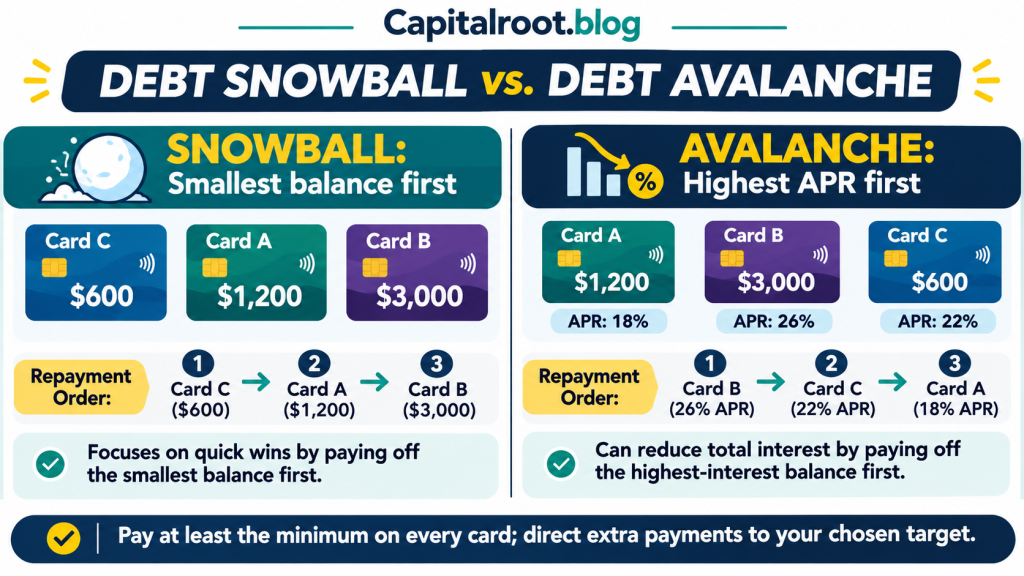
Two popular repayment strategies are the debt snowball method and the debt avalanche method.
Both approaches can help you repay multiple debts. The main difference is which balance you target first.
A. Debt Snowball Method
With the debt snowball method, you pay off the smallest balance first, regardless of its interest rate.
Follow these steps:
- List all your credit card balances from smallest to largest.
- Pay at least the minimum amount due on every card.
- Put any extra repayment money toward the smallest balance.
- Once that balance is paid off, move its payment amount to the next smallest balance.
- Continue until all balances are paid.
Using the earlier example:
| Card | Balance | Snowball priority |
|---|---|---|
| Card C | $600 | 1 |
| Card A | $1,200 | 2 |
| Card B | $3,000 | 3 |
You start with Card C because it has the smallest balance.
Advantages:
- You may pay off your first card relatively quickly.
- Early progress can help you stay motivated.
- Managing fewer outstanding balances can feel easier.
Disadvantage:
You may pay more interest overall than with the avalanche method because the highest-interest balance may remain unpaid for longer.
B. Debt Avalanche Method
With the debt avalanche method, you focus on the card with the highest APR first.
Follow these steps:
- List your cards from the highest APR to the lowest APR.
- Pay the minimum amount due on every card.
- Put extra money toward the card with the highest APR.
- After clearing that balance, move to the next-highest APR.
- Continue until all credit card debt is paid.
Using the same example:
| Card | Balance | APR | Avalanche priority |
|---|---|---|---|
| Card B | $3,000 | 26% | 1 |
| Card C | $600 | 22% | 2 |
| Card A | $1,200 | 18% | 3 |
You start with Card B because it has the highest interest rate.
Advantages:
- It generally reduces interest costs compared with the snowball method when all other factors are equal.
- It targets the most expensive debt first.
- It can help you reduce the overall cost of repayment.
Disadvantage:
If the highest-interest card has a large balance, it may take longer to see your first account fully paid off.
Debt Snowball vs Debt Avalanche: Which Is Better?
| Comparison | Debt Snowball | Debt Avalanche |
|---|---|---|
| First target | Smallest balance | Highest APR |
| Main benefit | Motivation and quick wins | Potential interest savings |
| Interest cost | May be higher | Generally lower |
| Best suited to | People motivated by visible progress | People focused on reducing interest |
| Payment approach | Minimums on all, extra to smallest | Minimums on all, extra to highest APR |
Which should you choose?
If paying off a small balance will help you stay motivated, the snowball method may suit you.
If your main goal is to reduce interest costs and you can stay consistent, the avalanche method is generally the more cost-efficient choice.
The most important thing is to choose a method you can realistically follow.
4. Pay More Than the Minimum Payment
Making only the minimum payment can keep your account current, but it may take a long time to repay the full balance.
This is because part of your payment may go toward interest and fees rather than reducing the principal balance.
For example, imagine you owe $5,000 on a credit card with a 24% APR.
A simple starting estimate of one month’s interest is:
$5,000 × 24% ÷ 12 = $100
This is an illustration, not an exact statement calculation. Credit card interest is generally calculated using the applicable daily balance method and the terms of the account.
If your payment is only slightly higher than the interest and fees charged, your balance may decline very slowly.
Whenever your budget allows:
- Pay more than the required minimum.
- Direct additional money toward your chosen target card.
- Avoid new purchases on the balance you are trying to clear.
- Review your statement to see how much of your payment reduces the balance.
If you cannot afford more than the minimum, do not skip the payment. Consider contacting the issuer to discuss your options.
5. Consider a 0% APR Balance Transfer Credit Card
A balance transfer allows you to move debt from one credit card to another.
Some credit card issuers offer promotional 0% APR or low-interest balance transfer periods for eligible applicants.
This may help you reduce interest costs while paying down your balance.
Example:
Suppose you have $4,000 in credit card debt at 24% APR.
You receive an offer for a balance transfer card with:
- 0% promotional APR for 15 months
- 3% balance transfer fee
- A credit limit sufficient for the transfer
The transfer fee on $4,000 would be:
$4,000 × 3% = $120
Your transferred balance would become $4,120, assuming the full amount and fee are added to the new balance.
If you could repay that amount evenly over 15 months, you would need to pay approximately $275 per month, assuming no additional charges and that the promotional terms remain in effect.
Before accepting a balance transfer offer, check:
- Promotional APR duration
- Balance transfer fee
- APR after the promotional period
- Whether the full amount can be transferred
- Payment due dates and conditions
- What happens if you miss a payment
- Whether new purchases have a separate interest rate
Important risks:
A 0% balance transfer offer is not free money. The transfer fee may reduce your savings, and the interest rate may increase after the promotional period.
Avoid making new purchases on the transfer card unless you fully understand how its grace period and interest rules work. Also, do not assume you will qualify for the advertised offer.
A balance transfer is most useful when you have a realistic repayment plan and can clear a substantial part of the transferred balance before the promotional rate ends.
6. Ask Your Credit Card Company for a Lower Interest Rate
Many people do not realize that they can contact their credit card issuer and ask whether a lower APR or other payment assistance is available.
If you have a good payment history or are experiencing financial difficulty, the issuer may be willing to discuss options.
Call the customer service number on the back of your card and explain:
- Your current financial situation.
- Your outstanding balance.
- Whether you have been making payments on time.
- Why you are finding the current interest rate difficult.
- What payment you can realistically afford.
You can ask about:
- A lower interest rate
- A temporary hardship program
- A reduced payment arrangement
- Waiving certain fees
- Changing your payment due date
Approval is not guaranteed. Ask the issuer to explain any changes to your APR, account privileges, credit reporting and repayment terms in writing before agreeing.
7. Consider a Debt Consolidation Loan
Debt consolidation combines multiple debts into one new loan.
Instead of making separate payments to several credit card issuers, you may be able to make one monthly payment to a bank, credit union or other lender.
A debt consolidation loan may offer a lower interest rate than your existing credit cards, depending on your credit profile and the lender’s terms.
Example of Debt Consolidation
Suppose you have:
| Credit card | Balance | APR |
|---|---|---|
| Card A | $2,000 | 25% |
| Card B | $1,500 | 23% |
| Card C | $1,500 | 21% |
| Total | $5,000 | — |
You may explore a consolidation loan that offers a lower APR than your current cards.
Before accepting it, compare:
- Interest rate and whether it is fixed or variable
- Loan origination fees
- Monthly payment
- Loan repayment term
- Total interest and total amount payable
- Any early repayment charges
- Whether the loan is secured or unsecured
A lower monthly payment does not automatically mean a cheaper loan. A longer repayment term may increase the total interest you pay.
Also, avoid running up the credit card balances again after consolidation. Otherwise, you could end up with both the new loan and additional credit card debt.
8. Create a Monthly Budget for Debt Repayment
A repayment strategy works best when it fits your actual income and expenses.
Start by calculating your monthly take-home income. Then list essential expenses such as:
- Rent or mortgage
- Groceries
- Utilities
- Transportation
- Insurance
- Healthcare
- Minimum debt payments
After covering essential expenses, decide how much extra money you can put toward your target credit card.
Example:
Suppose your monthly take-home income is $3,000.
| Category | Monthly amount |
|---|---|
| Rent and utilities | $1,100 |
| Groceries | $350 |
| Transportation | $250 |
| Insurance and healthcare | $250 |
| Phone and internet | $100 |
| Other essential expenses | $300 |
| Minimum debt payments | $200 |
| Extra debt repayment | $250 |
| Emergency savings | $100 |
| Flexible spending and buffer | $100 |
| Total | $3,000 |
This is an illustrative budget, not a standard for every US household. Adjust the figures to match your real living costs.
If your essential expenses already use most of your income, start with a smaller extra payment and look for practical ways to reduce costs or increase income.
9. Use Extra Income to Pay Down Credit Card Debt
Additional income can help you make faster progress without relying only on expense cuts.
Depending on your skills and availability, you could consider:
- Part-time work
- Freelancing
- Overtime or additional shifts
- Selling unused household items
- Tutoring
- Weekend work
- Offering services in your local community
Before spending extra income, decide how much will go toward your credit card repayment.
For example, if you earn an additional $200 from a side job and can afford to put it toward your highest-interest card, that extra payment can help reduce the outstanding balance.
Remember to account for taxes, work-related expenses and irregular income before deciding how much you can afford to pay.
10. Try Nonprofit Credit Counseling
If you have multiple credit cards and are struggling to manage payments, a nonprofit credit counseling organization may help.
A credit counselor may review your income, expenses and debt, then help you create a repayment plan.
Some organizations may offer a Debt Management Plan (DMP).
Under a DMP, you generally make one payment to the counseling organization, which distributes payments to participating creditors according to the agreed plan.
Depending on the creditors and program, the plan may help you obtain reduced interest rates or waived fees. However, these benefits are not guaranteed.
Before enrolling, ask:
- Is the organization nonprofit?
- What services are included?
- Are there setup or monthly fees?
- Which creditors participate?
- Will your cards be closed or restricted?
- How long will the repayment plan last?
- What happens if you miss a payment?
Compare the full cost and terms before signing an agreement.
You can start by reviewing the CFPB’s guidance on credit counseling and debt management.
11. Be Careful with Debt Settlement Companies
Some companies advertise that they can reduce or eliminate your credit card debt for a fee.
Debt settlement is different from credit counseling and debt consolidation.
A debt settlement company may attempt to negotiate with creditors so that you pay less than the full amount owed. However, the process can be risky.
Potential risks include:
- Late fees and additional interest.
- Damage to your credit history.
- Collection activity.
- Possible lawsuits by creditors.
- Fees charged by the settlement company.
- Potential tax consequences on forgiven debt, depending on your circumstances.
Be especially cautious if a company:
- Guarantees that it can erase your debt.
- Demands large upfront fees.
- Tells you to stop communicating with your creditors.
- Tells you to stop making payments without explaining the risks.
- Claims that a special government program will eliminate your credit card balances.
You can contact your creditors directly or explore nonprofit credit counseling before paying a debt settlement company.
For additional information, visit the Federal Trade Commission’s official consumer advice website.
12. What to Do If You Cannot Afford Your Credit Card Payments
If you are unable to make your minimum payments, do not ignore the situation.
Contact your credit card issuer as soon as possible.
Explain:
- Why you are having difficulty making payments.
- How much you can realistically afford.
- Whether your financial problem is temporary or ongoing.
- When you expect to resume normal payments, if known.
Ask whether the issuer offers:
- Financial hardship assistance
- Temporary reduced payments
- Lower interest rates
- Fee waivers
- A revised payment schedule
Get any approved arrangement in writing and understand how it may affect your account and credit reporting.
If you cannot meet basic living expenses and debt payments at the same time, prioritize essential needs and seek qualified advice about your options.
The CFPB recommends contacting the credit card company immediately if you cannot pay your bills. Waiting may make the situation more difficult.
13. Common Mistakes to Avoid When Paying Off Credit Card Debt
Avoid these mistakes while working toward becoming debt-free.
1. Paying Only the Minimum Every Month
Minimum payments may keep your account current, but they can extend repayment and increase total interest costs.
2. Ignoring High-Interest Credit Cards
If you use the avalanche method, make sure your extra payments go toward the highest-APR balance.
3. Opening New Cards Without a Plan
Applying for new credit to manage existing debt can create additional fees and repayment obligations.
4. Missing Payment Due Dates
Late payments may lead to fees, interest-rate changes and credit-reporting consequences.
5. Using a Balance Transfer Without Checking the Terms
A promotional APR may expire, and transfer fees can reduce your savings.
6. Taking a Consolidation Loan Without Comparing Total Costs
A lower monthly payment may hide a longer repayment period and higher overall cost.
7. Trusting Guaranteed Debt Relief Offers
No company can guarantee that every creditor will accept a reduced settlement.
8. Closing Every Credit Card Immediately
Closing accounts may affect available credit and utilization. Consider the fees, account terms and your spending habits before deciding.
14. Frequently Asked Questions (FAQs)
Q1. What is the fastest way to pay off credit card debt in the USA?
The fastest practical approach depends on your income, interest rates and total balances. Paying more than the minimum, avoiding new debt and directing extra payments toward a selected balance can help. The avalanche method generally reduces interest costs when other factors are equal.
Q2. Is the debt snowball method better than the debt avalanche method?
The snowball method targets the smallest balance first and may provide quick motivation. The avalanche method targets the highest APR first and generally saves more interest. Choose the approach you can follow consistently.
Q3. Should I pay off the credit card with the highest balance first?
Not necessarily. Under the avalanche method, you target the highest interest rate. Under the snowball method, you target the smallest balance. The largest balance is not automatically the best first target.
Q4. Does paying more than the minimum reduce credit card interest?
Generally, yes. Paying more than the minimum can reduce the outstanding balance faster, which may reduce future interest charges. The exact result depends on your APR, balance, payment timing and card terms.
Q5. Is a 0% balance transfer card a good idea?
It may help if you qualify, understand the transfer fee and can repay the transferred balance before the promotional period ends. Check the post-promotion APR and all account conditions before applying.
Q6. Will debt consolidation hurt my credit score?
Applying for a consolidation loan may result in a hard inquiry, and opening a new account can affect your credit profile. However, managing the new loan responsibly and reducing card balances may help your overall financial position. The impact varies.
Q7. What happens if I only make minimum credit card payments?
You may remain current if you pay the required amount on time, but interest can continue accumulating on the unpaid balance. Repayment may take much longer and cost more.
Q8. Can I ask my credit card company to lower my interest rate?
Yes. You can contact your card issuer and request a lower APR or hardship assistance. The issuer is not required to approve your request, so ask about the available terms.
Q9. Should I close my credit card after paying it off?
Not automatically. Consider annual fees, account benefits, available credit and your ability to avoid new debt. Keeping an account open may be useful in some situations, but closing it may be appropriate in others.
Q10. Where can I get free help with credit card debt in the USA?
You can start with the Consumer Financial Protection Bureau (CFPB) and Federal Trade Commission (FTC) resources. You may also explore reputable nonprofit credit counseling organizations and ask about fees before enrolling.
Conclusion
Paying off credit card debt faster in the USA requires a clear plan, consistent payments and control over new spending.
Start by listing your balances, APRs and minimum payments. Choose the debt snowball method if quick progress motivates you, or the debt avalanche method if reducing interest costs is your main priority.
You can also explore balance transfers, lower-interest repayment options, debt consolidation and nonprofit credit counseling, but compare fees and risks before making a decision.
Most importantly, contact your credit card issuer early if you are struggling to make payments. Taking action sooner can help you understand your available options and avoid making the situation worse.
You do not have to clear every balance at once. Focus on a realistic repayment plan and make steady progress toward becoming debt-free.
Disclaimer: This article is for general educational purposes only and is not individualized financial, tax or legal advice. Credit card terms, interest rates, balance transfer offers and debt relief options vary by issuer and borrower. Review your account agreement and consult qualified professionals when necessary.