

A personal loan can help you cover an unexpected expense, consolidate high-interest debt, pay for a major purchase, or manage an important financial need. However, borrowing money without understanding the interest rate, fees, repayment period, and eligibility requirements can make a loan more expensive than expected.
If you are considering a personal loan in the United States, it is important to understand how lenders evaluate applications and how to compare loan offers.
In this guide, you will learn what personal loans are, how they work, what interest rates and fees to expect, which documents lenders may require, and how to choose a loan that fits your budget.
1. What Is a Personal Loan?
A personal loan is money borrowed from a bank, credit union, or online lender that you agree to repay over a specific period.
Most personal loans are unsecured. This means you generally do not need to provide collateral, such as a car or house, to qualify. Instead, lenders review factors such as your credit history, income, existing debts, and ability to repay.
Some personal loans are secured by collateral, but these are different from typical unsecured personal loans.
Common Reasons to Get a Personal Loan
People in the USA may use personal loans for several purposes, including:
- Debt consolidation: Combining multiple debts into one loan.
- Home improvement: Paying for repairs, renovations, or upgrades.
- Medical expenses: Covering eligible healthcare costs not paid by insurance.
- Emergency expenses: Managing unexpected bills or urgent repairs.
- Major purchases: Paying for necessary expenses that cannot be covered immediately.
- Life events: Managing certain wedding, moving, or relocation expenses.
Before borrowing, consider whether the expense is necessary and whether you can afford the monthly payment.
2. How Do Personal Loans Work in the USA?
The personal loan process is usually straightforward.
Here is how it generally works:
- Choose a loan amount: Decide how much money you actually need.
- Compare lenders: Review banks, credit unions, and online lenders.
- Check estimated offers: Some lenders allow you to check potential rates through prequalification.
- Submit an application: Provide your personal, financial, and employment information.
- Complete verification: The lender may check your credit, income, identity, and other details.
- Review the loan agreement: Read the APR, fees, monthly payment, repayment term, and total repayment amount.
- Receive the funds: If approved and you accept the agreement, the lender disburses the money according to its process.
- Repay the loan: Make payments according to the agreed schedule.
Approval and funding times vary by lender. Prequalification is not a guarantee of final approval.
3. Personal Loan Interest Rates in the USA
Interest rates are one of the most important factors when choosing a personal loan.
The rate you receive may depend on:
- Your credit score and credit history
- Your income and employment situation
- Your debt-to-income ratio
- The loan amount
- The repayment term
- The lender’s underwriting policies
- Whether the loan is secured or unsecured
Borrowers with stronger credit profiles may qualify for lower rates, while borrowers with weaker credit histories may receive higher rates or may not qualify.
What Is APR?
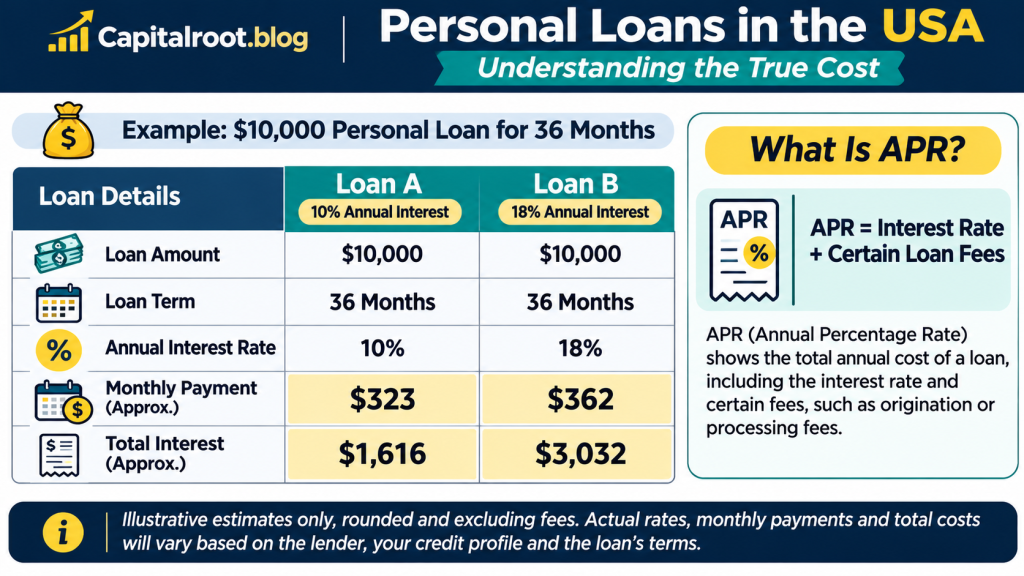
APR stands for Annual Percentage Rate. It helps show the yearly cost of borrowing, including the interest rate and certain loan fees.
For example, two lenders may advertise similar interest rates but charge different origination fees. Their APRs may therefore be different.
When comparing offers, look at the APR rather than focusing only on the advertised interest rate.
Important: APR is not necessarily the same as the interest rate, and the exact fees included in APR depend on applicable disclosure rules and the loan terms.
4. Personal Loan Interest Rate Example
Consider a hypothetical borrower who takes a $10,000 personal loan for three years.
The following examples use fixed annual interest rates and monthly payments. They assume no additional fees, no late payments, and a standard amortizing repayment schedule.
| Loan detail | Example A | Example B |
|---|---|---|
| Loan amount | $10,000 | $10,000 |
| Annual interest rate | 10% | 18% |
| Repayment term | 36 months | 36 months |
| Approx. monthly payment | $323 | $362 |
| Approx. total repayment | $11,616 | $13,032 |
| Approx. total interest | $1,616 | $3,032 |
These are illustrative calculations, not actual lender offers. The figures are rounded.
The example shows why comparing loan costs matters. A higher interest rate can significantly increase the total amount you repay.
5. Personal Loan Requirements in the USA
Every lender has its own eligibility rules. However, many lenders review similar factors before approving a personal loan.
1. Minimum Age
You generally need to be at least 18 years old to enter into a credit agreement, although some states and lenders may have additional requirements.
2. Credit Score
Your credit score helps lenders understand your borrowing history.
A higher score may improve your chances of qualifying for competitive terms, but there is no single credit score requirement for every personal loan.
Some lenders consider applicants with limited or less-than-perfect credit, but the available terms may be more expensive.
3. Stable Income
Lenders may ask for proof that you have enough income to repay the loan.
Income may come from employment, self-employment, retirement, or other acceptable sources, depending on the lender.
4. Debt-to-Income Ratio
Your debt-to-income ratio, commonly called DTI, compares your monthly debt payments with your gross monthly income.
Formula:
DTI = Total Monthly Debt Payments ÷ Gross Monthly Income × 100
For example, suppose your gross monthly income is $5,000 and your monthly debt payments total $1,500.
Your DTI would be:
$1,500 ÷ $5,000 × 100 = 30%
A lower DTI may indicate that you have more room in your budget to manage another payment. However, lenders use different standards.
5. Identity and Residency Verification
Lenders commonly verify your identity and may ask for a residential address, Social Security number or other permitted identification details.
Requirements vary by lender and product.
6. Bank Account
Some lenders require a verified bank account in your name to deposit loan funds and process repayments.
6. Documents Needed for a Personal Loan
The documents you need depend on the lender and your financial situation.
Commonly requested documents may include:
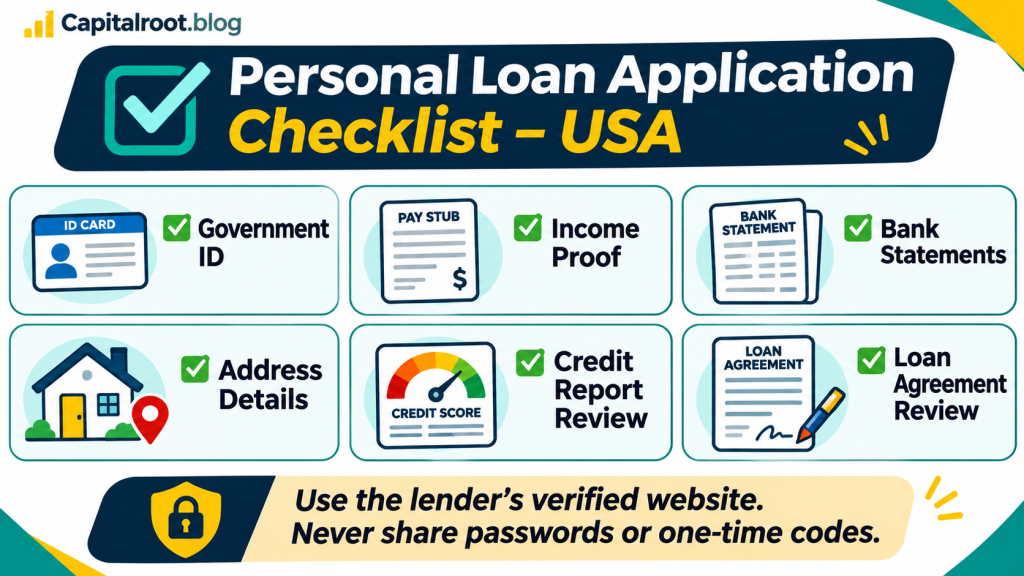
- Government-issued photo identification
- Social Security number or other accepted identification details
- Recent pay stubs
- Bank statements
- Tax returns, particularly for some self-employed applicants
- Proof of residential address
- Employment or income information
Some lenders verify information electronically, while others may request documents manually.
Always submit sensitive documents through the lender’s verified website or secure application.
7. Common Personal Loan Fees in the USA
The interest rate is not the only cost you should consider. Personal loans may include additional fees.
1. Origination Fee
An origination fee is a charge for processing or arranging the loan.
Some lenders deduct this fee from the loan proceeds. For example, if you are approved for $10,000 and the lender deducts a 3% origination fee, you may receive $9,700 while still owing the agreed loan balance.
Check whether the fee is included in the APR and how it affects the amount you receive.
2. Late Payment Fee
If you miss a payment or pay after the due date, your lender may charge a late fee under the loan agreement and applicable law.
Late payments may also affect your credit history.
3. Returned Payment Fee
A lender may charge a fee if an automatic payment fails because of insufficient funds or another payment-processing issue.
4. Prepayment Penalty
Some loan agreements may include a charge for paying off a loan early. Other lenders do not charge one.
Check the agreement before signing if you plan to make extra payments or repay the balance ahead of schedule.
5. Other Possible Charges
Depending on the lender and loan agreement, additional charges may apply. Review every disclosed fee instead of assuming that all personal loans have the same cost structure.
8. Fixed-Rate vs. Variable-Rate Personal Loans
Personal loans may have fixed or variable interest rates.
Fixed-Rate Personal Loan
A fixed-rate loan generally keeps the same interest rate throughout the agreed term.
Benefits may include:
- More predictable monthly payments
- Easier budgeting
- Less uncertainty about interest costs
Variable-Rate Personal Loan
A variable-rate loan may change according to the terms of the agreement and an underlying rate or index.
Benefits and risks include:
- The rate may decrease in some circumstances.
- The rate may also increase.
- Monthly payments or total borrowing costs may become less predictable.
Read the agreement carefully to understand how and when the rate can change.
9. How to Compare Personal Loan Offers
Do not choose a loan based only on the amount a lender offers you.
Compare the following details before accepting an offer:
| Factor | What to check |
|---|---|
| APR | The overall annual cost of borrowing |
| Interest rate | The rate charged on the outstanding balance |
| Origination fee | Whether a fee is charged or deducted |
| Monthly payment | Whether it fits your monthly budget |
| Loan term | How long you will be repaying |
| Total repayment | The total amount payable over the term |
| Prepayment rules | Whether early repayment involves a charge |
| Late fees | What happens if you miss a payment |
| Funding time | When the money may be disbursed |
Whenever possible, compare multiple offers for the same loan amount and repayment period.
 10. How to Apply for a Personal Loan in the USA
Follow these steps before submitting an application.
Step 1: Decide How Much You Need
Calculate the exact amount required. Borrowing more than necessary can increase interest costs.
Step 2: Check Your Credit Reports
Review your credit reports for incorrect information or unfamiliar accounts.
You can access free credit reports through AnnualCreditReport.com, the federally authorized source.
Step 3: Compare Different Lenders
Consider banks, credit unions, and reputable online lenders. Compare APRs, fees, repayment terms, and customer support.
Step 4: Check Prequalification Options
Some lenders offer prequalification using a soft credit inquiry. A soft inquiry generally does not affect your credit score.
However, submitting a full application may result in a hard inquiry. Confirm the lender’s process before continuing.
Step 5: Prepare Your Documents
Keep your identity, income, address, and banking information ready if requested.
Step 6: Read the Loan Agreement
Before accepting the loan, check the APR, amount financed, fees, payment dates, total repayment, and early repayment conditions.
Step 7: Accept Only If It Fits Your Budget
Make sure you can afford the payment alongside rent, utilities, food, insurance, existing debt, and savings.
11. Can You Get a Personal Loan With Bad Credit?
It may be possible to qualify for a personal loan with bad credit, but approval is not guaranteed.
Some lenders consider more than your credit score, including income, employment, debt obligations, and recent payment history.
If your credit score is low, consider these steps:
- Check your credit reports for errors.
- Pay existing bills on time.
- Reduce outstanding credit card balances where possible.
- Avoid submitting many full applications in a short period.
- Compare the APR and fees of any offer carefully.
- Consider a credit union or a reputable lender that evaluates your broader financial situation.
Be careful with loans that advertise guaranteed approval or extremely easy access to money. High-cost borrowing can make financial problems worse.
12. Are Personal Loans Safe in the USA?
Personal loans from legitimate lenders can be a useful financial tool, but borrowers should verify the lender and understand the contract.
Before applying:
- Check the lender’s official website and contact details.
- Confirm whether the lender is authorized or registered as required in the state where it operates.
- Read independent complaints and reviews, without relying on reviews alone.
- Review the privacy policy and data collection practices.
- Never share passwords or one-time verification codes.
- Avoid lenders that pressure you to act immediately.
- Do not pay someone who guarantees loan approval in exchange for an advance payment.
The Federal Trade Commission warns consumers about advance-fee loan scams. A company that promises guaranteed credit in exchange for an upfront payment may be attempting to steal your money.
13. Advantages and Disadvantages of Personal Loans
Advantages
- You may receive a lump sum for an important expense.
- Fixed-rate loans can offer predictable payments.
- Unsecured loans generally do not require collateral.
- A personal loan may help consolidate higher-interest debts if the new loan has a lower overall cost.
- Repayment terms are usually defined in the agreement.
Disadvantages
- Interest and fees can make borrowing expensive.
- A missed payment may damage your credit history.
- Some lenders charge origination or late fees.
- A longer repayment term may increase total interest.
- Borrowing more than you can afford can create financial stress.
14. Tips to Get a Better Personal Loan Offer
You cannot control every factor a lender considers, but you can prepare before applying.
- Improve your credit profile: Pay bills on time and address errors in your credit reports.
- Reduce existing debt: Lower debt payments may improve your DTI.
- Borrow only what you need: A smaller loan can reduce the total cost.
- Compare APRs: Look beyond advertised interest rates.
- Check all fees: Origination and other charges can change the cost of borrowing.
- Consider a shorter term carefully: It may reduce total interest but increase monthly payments.
- Avoid unnecessary applications: Check whether prequalification uses a soft inquiry.
- Read the full agreement: Understand the repayment rules before signing.
15. Frequently Asked Questions (FAQs)
1. What credit score do I need for a personal loan in the USA?
There is no universal minimum credit score. Each lender sets its own eligibility requirements and may also consider income, debt, and credit history.
2. What is a good interest rate for a personal loan?
A good rate depends on current market conditions, your credit profile, loan amount, repayment term, and fees. Compare APRs from multiple lenders rather than relying on one advertised rate.
3. Can I get a personal loan without a job?
Some lenders may consider income from self-employment, retirement, benefits, or other acceptable sources. You must meet the lender’s income and repayment requirements.
4. How much can I borrow with a personal loan?
Loan amounts vary by lender. Your credit profile, income, existing debt, and the lender’s policies may affect the amount you qualify for.
5. Does applying for a personal loan hurt my credit score?
Checking prequalified offers through a soft inquiry generally does not affect your score. A full application may involve a hard inquiry, which can affect your credit score.
6. How long does it take to get a personal loan?
Approval and funding times vary. Some online lenders may provide funds quickly after approval, while others may take several business days or longer.
7. Are personal loan interest payments tax-deductible?
Personal loan interest is generally not deductible when the money is used for personal expenses. Tax treatment can depend on how the borrowed funds are used and your individual circumstances. Consult a qualified tax professional for advice.
8. Can I pay off my personal loan early?
It depends on the loan agreement. Check whether the lender charges a prepayment penalty before making an early repayment.
9. Is a personal loan better than a credit card?
It depends on the interest rate, fees, repayment period, and how you plan to use the money. A personal loan may offer a fixed payment schedule, while credit cards offer revolving credit. Compare the total cost before deciding.
10. What happens if I miss a personal loan payment?
You may face late fees, additional interest where permitted, collection activity, and negative credit reporting. Contact your lender as soon as possible if you expect to miss a payment.
Conclusion
Personal loans in the USA can help manage planned expenses, emergencies, or high-interest debt, but they should be used carefully.
Before borrowing, compare APRs, interest rates, origination fees, repayment terms, and total costs. Check your credit reports, understand the lender’s eligibility requirements, and make sure the monthly payment fits your budget.
The best personal loan is not necessarily the one offering the largest amount. It is the one with clear terms and a repayment plan you can realistically manage.
Disclaimer: This article is for general educational purposes only and does not provide financial, legal, or tax advice. Loan availability, eligibility, rates, fees, and regulations vary by lender and state. Always review the lender’s official disclosures and loan agreement before borrowing.