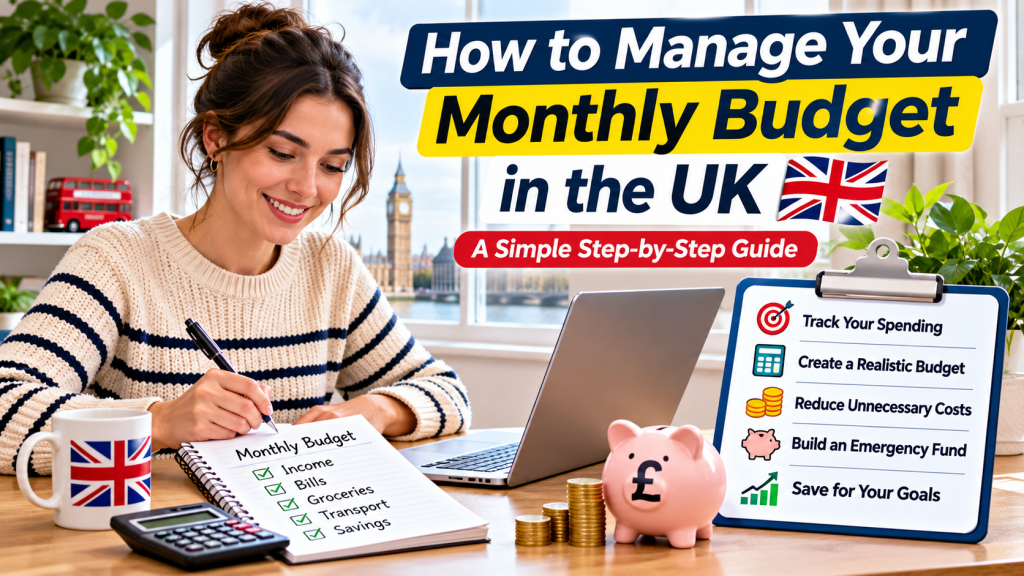

Introduction
Managing money can be challenging, especially when you have to deal with rent or mortgage payments, Council Tax, energy bills, groceries, transport costs and other monthly expenses.
Whether you live alone, share a home with a partner or support a family, having a monthly budget can make your financial life more organised.
A budget helps you understand how much money you receive, where your money goes and how much you can save. It can also help you avoid unnecessary debt and prepare for unexpected expenses.
The good news is that you do not need a high salary to manage your money effectively. You need a realistic plan, regular expense tracking and a few consistent financial habits.
In this guide, you will learn how to manage your monthly budget in the UK, reduce household expenses, save money and build better financial habits.
1. Understand Your Monthly Income
The first step in creating a monthly budget is understanding how much money you actually receive.
If you are employed in the UK, use your take-home pay rather than your gross salary.
Your take-home pay is the amount you receive after deductions such as:
- Income Tax
- National Insurance contributions
- Workplace pension contributions
- Student loan repayments, if applicable
- Other deductions from your salary
For example, if your annual salary is £35,000, your monthly take-home pay will not simply be £35,000 divided by 12. Your actual amount depends on your tax code, pension contributions and other deductions.
Include all regular sources of household income, such as:
- Salary or wages
- Self-employment income
- Pension income
- Eligible benefits
- Regular income from other sources
If you receive irregular income, avoid planning your essential expenses around your best earning month. Use a conservative estimate so that you can cover important bills even when income is lower.
2. List All Your Monthly Expenses
Once you know your income, write down everything you spend money on.
Many people underestimate their expenses because they remember large bills but forget small purchases.
Divide your expenses into different categories.
Essential Expenses
These are costs you generally need to pay to maintain your household and daily life.
Examples include:
- Rent or mortgage payments
- Council Tax
- Electricity and gas
- Water bills
- Groceries
- Public transport or fuel
- Phone and internet
- Insurance
- Essential childcare costs
Non-Essential Expenses
These are expenses that you may be able to reduce or adjust.
Examples include:
- Restaurant meals
- Takeaways
- Streaming subscriptions
- Shopping
- Gym memberships
- Entertainment
- Expensive holidays
- Unplanned online purchases
Financial Commitments
Also include your regular financial obligations:
- Credit card repayments
- Personal loan instalments
- Car finance
- Buy Now, Pay Later repayments
- Other agreed debt payments
Do not ignore small expenses. A few pounds spent regularly can add up to a significant amount over a month.
3. Choose a Monthly Budgeting Method
There is no single budgeting method that works for everyone. Choose a system that fits your income, household size and financial responsibilities.
The 50/30/20 Budgeting Rule
The 50/30/20 rule is a simple starting point for organising your take-home income.
It divides your money into three broad categories:
| Category | Suggested Share | Purpose |
|---|---|---|
| Needs | 50% | Housing, bills, groceries and essential transport |
| Wants | 30% | Entertainment, shopping and leisure |
| Savings and debt goals | 20% | Savings, emergency fund and additional debt repayments |
For example, if your monthly take-home income is £2,500:
- Needs: £1,250
- Wants: £750
- Savings and debt goals: £500
However, this is only a guideline. In areas with high housing costs, essential expenses may take up more than 50% of income.
Do not feel that you have failed if you cannot follow these percentages. A realistic budget is better than an ideal budget that you cannot maintain.
Zero-Based Budgeting
With zero-based budgeting, you assign every pound of your monthly income a purpose.
For example, you allocate money to rent, bills, food, transport, savings and personal spending until your planned income minus planned expenses equals zero.
This does not mean you must spend all your money. Savings and emergency-fund contributions are also budget categories.
This method can be useful if you want to track every pound carefully.
The Weekly Spending Method
Some people find it easier to manage their money weekly rather than monthly.
After paying or setting aside money for essential monthly bills, divide your remaining flexible spending money into weekly amounts.
For example, if you have £400 available for groceries and personal spending, you could set a weekly limit of £100.
This can help prevent overspending early in the month.
4. Create a Realistic Monthly Budget in the UK
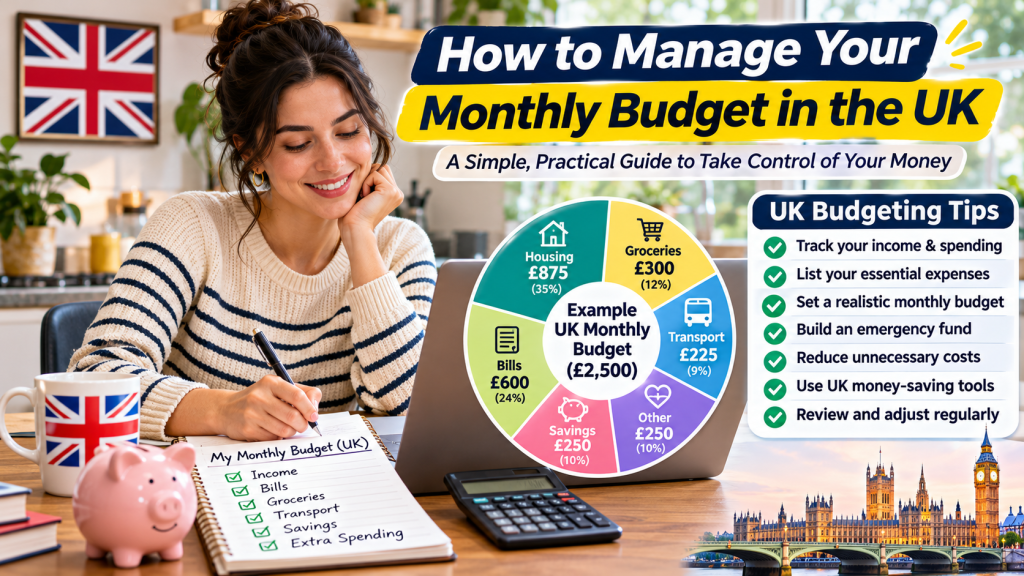
Let’s understand how a monthly budget might look for someone with a take-home income of £2,500.
The following example is illustrative. Actual expenses vary depending on location, household size, rent, lifestyle and financial commitments.
Example: Monthly Budget for £2,500 Take-Home Income
| Expense Category | Monthly Amount |
|---|---|
| Rent or mortgage | £900 |
| Council Tax | £150 |
| Gas and electricity | £180 |
| Groceries | £300 |
| Transport | £150 |
| Phone and broadband | £60 |
| Insurance and health costs | £60 |
| Minimum debt repayments | £150 |
| Savings | £200 |
| Personal and entertainment | £200 |
| Irregular expenses fund | £100 |
| Monthly buffer | £50 |
| Total | £2,500 |
This example shows how you can give every pound a purpose.
If your rent or other essential costs are higher, you may need to reduce flexible spending or adjust your savings target.
The most important thing is to create a budget based on your actual circumstances rather than copying someone else’s spending plan.
5. Reduce Your Household Bills
Household bills can take up a large part of your monthly income.
Reviewing these costs regularly may help you find opportunities to save.
Compare Energy Tariffs
Review your electricity and gas arrangements to understand whether a different tariff may suit your household.
Compare the unit rates, standing charges, exit fees and contract conditions rather than looking only at the advertised price.
You can also reduce unnecessary energy use by:
- Turning off unused lights.
- Avoiding unnecessary heating.
- Using energy-efficient appliances where practical.
- Washing clothes at suitable lower temperatures.
- Improving insulation where possible.
Review Your Broadband and Mobile Plans
Check whether you are paying for more data, speed or services than you actually need.
Compare available plans before renewing a contract. Check whether an exit fee or price increase applies.
Check Council Tax Discounts
Council Tax depends on your property, local authority and circumstances.
Some households may qualify for discounts, exemptions or Council Tax Reduction.
For example, eligible low-income households may receive Council Tax Reduction, but the rules and application process vary by local council and across the UK.
Check your local council’s official website to understand what support is available.
Review Insurance Policies
Compare suitable insurance policies when they are due for renewal.
However, do not choose a policy based only on the lowest premium. Check the cover, exclusions, excess and policy conditions.
6. Plan Your Grocery Shopping
Food shopping is one of the expenses where a little planning can make a difference.
Try these practical habits:
- Prepare a weekly meal plan.
- Make a shopping list before visiting the supermarket.
- Compare prices between suitable supermarket options.
- Buy only the quantity you are likely to use.
- Avoid shopping when you are hungry.
- Use leftovers safely.
- Check supermarket offers without buying unnecessary items.
You can also compare the cost per kilogram or litre instead of choosing a product based only on its package price.
For example, a larger pack may appear cheaper, but it is only good value if you can use it before it expires.
7. Build an Emergency Fund
An emergency fund is money kept aside for unexpected expenses.
It can help you manage situations such as:
- Unexpected car repairs
- Emergency travel
- A broken household appliance
- Temporary loss of income
- Urgent home repairs
Start with a small target if saving feels difficult.
For example, you could initially aim to save £500, then gradually increase your target.
Over time, a useful longer-term goal may be to build savings covering around three months of essential living expenses, depending on your circumstances.
Keep emergency savings somewhere accessible and suitable for your needs. Check the account’s access conditions, interest rate and any withdrawal restrictions.
Do not feel pressured to reach a large savings target immediately. Regular small contributions can help you build the habit.
8. Manage Credit Card and Loan Payments Carefully
Debt repayments can make monthly budgeting difficult, particularly when interest and fees increase the amount you owe.
Start by listing all your debts.
Record:
- Outstanding balance
- Interest rate or APR
- Minimum monthly payment
- Payment due date
- Any fees or charges
Make sure you understand which payments are essential and which debts may carry serious consequences if missed.
Keep up with contractual minimum payments where possible. If you have several debts, you may choose to focus additional repayments on the debt with the highest interest rate, while maintaining required payments on the others.
If you are struggling to make payments, contact your lender or a free debt advice service as early as possible.
Avoid taking out another expensive loan simply to cover regular monthly spending without understanding the total cost.
9. Save Money Automatically
One simple way to develop a savings habit is to transfer money into savings soon after you receive your income.
For example, if you can comfortably save £100 per month:
- Month 1: £100
- Month 3: £300
- Month 6: £600
- Month 12: £1,200
This assumes you make each contribution and do not withdraw the money.
You can set up a standing order from your current account to a suitable savings account.
Choose an amount that does not put your essential bills or debt commitments at risk. You can increase it later when your financial position improves.
10. Track Your Spending Every Week
Creating a budget is only the beginning. You also need to check whether you are following it.
Set aside a few minutes every week to review your transactions.
Look for:
- Unplanned purchases
- Repeated small expenses
- Unused subscriptions
- Higher-than-expected food costs
- Additional transport expenses
- Bank fees or interest charges
You can track your spending through a spreadsheet, notebook, budgeting app or your bank’s own budgeting features.
MoneyHelper also provides a free online Budget Planner that helps you organise income and spending.
Use accurate figures from payslips, bank statements and bills wherever possible.
11. Plan for Irregular and Annual Expenses
One common budgeting mistake is focusing only on monthly bills.
Some expenses happen once or a few times a year, but they can still affect your finances significantly.
Examples include:
- Car insurance
- MOT and vehicle maintenance
- Road tax, where applicable
- TV Licence
- Annual subscriptions
- School or childcare costs
- Christmas and birthday expenses
- Holiday spending
- Home maintenance
Suppose you expect to spend £600 on annual car-related costs.
Instead of waiting until the payment is due, set aside £50 each month.
This makes large expenses easier to manage and reduces the need to rely on credit.
12. Check Whether You Are Eligible for Financial Support
If your income is low or your circumstances have changed, you may be eligible for financial support.
Depending on your situation, this could include:
- Universal Credit
- Pension Credit
- Council Tax Reduction
- Help with housing costs
- Carer’s Allowance
- Support with energy bills
- Help with childcare costs
- Help to Save, if eligible
Eligibility rules differ across England, Scotland, Wales and Northern Ireland.
Use official government information or a trusted advice service to check your eligibility. Do not assume you are ineligible simply because you are working.
Be careful of messages or websites asking for bank details or passwords in exchange for supposed government payments. Check support schemes through official websites.
13. What to Do If Your Monthly Expenses Are Higher Than Your Income
If your spending is consistently higher than your income, you need to review your budget as soon as possible.
Start with these steps:
- Identify which expenses are essential.
- Review subscriptions and non-essential spending.
- Contact service providers if you are struggling with bills.
- Check whether you qualify for benefits or local support.
- Speak to lenders before missing payments.
- Seek free, independent debt advice if debts are becoming difficult to manage.
Do not ignore letters or messages about missed payments, rent arrears, Council Tax or other important bills.
If you are facing eviction, court action or enforcement, seek specialist advice urgently.
Free and confidential debt guidance is available through trusted UK services such as MoneyHelper and other recognised debt advice organisations.
14. Common Monthly Budgeting Mistakes to Avoid
Even a good budget can fail if you make the same mistakes repeatedly.
Here are some common problems to avoid:
1. Forgetting Small Expenses
Coffee, snacks, takeaway orders and small online purchases can add up over time.
2. Setting Unrealistic Savings Targets
Do not set a savings goal that leaves you unable to pay essential bills.
3. Ignoring Annual Expenses
Remember to plan for insurance, vehicle costs, holidays and other irregular payments.
4. Using Credit Cards for Everyday Shortfalls
Regularly borrowing to cover normal living costs may create a debt cycle.
5. Not Reviewing Your Budget
Your income, household costs and financial priorities can change. Review your budget regularly.
6. Copying Someone Else’s Budget
A budget that works for a single person may not work for a family with children, housing costs or debt commitments.
Your budget should reflect your own financial situation.
15. Frequently Asked Questions (FAQs)
Q1. How do I manage my monthly budget in the UK?
Start by calculating your take-home income, listing all monthly expenses, separating essential and non-essential spending, setting savings goals and reviewing your spending regularly.
Q2. What is the 50/30/20 budgeting rule?
The 50/30/20 rule suggests allocating 50% of take-home income to needs, 30% to wants and 20% to savings and debt goals. It is a guideline, not a fixed requirement.
Q3. How much should I save every month in the UK?
There is no fixed amount that everyone should save. It depends on your income, essential expenses, debts and financial goals. Start with an affordable amount and increase it when possible.
Q4. How can I save money on a low income in the UK?
Track your spending, plan groceries, compare household bills, review subscriptions, check benefit eligibility and start with small savings contributions.
Q5. What expenses should I include in a monthly budget?
Include housing, Council Tax, utilities, groceries, transport, insurance, debt repayments, childcare, subscriptions, personal spending, savings and irregular expenses.
Q6. Is the 50/30/20 rule suitable for everyone in the UK?
No. Housing costs and other essential expenses vary significantly across the UK. Some households may need to spend more than 50% of their income on needs.
Q7. How can I manage money when my income changes every month?
Build your essential budget around a conservative estimate of your income. Prioritise important bills and use higher-income months to build a buffer for lower-income periods.
Q8. Where can I get free budgeting help in the UK?
MoneyHelper provides free, impartial money guidance and an online Budget Planner. Citizens Advice can also provide budgeting guidance, while GOV.UK lists relevant government support.
Q9. Should I pay off debt or save money first?
It depends on the type of debt and your circumstances. Keep up with required payments, address priority or expensive debt and consider building a small emergency buffer. Free debt advice can help you decide what to prioritise.
Q10. How often should I review my monthly budget?
Review your spending weekly and update your full budget every month. Also review it whenever your income, rent, bills or household circumstances change.
Conclusion
Managing your monthly budget in the UK does not have to be complicated.
The key is to understand your income, plan your essential expenses, control flexible spending and save regularly whenever possible.
Start with a simple budget and make small improvements over time. You do not need to change everything in one day.
Remember that a successful budget is not about stopping yourself from enjoying life. It is about making sure your money supports your needs, priorities and future goals.
Start today by checking your latest bank statement, listing your monthly expenses and deciding how much you can realistically save.
Disclaimer: This article is for educational and informational purposes only. It does not provide personalised financial, tax or debt advice. Government support, benefits and household-cost rules can vary across England, Scotland, Wales and Northern Ireland. Check official sources or seek qualified guidance for decisions affecting your circumstances.