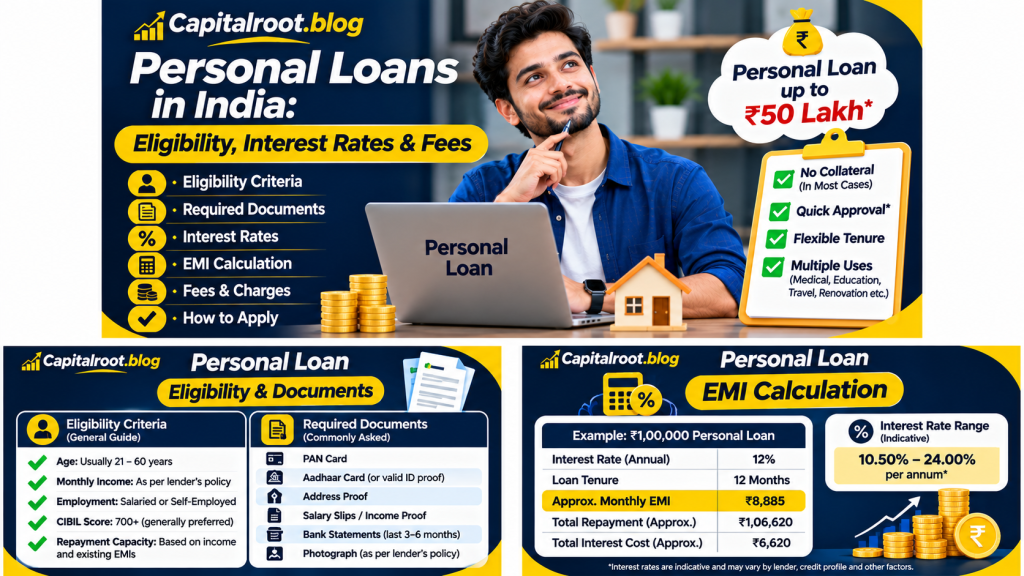

A personal loan can help you manage unexpected expenses, medical bills, education costs, home repairs, travel expenses or other important financial needs.
Unlike a home loan or car loan, a personal loan is generally an unsecured loan, which means it usually does not require the borrower to provide property or a vehicle as collateral. However, lenders assess your income, credit history, repayment capacity and other eligibility factors before approving an application.
Personal loans are available through banks, Non-Banking Financial Companies (NBFCs) and certain regulated digital lending arrangements in India.
Before applying, it is important to understand the interest rate, processing fees, eligibility criteria, EMI and total repayment amount.
In this guide, we explain everything you need to know about personal loans in India, including how to apply, what documents are required and how to choose a suitable lender.
1. What Is a Personal Loan?
A personal loan is money borrowed from a bank or financial institution that must be repaid over an agreed period with interest and applicable charges.
Most personal loans are unsecured, so the borrower generally does not need to pledge property or another asset as security.
The lender evaluates the borrower’s financial profile before deciding whether to approve the loan.
Common uses of personal loans include:
- Medical and emergency expenses.
- Wedding expenses.
- Higher education costs.
- Home renovation.
- Travel expenses.
- Debt consolidation, where financially appropriate.
- Other planned personal expenses.
A personal loan is generally flexible in terms of its usage, but some lenders may impose restrictions depending on the product.
2. How Does a Personal Loan Work?
The personal loan process usually follows these steps:
- The borrower chooses a bank or financial institution.
- The borrower checks the lender’s eligibility requirements.
- An application is submitted with the required information and documents.
- The lender evaluates income, credit history and repayment capacity.
- If approved, the lender communicates the loan amount, interest rate, tenure and charges.
- The borrower reviews and accepts the loan agreement.
- The loan amount is disbursed according to the agreed terms.
- The borrower repays the loan through monthly EMIs.
For example, if you borrow ₹1,00,000 for a planned expense, you will repay the principal amount along with interest over the selected repayment period.
The actual EMI depends on the interest rate, loan amount and tenure.
3. Personal Loan Eligibility Criteria in India
Eligibility requirements differ between banks and NBFCs. There is no single eligibility rule that applies to every personal loan.
However, lenders commonly consider the following factors:
A. Age
Lenders specify minimum and maximum age limits for applicants.
The eligible age range depends on the loan product and the lender’s policy.
B. Monthly Income
Your income helps the lender evaluate whether you can afford the monthly EMI.
Applicants with a stable and sufficient income may have a stronger application, although the required income varies between lenders.
C. Employment Status
Personal loans may be available to:
- Salaried employees.
- Self-employed professionals.
- Business owners.
- Other eligible income earners.
Some lenders offer separate loan products for salaried and self-employed applicants.
D. CIBIL Score
Your credit score and repayment history may influence loan approval, interest rates and the amount offered.
A stronger credit profile may improve your chances of receiving favourable loan terms, but it does not guarantee approval.
E. Existing Loan Obligations
Lenders also consider your existing EMIs and other financial commitments.
If a large portion of your monthly income is already used for loan repayments, the lender may consider your repayment capacity insufficient.
F. Employment or Business Stability
Some lenders consider employment duration, business history and income consistency when evaluating applications.
4. What Is a Good CIBIL Score for a Personal Loan?
A CIBIL score is a three-digit number that generally ranges from 300 to 900.
Many lenders prefer applicants with a stronger credit history. A score of 750 or above is often treated as a useful target, but individual lender requirements differ.
| CIBIL Score | General Credit Profile |
|---|---|
| 300–549 | Low |
| 550–649 | Below average |
| 650–699 | Fair |
| 700–749 | Good |
| 750–900 | Strong |
This is a simplified guide, not a universal lender classification.
If your score is low, consider improving your credit profile before applying:
- Pay existing EMIs on time.
- Pay credit card bills by the due date.
- Keep credit utilisation manageable.
- Avoid unnecessary loan applications.
- Check your credit report for errors.
- Reduce outstanding debt where possible.
For more information, read our guide on How to Improve Your CIBIL Score: A Complete Guide.
5. Documents Required for a Personal Loan
The documents required depend on the lender, applicant profile and loan amount.
For Salaried Employees
Commonly requested documents may include:
- PAN card.
- Aadhaar card or another accepted identity document.
- Address proof.
- Recent salary slips.
- Bank statements.
- Employment details.
- Passport-size photograph, where required.
For Self-Employed Applicants
Lenders may request:
- PAN card.
- Identity and address proof.
- Bank statements.
- Income tax returns.
- Business registration documents, where applicable.
- Financial statements or other income-related documents.
Not every lender requires every document. Check the official document checklist before applying.
6. Personal Loan Interest Rates in India
The interest rate is one of the most important factors when choosing a personal loan.
Personal loan rates vary between lenders and applicants. There is no single interest rate applicable to every borrower.
Your offered rate may depend on:
- Credit score.
- Monthly income.
- Employment or business profile.
- Existing financial obligations.
- Loan amount.
- Repayment tenure.
- Lender’s internal risk assessment.
- Type of interest rate and loan product.
A borrower with a stronger repayment profile may receive a different offer from someone with a weaker credit history.
Fixed vs Floating Interest Rates
Fixed interest rate: The applicable rate generally remains unchanged according to the loan agreement.
Floating interest rate: The rate may change according to the agreed benchmark or interest-rate reset mechanism.
Always check whether the rate is fixed or floating and how changes could affect your EMI or repayment period.
Understand APR Before Accepting a Loan
The Annual Percentage Rate (APR) represents the annualised cost of credit and includes the applicable interest and specified loan charges.
Do not compare loans only by looking at the advertised interest rate. Compare the APR, total repayment amount and Key Facts Statement (KFS).
7. Personal Loan Processing Fees and Other Charges
Apart from interest, personal loans may include additional charges.
Common charges include:
A. Processing Fee
A lender may charge a processing fee for evaluating and processing your application.
The amount and payment conditions vary.
B. GST
Applicable taxes may be charged on eligible fees and services according to prevailing tax rules.
C. Late Payment or Penal Charges
If you fail to follow important loan repayment conditions, the lender may impose applicable penal charges according to the agreement and regulatory requirements.
D. Prepayment or Foreclosure Charges
Some loan products may have charges or conditions for repaying the loan early. The applicable RBI rules and the specific loan agreement should be checked.
E. Documentation or Other Applicable Charges
Certain products may include additional disclosed charges. Review the KFS and loan agreement before accepting them.
Important: RBI’s Key Facts Statement requirements help borrowers understand the important loan terms and costs. Charges not disclosed in the KFS generally cannot be imposed later without the borrower’s explicit consent, subject to applicable rules.
8. What Is a Key Facts Statement (KFS)?
A Key Facts Statement is a standardised document that provides important information about a loan in a simple format.
It helps borrowers understand the financial obligations before accepting a loan.
A KFS generally includes information such as:
- Loan amount.
- Interest rate.
- Annual Percentage Rate (APR).
- Repayment schedule.
- Applicable fees and charges.
- Penal charges.
- Important loan conditions.
- Other relevant disclosures.
RBI’s KFS framework applies to specified new retail and MSME term loans sanctioned by covered regulated entities from October 1, 2024.
Read the KFS carefully before signing or accepting the loan agreement.
9. How to Calculate Personal Loan EMI
EMI stands for Equated Monthly Instalment. It is the amount paid by a borrower every month towards repayment of a loan.
An EMI generally includes:
- Principal repayment.
- Interest payment.
The EMI depends on the principal amount, monthly interest rate and loan tenure.
The standard EMI formula is:
[
EMI = \frac{P \times r \times (1+r)^n}{(1+r)^n-1}
]
Where:
- P = Principal loan amount.
- r = Monthly interest rate.
- n = Total number of monthly instalments.
Example of Personal Loan EMI
Suppose you borrow ₹1,00,000 at an illustrative annual interest rate of 12% for 12 months.
The approximate EMI would be ₹8,885.
| Loan Detail | Amount |
|---|---|
| Loan amount | ₹1,00,000 |
| Annual interest rate | 12% |
| Loan tenure | 12 months |
| Approximate monthly EMI | ₹8,885 |
| Approximate total repayment | ₹1,06,620 |
| Approximate interest cost | ₹6,620 |
These figures are illustrative and exclude additional charges. The actual amount may vary according to the lender’s calculation method and repayment terms.
10. How to Apply for a Personal Loan in India
You can generally apply through a bank branch, official lender website or authorised digital lending channel.
Follow these steps:
Step 1: Compare Different Lenders
Compare banks and NBFCs based on:
- Interest rate.
- APR.
- Processing fees.
- Loan tenure.
- Eligibility requirements.
- Customer service.
- Repayment flexibility.
Step 2: Check Your Eligibility
Review your age, income, employment profile, credit history and existing loan obligations.
Step 3: Calculate Your EMI
Use an EMI calculator to estimate your monthly repayment before applying.
Choose an amount that comfortably fits your budget.
Step 4: Complete the Application
Enter your personal, employment and income details accurately.
Step 5: Upload Required Documents
Submit the documents requested by the lender through its official website, branch or authorised channel.
Step 6: Review the Loan Offer
Check the interest rate, APR, KFS, processing fees, tenure and total repayment amount.
Step 7: Accept the Agreement
Proceed only after understanding the loan conditions.
Step 8: Receive the Loan Amount
Once approved and all requirements are completed, the lender disburses the amount according to the agreed terms.
11. How to Choose the Best Personal Loan
The lowest advertised interest rate does not always mean the best loan.
Consider these points before making a decision:
Compare the Total Cost
Look at the APR, fees and total repayment amount rather than comparing only the interest rate.
Choose a Suitable Tenure
A longer tenure may reduce the monthly EMI but can increase the total interest paid.
A shorter tenure may reduce the overall interest cost but result in a higher monthly EMI.
Check Prepayment Conditions
If you expect to repay the loan early, understand the applicable prepayment rules and charges.
Check Lender Credentials
Verify that the bank or NBFC is authorised and that any digital lending app is linked to a regulated lender.
Read Customer Support and Grievance Information
Understand how to contact the lender if you have a repayment, account or service-related complaint.
12. Advantages of Personal Loans
Personal loans can offer several benefits when used responsibly.
No Collateral in Most Standard Personal Loans
Many personal loans are unsecured, so the borrower generally does not need to pledge property or a vehicle.
Flexible Usage
The money may be used for several legitimate personal expenses, subject to product conditions.
Structured Repayment
EMIs allow borrowers to plan repayments over an agreed period.
Online Application Options
Many lenders provide digital application and account-management facilities.
Useful for Planned Financial Needs
A personal loan may help manage a necessary expense when the borrower has a suitable repayment plan.
13. Disadvantages of Personal Loans
Personal loans also have potential disadvantages.
Higher Interest Compared with Some Secured Loans
Because many personal loans are unsecured, their interest rates may be higher than certain secured loan products.
Additional Charges
Processing fees and other applicable charges can increase borrowing costs.
Monthly Financial Commitment
EMIs reduce the amount of income available for other expenses and savings.
Credit Score Impact
Missed repayments may negatively affect your credit history.
Debt Burden
Taking multiple loans without a proper repayment plan can create financial stress.
14. Are Instant Personal Loan Apps Safe in India?
Digital lending has made it easier to apply for loans online. However, borrowers should be careful when choosing an app.
A loan app may operate as a Lending Service Provider (LSP) for a regulated bank or NBFC. The app itself is not necessarily the lender.
Before applying:
- Identify the actual bank or NBFC providing the loan.
- Verify the lender’s regulatory status.
- Check the app through the lender’s official website or authorised channels.
- Read the privacy policy.
- Review the KFS and loan agreement.
- Check the APR and all applicable charges.
- Avoid apps demanding unnecessary access to contacts or personal data.
- Never pay suspicious advance fees to an unknown person.
- Avoid sharing OTPs, PINs or passwords.
RBI’s Digital Lending Directions, 2025 include requirements relating to lender and lending service provider responsibilities, borrower disclosures, data handling and grievance redressal.
15. What Happens If You Miss a Personal Loan EMI?
Missing an EMI can create financial and credit-related consequences.
Possible consequences include:
- Applicable overdue or penal charges.
- Negative reporting to credit information companies.
- A decline in your credit score.
- Collection communication from the lender.
- Difficulty obtaining credit in the future.
- Legal recovery action, depending on the circumstances.
If you are unable to make a payment:
- Contact the lender as early as possible.
- Explain your financial situation.
- Ask about available repayment or restructuring options.
- Understand any additional charges.
- Keep written records of communication.
- Avoid taking another expensive loan simply to cover the EMI without evaluating the consequences.
Do not ignore repayment notices or communication from the lender.
16. Tips to Get a Personal Loan on Better Terms
You can improve your overall borrowing profile by following responsible financial habits.
- Maintain a good credit history.
- Pay all existing EMIs on time.
- Keep credit card utilisation manageable.
- Avoid multiple loan applications within a short period.
- Maintain stable and verifiable income.
- Reduce unnecessary outstanding debt.
- Compare offers from multiple authorised lenders.
- Choose an affordable loan amount.
- Read the KFS before accepting the offer.
Remember that no method guarantees approval or a particular interest rate.
17. Personal Loan vs Credit Card Loan
Both products allow consumers to borrow money, but their structures differ.
| Feature | Personal Loan | Credit Card Borrowing |
|---|---|---|
| Loan structure | Usually a fixed loan amount | Borrowing against available card limit |
| Repayment | Usually monthly EMI | Statement payment or eligible EMI conversion |
| Interest | Depends on loan offer | Depends on card terms and transaction type |
| Charges | Processing and other applicable fees | Card fees and applicable interest or charges |
| Best suited for | Planned larger expenses | Eligible purchases and short-term credit needs |
Compare the actual cost of both options before choosing one.
Frequently Asked Questions (FAQs)
1. What is the minimum salary required for a personal loan in India?
There is no universal minimum salary. Each bank and NBFC sets its own income and eligibility requirements based on the loan product and applicant profile.
2. What CIBIL score is required for a personal loan?
Many lenders prefer a stronger credit score, and 750 or above is often a useful target. However, approval depends on the lender’s policy and the borrower’s overall financial profile.
3. Can I get a personal loan without income proof?
Most regulated lenders assess repayment capacity and require suitable income-related information. The exact documents depend on the applicant’s employment type and lender requirements.
4. How much personal loan can I get on a ₹25,000 salary?
The eligible amount depends on your income, existing EMIs, credit history, employer or business profile and lender policy. There is no fixed loan amount for every person earning ₹25,000.
5. Can self-employed people apply for personal loans?
Yes. Many banks and NBFCs offer personal loan products to eligible self-employed applicants, subject to income verification and other requirements.
6. Does applying for a personal loan reduce my CIBIL score?
A lender’s hard enquiry may have an impact on your credit profile. Multiple applications within a short period may also be viewed negatively.
7. Can I repay my personal loan early?
Many lenders offer prepayment or foreclosure options, but the terms and charges depend on the product, agreement and applicable RBI rules.
8. What is the difference between interest rate and APR?
The interest rate represents the borrowing rate, while APR reflects the annualised cost of credit including applicable charges. APR can help borrowers compare the overall cost of different loan offers.
9. Are personal loans safe?
Personal loans from authorised banks and regulated financial institutions can be legitimate financial products. Borrowers should verify the lender, read the agreement and avoid suspicious loan apps.
10. What happens if I cannot repay my personal loan?
Contact the lender promptly and ask about possible repayment arrangements. Missing payments can lead to additional charges, credit reporting consequences and recovery action.
Conclusion
Personal loans can be useful for managing important expenses, but borrowing without understanding the costs can create long-term financial problems.
Before applying, check your eligibility, compare interest rates, calculate the EMI and review the processing fees and total repayment amount.
Always verify the lender and read the Key Facts Statement before accepting a loan. Choose an amount that fits your income and repayment capacity rather than borrowing the maximum amount offered.
Responsible borrowing can help you meet financial needs while protecting your long-term financial health.