
Medical expenses in India can put considerable pressure on a family’s finances. Hospitalisation, surgeries, medical tests and long-term treatments may cost more than expected. Without adequate financial preparation, even a single medical emergency can disturb your savings and other financial goals.
This is why having a suitable health insurance policy is an important part of personal financial planning.
Health insurance helps cover eligible medical expenses according to the terms and conditions of the policy. Depending on the plan, it may provide hospitalisation coverage, pre- and post-hospitalisation benefits, day-care treatment and other medical benefits.
However, choosing the right policy can be confusing because insurers offer different coverage limits, premiums, waiting periods, exclusions and claim facilities.
In this guide, we explain how to choose the best health insurance in India, understand policy features, compare plans and avoid common mistakes before purchasing coverage.
1. What Is Health Insurance?
Health insurance is a financial protection product that helps pay for eligible healthcare expenses when an insured person requires medical treatment.
Depending on the policy, the insurer may settle an eligible hospital bill directly through a cashless facility or reimburse the policyholder after treatment.
For example, suppose you purchase a health insurance policy with a sum insured of ₹5 lakh. If you are hospitalised for a covered medical condition, the insurer may pay eligible expenses up to the available coverage limit, subject to policy conditions, sub-limits, deductibles and exclusions.
Health insurance does not necessarily cover every medical expense. Always read the policy wording to understand what is included.
2. Why Is Health Insurance Important in India?
Health insurance can help individuals and families manage unexpected medical expenses.
Some important benefits include:
Financial Protection
A suitable policy can reduce the financial burden of eligible hospitalisation and treatment expenses.
Protection of Savings
Instead of using all your savings for a covered medical emergency, you may be able to use your insurance benefits.
Access to Cashless Hospitalisation
Many insurers offer cashless treatment at network hospitals, subject to policy terms and authorisation.
Support for Family Members
Family health insurance plans can provide coverage for multiple eligible family members under one policy.
Coverage for Certain Major Treatments
Depending on the policy, coverage may include surgeries, specified critical treatments, day-care procedures and other eligible medical expenses.
Tax Benefits
Eligible health insurance premiums may qualify for tax deductions under applicable Indian tax provisions. The availability of deductions depends on the taxpayer’s circumstances and the applicable tax regime.
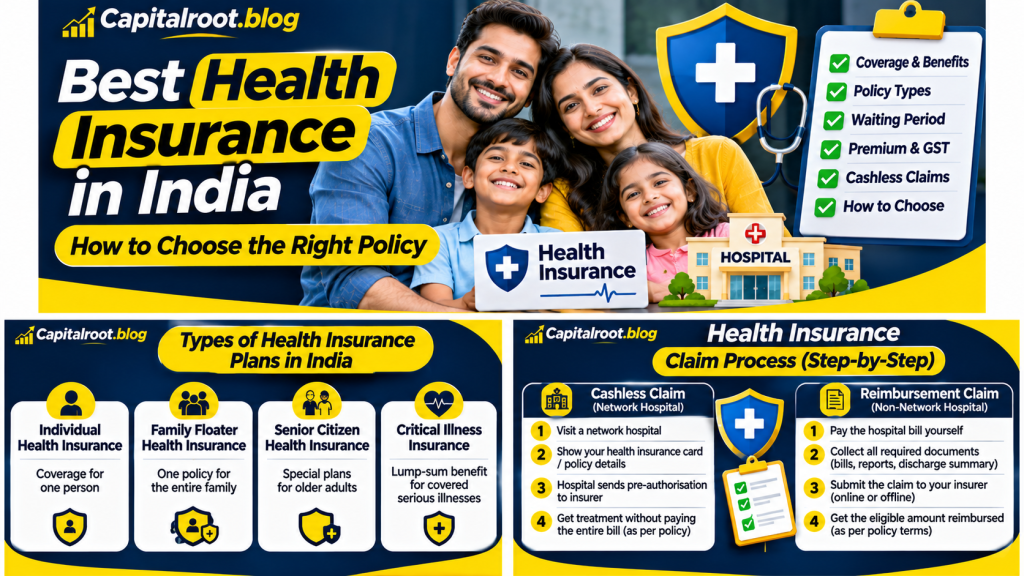
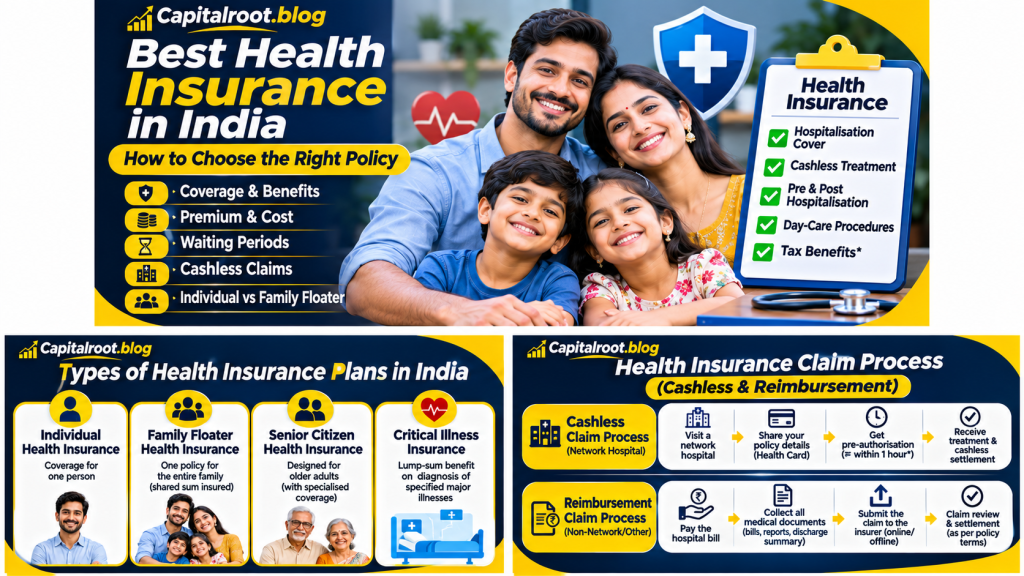
3. Types of Health Insurance Plans in India
Different health insurance policies are designed for different needs.
A. Individual Health Insurance
An individual health insurance policy provides coverage to one insured person.
The policy has a specified sum insured that can be used for eligible medical expenses of that individual.
It may be suitable for:
- Single individuals.
- People who want separate coverage.
- Individuals with different medical requirements from other family members.
B. Family Floater Health Insurance
A family floater policy covers multiple insured family members under a shared sum insured.
For example, a family purchases a policy with ₹10 lakh coverage. The eligible members share this coverage rather than each receiving a separate ₹10 lakh limit.
It may be suitable for families who want a single policy for multiple members.
However, remember that one large claim can reduce the available balance for other members during the same policy period.
C. Senior Citizen Health Insurance
These policies are designed for older individuals. They may include specific coverage features, eligibility requirements, waiting periods and medical underwriting conditions.
Before purchasing, carefully review:
- Pre-existing disease coverage.
- Co-payment requirements.
- Waiting periods.
- Room-rent limits.
- Renewal conditions.
- Available hospital networks.
D. Critical Illness Insurance
Critical illness insurance generally pays a specified lump-sum benefit if the insured person is diagnosed with a covered illness and satisfies the policy conditions.
The covered illnesses, survival periods and other requirements vary by product.
It is different from a standard indemnity-based health insurance policy, which generally covers eligible medical expenses.
E. Group Health Insurance
Group health insurance is generally offered through an employer, organisation or other eligible group arrangement.
It may provide medical coverage to employees or group members according to the policy terms.
People who receive employer-provided insurance should understand its coverage and consider whether separate personal coverage is also necessary.
4. What Does Health Insurance Cover?
Coverage depends on the selected plan, policy wording and applicable conditions.
Common benefits may include:
Hospitalisation Expenses
Eligible expenses for treatment requiring hospital admission, subject to the policy’s minimum hospitalisation requirements and other conditions.
Pre-Hospitalisation Expenses
Certain medical expenses incurred before hospitalisation may be covered for a specified period.
Post-Hospitalisation Expenses
Eligible follow-up expenses after discharge may be covered for a specified period.
Day-Care Procedures
Certain treatments and surgeries that do not require a 24-hour hospital stay may be covered.
Ambulance Charges
Some policies cover eligible ambulance expenses up to specified limits.
Domiciliary Hospitalisation
Some plans may cover eligible treatment provided at home when policy conditions are satisfied.
AYUSH Treatment
Eligible treatment under Ayurveda, Yoga and Naturopathy, Unani, Siddha and Homoeopathy may be covered according to the policy.
Organ Donor Expenses
Some policies cover specified medical expenses related to organ donation, subject to conditions.
Do not assume every policy includes all these benefits. Compare the coverage schedule and exclusions before buying.
5. What Is Not Covered by Health Insurance?
Health insurance policies contain exclusions and limitations.
Common exclusions or restricted areas may include:
- Treatments specifically excluded by the policy.
- Cosmetic procedures, unless medically necessary or specifically covered.
- Non-medical expenses that are not covered by the policy.
- Treatment during applicable waiting periods.
- Certain pre-existing diseases during their waiting periods.
- Injuries or illnesses arising from excluded activities or circumstances.
- Expenses above policy limits or specified sub-limits.
- Uncovered outpatient treatment, unless included as a benefit.
The exact exclusions differ between insurers and products.
Read the policy wording and Customer Information Sheet (CIS) instead of relying only on advertisements.
6. How Much Health Insurance Coverage Do You Need?
There is no single sum insured that is suitable for every person.
Your required coverage depends on several factors:
- Your age.
- Number of family members.
- City and hospital costs.
- Existing medical conditions.
- Family medical history.
- Income and savings.
- Available employer coverage.
- Long-term financial responsibilities.
For example, a person living in a large metropolitan city may face different hospitalisation costs from someone living in a smaller town.
A family with several members may also need a different coverage arrangement from a single individual.
Understand Sum Insured
Sum insured is the maximum amount available under the policy for eligible claims, subject to its terms and conditions.
When comparing policies, check whether the coverage is:
- Individual or shared family floater.
- Inclusive of any applicable sub-limits.
- Increased through a cumulative bonus.
- Supported by a restoration benefit.
Do not select a low sum insured simply because the premium is cheaper.
7. What Is a Waiting Period in Health Insurance?
A waiting period is a specified period during which certain medical conditions or treatments are not covered, according to the policy.
Common types include:
Initial Waiting Period
Many policies have an initial waiting period after the policy begins. Accidental hospitalisation may be treated differently, depending on the policy.
Pre-Existing Disease Waiting Period
A pre-existing disease is generally defined under the applicable regulatory framework and policy wording.
Under the IRDAI health insurance framework, the waiting period for pre-existing diseases cannot exceed 36 months of continuous coverage.
Specific Disease Waiting Period
Certain specified diseases or treatments may have a separate waiting period, subject to regulatory limits and policy terms.
Why Is the Waiting Period Important?
Suppose a policy has a waiting period for a particular medical condition. If treatment is required before that waiting period ends, the claim may not be payable for that condition.
Before purchasing, check:
- Which conditions have waiting periods.
- How long each waiting period lasts.
- Whether portability or migration credits are available.
- Whether a shorter waiting period is offered at an additional premium.
8. What Is a Health Insurance Premium?
A premium is the amount paid to the insurer to keep the policy active.
The cost of health insurance depends on several factors:
- Age of the insured person.
- Number of people covered.
- Sum insured.
- Medical history and underwriting.
- City or geographical zone, where applicable.
- Selected add-ons and riders.
- Deductibles and co-payment conditions.
- Policy features and coverage limits.
Premiums can differ significantly between insurers, even for apparently similar coverage.
Important GST Update for 2026
From 22 September 2025, GST exemption was introduced for individual life and health insurance policies, including individual family floater health insurance policies, according to the Government of India.
However, do not assume the same treatment applies to every group or commercial insurance arrangement. Check the applicable tax treatment for your particular product.
9. Individual Health Insurance vs Family Floater Policy
Both options can provide useful protection, but their structures are different.
| Feature | Individual Plan | Family Floater Plan |
|---|---|---|
| Coverage | Separate sum insured for each insured person | Shared sum insured |
| Suitable for | Individual or separately insured members | Eligible families |
| Premium | Based on individual coverage and risk | Depends on family composition and risk |
| Claim impact | One person’s claim generally uses their own policy limit | One member’s claim reduces shared available cover |
| Flexibility | Separate coverage decisions | One shared policy arrangement |
Which Is Better?
An individual policy may suit people who want separate coverage limits or have different medical requirements.
A family floater may be convenient for families that prefer shared coverage under one policy.
Compare both options based on the ages and health conditions of family members rather than choosing only by premium.
10. How to Choose the Best Health Insurance Policy in India
Before purchasing health insurance, compare the following features.
Step 1: Check the Sum Insured
Select a coverage amount that reasonably reflects your medical expenses, family size and location.
Step 2: Review Hospital Network
Check whether suitable hospitals near your home and workplace are included in the insurer’s network.
A large network does not automatically guarantee that every treatment or hospital bill will be approved.
Step 3: Understand Room-Rent Limits
Some policies impose limits on room category or room charges.
Choosing a room above the permitted category may result in proportionate deductions or other restrictions, depending on the policy.
Step 4: Check Co-Payment
A co-payment means the policyholder must pay a specified percentage of eligible claim expenses.
For example, with a 10% co-payment, the insured person may have to pay 10% of the admissible amount, subject to the policy terms.
Step 5: Review Disease Waiting Periods
Compare initial, pre-existing disease and specific disease waiting periods.
Step 6: Check Restoration Benefits
Some plans restore the sum insured after it is used, subject to specific conditions.
Understand whether restoration applies to the same illness, same insured member or subsequent claims.
Step 7: Compare Exclusions
Read the policy wording to identify exclusions, sub-limits, non-medical expenses and special conditions.
Step 8: Review Claim Procedures
Understand the cashless and reimbursement claim process, documentation and notification requirements.
Step 9: Compare the Total Premium
Compare the complete policy features instead of selecting the cheapest option.
Step 10: Read the Customer Information Sheet
The CIS provides a simplified summary of important policy information. Review it alongside the full policy document.
11. What Is Cashless Health Insurance?
Cashless health insurance allows an insured person to receive eligible treatment at a network hospital without paying the entire admissible hospital bill upfront.
The insurer or its authorised claims administrator coordinates payment with the hospital after the required authorisation.
A typical process is:
- Visit a network hospital.
- Provide your health insurance details.
- Submit the required pre-authorisation information.
- The hospital sends the request to the insurer or claims administrator.
- The insurer reviews the request.
- Approved eligible expenses are settled according to policy terms.
- You pay applicable deductibles, co-payments, exclusions and non-covered expenses.
Cashless Claim Timelines
IRDAI’s health insurance framework requires insurers to decide on cashless pre-authorisation requests within one hour of receiving the request and final discharge authorisation within three hours of receiving the hospital’s discharge request.
These timelines do not mean every claim is automatically approved. The claim remains subject to coverage, medical necessity and policy conditions.
12. How to File a Health Insurance Claim
If you need medical treatment, follow the appropriate claim procedure.
For Cashless Claims
- Check whether the hospital is in the insurer’s network.
- Inform the insurance desk about your policy.
- Submit the required identification and policy details.
- Complete the pre-authorisation process.
- Review the approval and any non-payable expenses.
- Keep copies of the discharge summary and bills.
For Reimbursement Claims
If cashless treatment is not available or applicable:
- Inform the insurer according to the policy requirements.
- Pay the eligible hospital expenses.
- Collect original bills and medical documents.
- Obtain prescriptions and discharge summaries.
- Submit the reimbursement claim form.
- Provide any additional documents requested.
- Track the claim until the insurer communicates its decision.
Always follow the claim notification requirements in your policy.
13. Can You Change Your Health Insurance Company?
Yes. Health insurance portability allows eligible policyholders to transfer an indemnity-based health insurance policy from one insurer to another, subject to the applicable rules and the new insurer’s underwriting requirements.
Portability can help preserve eligible continuity credits for waiting periods and pre-existing diseases.
Before switching:
- Compare the new policy’s benefits.
- Check the new insurer’s hospital network.
- Review exclusions and waiting periods.
- Understand any change in sum insured.
- Apply within the prescribed portability window.
- Do not discontinue the existing policy until the new coverage is confirmed.
Migration within the same insurer may also be available under applicable rules.
14. Important Health Insurance Rules in India
IRDAI has introduced several important policyholder protections.
A. Waiting Period Limits
The maximum waiting period for pre-existing diseases and specified diseases or treatments is generally capped at 36 months of continuous coverage under the applicable framework.
B. Moratorium Period
After 60 continuous months of coverage, a health insurance policy and claims generally cannot be contested on grounds of non-disclosure or misrepresentation, except in cases of established fraud.
If the sum insured is enhanced, the 60-month period applies separately to the enhanced portion.
C. Free-Look Period
Health insurance policies with a term of one year or more generally have a 30-day free-look period from receipt of the policy document, subject to applicable conditions.
This allows eligible policyholders to review the policy and request cancellation if they disagree with its terms.
D. Portability
Eligible policyholders can transfer their health insurance coverage to another insurer and receive applicable continuity credits, subject to the rules and underwriting process.
These protections do not remove the need to disclose medical information accurately and understand the policy wording.
15. Common Health Insurance Mistakes to Avoid
Avoid these mistakes when buying a health insurance policy:
- Selecting a policy only because its premium is low.
- Ignoring pre-existing disease waiting periods.
- Not disclosing existing medical conditions.
- Overlooking room-rent limits.
- Ignoring co-payment requirements.
- Assuming every hospital offers cashless treatment.
- Not checking policy exclusions.
- Choosing insufficient coverage for the family.
- Failing to renew the policy on time.
- Not reading the Customer Information Sheet.
- Ignoring the impact of a family floater claim on shared coverage.
- Depending entirely on employer-provided health insurance.
A careful comparison before purchasing can help prevent unexpected problems during a medical emergency.
Frequently Asked Questions (FAQs)
1. Which is the best health insurance policy in India?
There is no single best policy for everyone. The right choice depends on age, medical history, budget, family size, sum insured, hospital network, waiting periods and policy exclusions.
2. How much health insurance coverage should I buy?
Your coverage should reflect your medical needs, location, family size and financial situation. Compare the potential cost of hospitalisation with your available coverage and savings.
3. Is health insurance compulsory in India?
Health insurance is generally not compulsory for every individual in India. However, it can provide important financial protection against eligible medical expenses.
4. Can I buy health insurance for my parents?
Yes. Many insurers offer policies for parents and senior citizens, subject to age limits, underwriting and product conditions.
5. What is the difference between individual and family floater health insurance?
An individual policy generally provides a separate sum insured for one insured person, while a family floater shares one sum insured among covered family members.
6. Does health insurance cover pre-existing diseases?
Many policies cover eligible pre-existing diseases after the applicable waiting period, subject to disclosure and policy conditions.
7. Can I claim health insurance immediately after buying it?
Some benefits may have an initial waiting period. Accident-related treatment may be treated differently, while specific diseases and pre-existing conditions may have longer waiting periods.
8. What is cashless hospitalisation?
Cashless hospitalisation allows eligible expenses to be settled directly between the insurer or its claims administrator and a network hospital, subject to authorisation and policy terms.
9. Can I have two health insurance policies?
Yes, an individual may hold multiple health insurance policies. Applicable rules govern how claims are coordinated and settled. Read the policy conditions and inform the insurers when required.
10. Can I port my health insurance policy to another company?
Yes. Eligible indemnity-based health insurance policies can generally be ported to another insurer, subject to the applicable rules, underwriting and prescribed process.
11. Does health insurance cover OPD expenses?
Some policies offer outpatient department (OPD) coverage as a built-in feature or add-on. It is not automatically included in every standard health insurance plan.
12. What happens if I forget to renew my health insurance?
A policy may enter a grace period according to its terms and applicable rules. If it is not renewed within the permitted period, continuity benefits may be affected. Renew on time to avoid a break in coverage.
Conclusion
Health insurance is an important financial protection tool for individuals and families in India. It can help manage eligible medical expenses and protect savings during unexpected hospitalisation.
However, choosing the right policy requires more than comparing premiums. You should understand the sum insured, hospital network, waiting periods, room-rent limits, co-payment, exclusions and claims process.
Compare multiple policies, disclose medical information honestly and read the full policy wording before purchasing.
The best health insurance policy is the one that matches your healthcare requirements, financial situation and long-term protection needs.