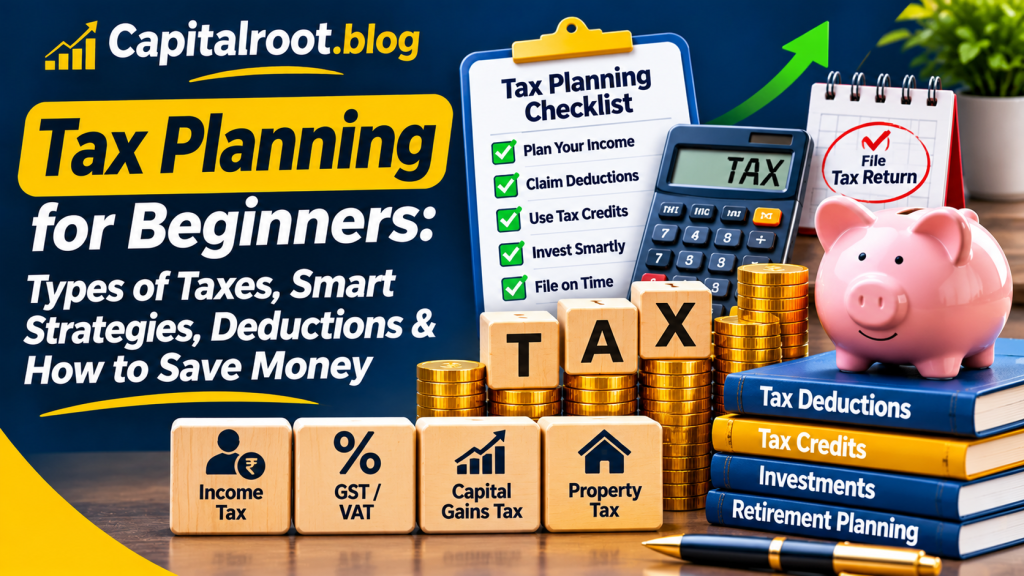

Taxes are an important part of personal finance. Whether you earn a salary, run a business, receive rental income, or invest your money, understanding taxes can help you make better financial decisions.
Tax planning means organising your income, expenses, savings, and investments legally so that you pay the correct amount of tax and use the tax benefits available to you.
Good tax planning is not about hiding income or avoiding legal responsibilities. It is about understanding tax rules, keeping proper records, claiming eligible deductions and reliefs, and planning financial decisions in advance.
Tax systems differ across countries. A deduction available in India may not exist in the USA or UK, and tax rules can change from one financial or tax year to another.
In this guide, we will explain the basics of tax planning, common types of taxes, deductions, tax-saving strategies, common mistakes, and important tax considerations for individuals in India, the USA, and the UK.
What Is Tax Planning?
Tax planning is the process of reviewing your financial situation and making lawful decisions to manage your tax liability.
It may involve:
- Understanding your taxable income.
- Using eligible tax deductions and exemptions.
- Claiming applicable tax credits or reliefs.
- Planning investments according to your financial goals.
- Maintaining income and expense records.
- Filing tax returns correctly and on time.
- Reviewing tax implications before major financial decisions.
For example, an eligible taxpayer may receive a tax benefit for contributing to a qualifying retirement plan or paying certain approved expenses.
The exact benefit depends on the country’s tax laws, the taxpayer’s circumstances, and the rules for the relevant tax year.
Why Is Tax Planning Important?
Tax planning is not only about reducing tax. It also helps you organise your finances and avoid unexpected tax liabilities.
1. Helps Manage Your Tax Liability
Understanding available deductions, exemptions, credits, and reliefs may help reduce the amount of tax you legally owe.
2. Improves Financial Planning
Tax planning helps you understand how much money remains after taxes, making it easier to plan savings, investments, and expenses.
3. Supports Long-Term Savings
Some tax systems provide benefits for eligible retirement contributions, health-related expenses, education costs, or approved investments.
4. Reduces Last-Minute Pressure
Planning throughout the year gives you time to collect documents and review your financial records before filing.
5. Helps Avoid Penalties
Understanding filing deadlines and payment requirements can reduce the risk of late fees, interest, and other consequences.
6. Encourages Better Financial Decisions
Before purchasing property, selling investments, changing jobs, or starting a business, you can review the possible tax implications.
Common Types of Taxes Individuals Should Know
Tax systems include several types of taxes. The exact names, rates, and rules vary by country.
1. Income Tax
Income tax is charged on taxable income earned by individuals or businesses.
Income may include:
- Salary and wages.
- Business or professional income.
- Rental income.
- Interest from savings.
- Dividends.
- Certain investment gains.
- Other taxable receipts.
Tax rates may depend on income levels, residency, filing status, and other factors.
2. Capital Gains Tax
Capital gains tax may apply when you sell an asset for more than its cost or tax basis.
Examples of assets may include:
- Shares and securities.
- Mutual fund units.
- Property.
- Certain digital assets.
- Other investments.
The tax treatment may depend on how long you owned the asset, the type of asset, and the applicable tax rules.
3. Property Tax
Property tax is generally imposed by local or regional authorities on property ownership.
The amount may depend on property value, location, property type, and local rules.
Property tax is different from income tax on rental income or capital gains from selling property.
4. Sales Tax and Value Added Tax (VAT)
Sales tax or VAT is generally charged on the sale of goods and services.
Consumers usually pay this tax as part of the purchase price, while businesses may have responsibilities to collect and report it.
5. Payroll and Social Security Taxes
Some countries collect taxes or contributions linked to employment income.
These may fund social security, healthcare, pensions, unemployment support, or other public programmes.
6. Inheritance and Estate Taxes
Some jurisdictions impose taxes on certain transfers of wealth after death or on inherited assets.
Rules differ significantly between countries and may include exemptions or thresholds.
Important Tax Planning Terms
Understanding common tax terms can make tax planning easier.
1. Gross Income
Gross income generally refers to income before certain deductions or adjustments.
The precise definition depends on the tax system.
2. Taxable Income
Taxable income is the amount on which tax is calculated after applying relevant adjustments, deductions, allowances, or exemptions.
3. Tax Deduction
A tax deduction reduces the income on which tax is calculated.
For example, an eligible retirement contribution may reduce taxable income under certain tax systems.
4. Tax Credit
A tax credit directly reduces the amount of tax owed, subject to the applicable rules.
A credit and a deduction are not the same thing.
5. Tax Exemption
An exemption means that certain income, transactions, or amounts are excluded from tax under specified conditions.
6. Tax Bracket
A tax bracket is a range of taxable income taxed at a particular rate in a progressive tax system.
In such systems, moving into a higher bracket generally does not mean all your income is taxed at the higher rate.
7. Withholding Tax
Withholding tax is tax deducted from certain payments before the recipient receives the money.
For example, an employer may deduct income tax from an employee’s salary.
8. Tax Return
A tax return is a document or electronic filing through which taxpayers report income, deductions, credits, and other required information to the tax authority.
Tax Planning vs Tax Avoidance vs Tax Evasion
These terms are often confused, but they have important differences.
| Term | Meaning | Legal Position |
|---|---|---|
| Tax Planning | Organising finances to use lawful tax benefits | Legal when rules are followed |
| Tax Avoidance | Arranging transactions to reduce tax, sometimes using aggressive or artificial structures | Depends on the law and anti-avoidance rules |
| Tax Evasion | Hiding income, falsifying records, or deliberately avoiding tax legally owed | Illegal |
Examples of illegal tax evasion may include:
- Hiding income from tax authorities.
- Creating fake invoices.
- Claiming deductions for expenses that never occurred.
- Using false documents.
- Deliberately failing to report taxable transactions.
A good tax plan should always be based on accurate information and genuine eligibility.
10 Smart Tax Planning Strategies
Tax-saving opportunities depend on your country, income, and financial situation. The following strategies can help you plan responsibly.
1. Understand Your Taxable Income
Start by identifying all your income sources.
Include salary, business profits, rental income, interest, dividends, and investment gains where applicable.
Do not assume that income is tax-free simply because it comes from a side activity or online platform.
2. Compare Available Tax Regimes
Some countries offer different tax calculation systems or regimes.
For example, eligible taxpayers in India may need to compare the new and old tax regimes under the applicable rules.
Compare the actual tax payable under each option rather than choosing based only on the number of deductions available.
3. Use Eligible Retirement Contributions
Certain retirement plans provide tax deductions, tax relief, or other benefits.
Examples include qualifying pension contributions, employer-sponsored retirement plans, and individual retirement accounts, depending on the country.
Consider the investment risk, withdrawal restrictions, and long-term purpose—not only the tax benefit.
4. Keep Records of Eligible Expenses
Maintain records of expenses that may qualify for deductions or relief.
These may include eligible medical expenses, education-related expenses, charitable donations, professional costs, or business expenses, depending on local rules.
5. Plan Investment Sales Carefully
Selling investments may create taxable gains or losses.
Before selling shares, funds, property, or other assets, understand the tax consequences and applicable holding-period rules.
Do not hold or sell an unsuitable investment only to obtain a tax benefit.
6. Review Health Insurance and Medical Benefits
Some tax systems provide relief for eligible health insurance premiums or medical expenses.
Check the eligibility rules, limits, and documentation requirements in your country.
7. Understand Charitable Donation Rules
Certain donations to approved organisations may qualify for tax relief or deductions.
Keep official receipts and verify that the organisation and donation meet the required conditions.
8. Plan Business and Self-Employment Expenses
Self-employed people and business owners may be able to deduct genuine business-related expenses.
Examples may include eligible equipment, software, professional services, and business travel.
Personal expenses should not be incorrectly reported as business expenses.
9. Review Your Tax Withholding
Employees should check whether the tax being deducted from their salary is appropriate.
If too little tax is withheld, you may face a payment when filing your return. If too much is withheld, you may be entitled to a refund under the applicable rules.
10. Start Planning Early
Do not wait until the tax filing deadline.
Review your income, investments, expenses, and records throughout the year so you have time to make informed decisions.
Tax Deductions vs Tax Credits
Tax deductions and tax credits can both reduce your tax burden, but they work differently.
| Feature | Tax Deduction | Tax Credit |
|---|---|---|
| What it reduces | Taxable income | Tax payable |
| Effect | Reduces the amount of income subject to tax | Directly reduces the tax bill |
| Value | Depends on the applicable tax rate | Depends on the credit amount and eligibility |
| Refundability | Generally not refundable by itself | Some credits may be refundable |
| Example | Eligible retirement contribution deduction | Eligible education or family tax credit |
Simple Example
Suppose your taxable income is ₹8,00,000 and you qualify for a deduction of ₹50,000.
Your taxable income may be reduced to ₹7,50,000, subject to the applicable tax rules.
A tax credit works differently. If your calculated tax is ₹40,000 and you qualify for a ₹5,000 credit, the tax payable may be reduced to ₹35,000, subject to the credit’s conditions.
These are simplified examples, not calculations of tax payable under any specific country’s law.
Tax Planning in India
India’s income tax framework changed on 1 April 2026, when the Income-tax Act, 2025 came into force.
Individuals should use current government guidance for the relevant tax year rather than relying on older articles that refer only to previous law or outdated section numbers.
1. Understand the Applicable Tax Regime
Eligible individuals should compare the available tax regimes under current rules.
The choice may affect which deductions, exemptions, and tax benefits can be claimed.
Do not assume that every deduction available under the old regime is available under the new regime.
2. Review Eligible Deductions
Depending on the applicable regime and current law, deductions or tax benefits may relate to:
- Eligible retirement contributions.
- Certain insurance payments.
- Specified medical expenses.
- Eligible education loan interest.
- Approved charitable donations.
- Other qualifying payments or investments.
The conditions and limits must be checked under the law applicable to the relevant tax year.
3. Maintain Financial Documents
Keep records of:
- Salary and Form 16 information.
- Bank interest certificates.
- Investment statements.
- Insurance premium receipts.
- Eligible donation receipts.
- Capital gains statements.
- Business income and expense records.
- Other supporting documents.
4. File Your Income Tax Return Correctly
Use the official Income Tax e-Filing portal to check applicable forms, instructions, filing deadlines, and return status.
Official portal: https://www.incometax.gov.in/
5. Check Tax Rules for Investments
Interest, dividends, capital gains, and other investment income may have different tax treatment.
Review the rules before selling or withdrawing investments.
6. Use Official Government Guidance
The Income Tax Department publishes guidance about tax regimes, deductions, filing, and other compliance requirements.
Official website: https://www.incometaxindia.gov.in/
Tax Planning in the USA
The United States has federal income tax and may also have state and local taxes.
The tax treatment of an individual depends on factors such as filing status, income, deductions, credits, residency, and applicable federal and state rules.
1. Understand Your Filing Status
Common federal filing statuses include:
- Single.
- Married filing jointly.
- Married filing separately.
- Head of household.
- Qualifying surviving spouse.
Your filing status can affect tax brackets, deductions, and eligibility for credits.
2. Compare Standard and Itemized Deductions
Eligible taxpayers may generally compare the standard deduction with itemized deductions.
Itemized deductions may include qualifying medical expenses, certain taxes, charitable contributions, and mortgage interest, subject to applicable limits and conditions.
3. Review Tax Credits
Eligible taxpayers may qualify for credits related to:
- Children and dependants.
- Earned income.
- Education.
- Certain energy improvements.
- Other qualifying circumstances.
Credits have detailed eligibility requirements and may change under new legislation.
4. Review Retirement Contributions
Certain eligible retirement contributions may receive tax benefits.
Examples include qualifying contributions to traditional IRAs and employer-sponsored retirement plans.
Contribution limits, eligibility, and tax treatment depend on the plan and tax year.
5. Plan Estimated Tax Payments
Self-employed individuals and people with income not subject to sufficient withholding may need to make estimated tax payments.
Review IRS guidance to understand whether estimated payments are required.
6. Use Official IRS Resources
The Internal Revenue Service provides information about deductions, credits, filing, and tax payments.
Official website: https://www.irs.gov/
Tax Planning in the UK
The UK tax system is administered by HM Revenue & Customs (HMRC).
Income tax, National Insurance, capital gains tax, and other tax responsibilities may apply depending on the taxpayer’s circumstances.
1. Understand Your Personal Allowance
Many UK taxpayers receive a tax-free Personal Allowance, subject to income and eligibility rules.
For the 2026–27 tax year, the standard Personal Allowance is £12,570. It may be reduced for people with adjusted net income above £100,000.
2. Understand Income Tax Bands
For taxpayers in England, Wales, and Northern Ireland with the standard Personal Allowance, the published 2026–27 bands are:
| Taxable Income | Income Tax Rate |
|---|---|
| Up to £12,570 | 0% |
| £12,571 to £50,270 | 20% |
| £50,271 to £125,140 | 40% |
| Over £125,140 | 45% |
Scotland has different income tax bands and rates for non-savings, non-dividend income.
These figures are for the stated tax year and standard circumstances. Other income types and individual circumstances can affect the calculation.
3. Review Pension Tax Relief
Eligible pension contributions may receive tax relief.
The method and amount of relief can depend on the pension arrangement, income, contribution level, and applicable limits.
4. Check ISA Allowances
Individual Savings Accounts (ISAs) can provide tax advantages for eligible savings and investments.
Interest, income, and capital gains within qualifying ISA arrangements are generally exempt from UK tax, subject to the relevant rules.
5. Review Capital Gains Tax
Selling certain assets may create a capital gains tax liability.
Keep records of purchase costs, sale proceeds, and allowable expenses.
6. Use HMRC Guidance
Check your tax code, allowances, filing obligations, and tax payments through official HMRC services.
Official website: https://www.gov.uk/government/organisations/hm-revenue-customs
Common Tax Planning Mistakes to Avoid
Even people who understand basic tax rules can make costly mistakes.
1. Waiting Until the Last Minute
Leaving tax planning until the filing deadline can result in missing documents and avoidable errors.
2. Choosing Investments Only for Tax Benefits
An investment should suit your financial goals, risk tolerance, and time horizon. Tax benefits alone do not make an investment suitable.
3. Claiming Ineligible Deductions
Claiming expenses or deductions without meeting the legal conditions can result in penalties or additional tax.
4. Ignoring Side Income
Freelancing, online sales, rental income, and other side activities may create tax obligations.
5. Forgetting Capital Gains
Selling investments or property may have tax consequences. Keep proper transaction records.
6. Not Comparing Tax Regimes
Where more than one tax regime is available, choosing without calculating the actual tax impact may lead to an inefficient result.
7. Ignoring Tax Notices
Do not ignore official communications from tax authorities. Check whether the notice is genuine and respond through official channels.
8. Using Fake Documents
Never create false bills, receipts, or investment records to claim tax benefits.
9. Relying on Outdated Online Information
Tax laws change. Always verify limits, deadlines, rates, and eligibility for the correct tax year.
10. Mixing Personal and Business Expenses
Maintain clear records so genuine business expenses can be distinguished from personal spending.
How to Create a Simple Annual Tax Planning Checklist
A tax checklist can help you stay organised throughout the year.
At the Beginning of the Tax Year
- Review your expected income.
- Understand the current tax rules.
- Compare available tax regimes where applicable.
- Review retirement and investment contributions.
- Estimate your tax liability.
During the Year
- Keep salary and business income records.
- Save receipts for eligible expenses.
- Track interest, dividends, and investment transactions.
- Review tax withheld from income.
- Make required estimated payments where applicable.
Before Filing Your Return
- Collect income statements.
- Review deductions and credits.
- Check bank and investment records.
- Verify personal and banking details.
- Reconcile tax already paid.
- Use the correct return form.
- File and pay by the applicable deadline.
After Filing
- Save a copy of your return.
- Keep supporting documents.
- Check filing status and any refund.
- Respond to genuine tax authority notices.
- Review lessons for the next tax year.
Frequently Asked Questions (FAQs)
1. What is tax planning?
Tax planning is the process of arranging your finances legally to manage tax liability, claim eligible deductions and credits, and meet tax obligations.
2. Is tax planning legal?
Yes. Tax planning is legal when it follows applicable tax laws and involves genuine transactions and accurate reporting. Hiding income or using fake documents is illegal.
3. What is the difference between tax planning and tax evasion?
Tax planning uses legal deductions, allowances, and reliefs. Tax evasion involves deliberately hiding income, falsifying information, or avoiding tax legally owed.
4. What is taxable income?
Taxable income is the amount on which tax is calculated after applying relevant adjustments, deductions, exemptions, or allowances under the applicable tax system.
5. What is the difference between a tax deduction and a tax credit?
A deduction reduces taxable income, while a credit directly reduces the amount of tax payable, subject to the applicable rules.
6. Can investments help reduce taxes?
Some eligible investments may provide tax benefits in certain countries. However, eligibility, limits, lock-in periods, and investment risks should be reviewed before investing.
7. Do salaried employees need tax planning?
Yes. Salaried employees may need to review salary structure, withholding, eligible deductions, investment income, and tax filing responsibilities.
8. Do freelancers and self-employed people need tax planning?
Yes. They should track business income, genuine business expenses, tax payments, and filing requirements throughout the year.
9. Can I reduce my taxes by investing in retirement plans?
Some tax systems provide deductions, relief, or tax advantages for eligible retirement contributions. The amount and conditions depend on the country and plan.
10. What happens if I file my tax return late?
Late filing may lead to penalties, interest, delayed refunds, or other consequences depending on local law and your circumstances.
11. Should I hire a tax professional?
A tax professional may be useful if you have multiple income sources, investments, property transactions, overseas income, business activities, or complex tax obligations.
12. How often should I review my tax plan?
Review your tax position at least once during the tax year and whenever you experience a major financial change, such as a new job, property purchase, business launch, or significant investment sale.
Conclusion
Tax planning is an important part of managing personal finances. It helps you understand your taxable income, use eligible deductions and credits, organise financial records, and avoid unnecessary tax-related problems.
The most effective approach is to plan throughout the year rather than waiting until the filing deadline.
Understand the tax rules in your country, compare available tax options, maintain genuine records, and use official government guidance before making decisions.
Remember, the goal of tax planning is not simply to pay less tax. It is to manage your money responsibly while meeting all legal tax obligations.