
Unexpected expenses can happen at any time. A medical bill, sudden car repair, job loss, urgent home maintenance, or temporary loss of income can create financial pressure—even if you manage your monthly budget carefully.
This is why building an emergency fund is an important part of personal financial planning. It gives you access to money when life does not go according to plan and can reduce the need to borrow through credit cards or personal loans.
But how much should you save? Should you keep the money in a savings account, fixed deposit, or investment? And how can you build an emergency fund when your income is limited?
This guide explains everything in simple terms, with practical examples for readers in India, the USA, and the UK.
1. What Is an Emergency Fund?
An emergency fund is money you save specifically for unexpected and essential expenses. It acts as a financial safety net when you face an unplanned situation that requires immediate money.
Unlike savings for a holiday, new phone, car, or other planned purchase, an emergency fund should be reserved for genuine financial emergencies.
Common examples include:
- Unexpected medical or hospital expenses.
- Job loss or a sudden reduction in income.
- Urgent home repairs, such as plumbing or electrical problems.
- Essential vehicle repairs.
- Emergency travel due to a family situation.
- Temporary business or freelance income loss.
The main purpose is not to earn high investment returns. It is to keep money available, relatively safe, and accessible when you need it.
2. Why Is an Emergency Fund Important?
An emergency fund can make a significant difference during financially difficult situations.
Helps You Avoid Unnecessary Debt
Without savings, you may have to use a credit card, take a personal loan, or borrow money from others. Interest and fees can make an unexpected expense even more expensive.
An emergency reserve can help you pay essential bills without immediately relying on high-cost borrowing.
Provides Financial Security During Job Loss
Finding a new job can take time. If your income suddenly stops, you still need to pay rent, food bills, utility bills, insurance premiums, and other essential expenses.
Emergency savings can help cover these costs while you look for another source of income.
Helps You Handle Medical Expenses
Even with health insurance, you may face deductibles, co-payments, exclusions, or expenses that are not covered by your policy.
An emergency fund can help manage these costs. It should complement insurance, not replace it.
Protects Your Long-Term Investments
If you have no emergency savings, you may need to sell long-term investments at an inconvenient time to cover an urgent expense.
A separate cash reserve can reduce the likelihood of disturbing investments meant for future goals.
Reduces Financial Stress
Knowing that you have money set aside for unexpected situations can make it easier to handle financial setbacks calmly.
3. How Much Money Should You Save in an Emergency Fund?
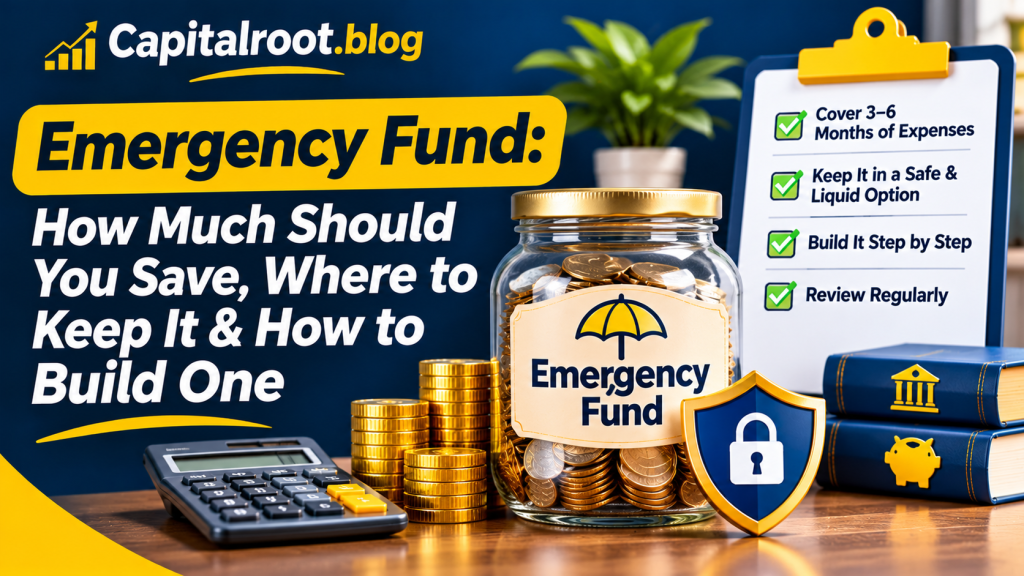
A commonly used starting target is three to six months of essential living expenses.
However, the right amount depends on your income stability, family responsibilities, health coverage, debt obligations, and employment situation.
Here is a general guide:
| Financial Situation | Possible Savings Target |
|---|---|
| Stable income and low financial responsibilities | 3 months of essential expenses |
| Regular family responsibilities | 3–6 months |
| Single-income household | 6 months or more |
| Freelancer or self-employed person | 6–12 months |
| Irregular income or uncertain employment | 6–12 months |
These are planning guidelines, not fixed rules. You can start with a smaller target and increase it over time.
Example: Calculate Your Emergency Fund
Suppose your essential monthly expenses are:
| Expense | Monthly Amount |
|---|---|
| Rent or housing | ₹10,000 |
| Groceries | ₹6,000 |
| Electricity and bills | ₹2,000 |
| Transport | ₹3,000 |
| Insurance and medical basics | ₹2,000 |
| Essential family expenses | ₹5,000 |
| Total | ₹28,000 |
If you want to save six months of essential expenses:
₹28,000 × 6 = ₹1,68,000
Your emergency fund target would be ₹1,68,000.
This is only an illustrative example. Use your own essential expenses and local currency to calculate your target.
4. How to Calculate Your Emergency Fund Step by Step
You do not need complicated financial software to calculate your target. Follow these steps:
Step 1: List Your Essential Monthly Expenses
Include costs you must continue paying even if your income decreases. These may include housing, groceries, utilities, transport, essential insurance, medical needs, and minimum debt payments.
Step 2: Exclude Non-Essential Spending
You generally do not need to include restaurant visits, entertainment, shopping, holidays, subscriptions you can cancel, or other optional spending.
Step 3: Choose Your Savings Period
Decide whether you need three, six, or more months of essential expenses based on your personal situation.
Step 4: Multiply Your Monthly Expenses
Use this simple formula:
Emergency Fund Target = Essential Monthly Expenses × Number of Months
Step 5: Review Your Target Regularly
Your expenses may change when you move home, get married, have children, change jobs, or take on new financial responsibilities. Review your target at least once or twice a year.
5. Where Should You Keep Your Emergency Fund?
The right place for emergency savings should offer three important features:
- Safety: Your money should be held in a suitable, regulated financial institution or account.
- Accessibility: You should be able to withdraw it when a genuine emergency occurs.
- Liquidity: You should not have to wait a long time or pay a large penalty to access your money.
Here are some common options.
Savings Account
A savings account is one of the simplest places to keep emergency money.
Benefits include:
- Easy access to funds.
- Convenient online transfers.
- Suitable for money you may need quickly.
- A separate account can help prevent unnecessary spending.
Check account fees, withdrawal conditions, access arrangements, and deposit protection before choosing a bank.
Fixed Deposits or Certificates of Deposit
Some people keep part of their emergency savings in deposits that earn interest.
However, check the withdrawal rules carefully. Early withdrawal may involve penalties or restrictions, depending on the product and bank.
Do not lock away all your emergency money if you may need it immediately.
Money Market Deposit Accounts
In the USA, some banks offer money market deposit accounts. These may provide interest while allowing access under the account’s terms.
Check minimum balance requirements, transaction restrictions, fees, and FDIC coverage.
Cash for Immediate Needs
Keeping a small amount of cash in a secure place can help during situations such as payment network outages or emergencies where digital payments are unavailable.
Avoid keeping your entire emergency fund as physical cash because it can be lost, stolen, or damaged.
Should You Invest Your Emergency Fund in Stocks or Cryptocurrency?
Generally, no. Shares, equity mutual funds, cryptocurrencies, and other volatile investments can fall in value when you need the money.
An emergency fund should prioritise stability and access rather than high returns.
6. Emergency Fund Rules and Deposit Protection in India, the USA and the UK
Where you keep your money matters. Deposit protection rules differ by country, so check the applicable scheme and whether your financial institution and account are eligible.

India
In India, the Deposit Insurance and Credit Guarantee Corporation (DICGC) provides deposit insurance for eligible deposits at insured banks.
The current limit is ₹5 lakh per depositor per insured bank, including principal and interest, held in the same right and capacity. Eligible savings, fixed, current, and recurring deposits are covered under the scheme, subject to its rules.
This protection does not mean every financial product is insured. Mutual funds, stocks, bonds, ETFs, and cryptocurrency are not covered as bank deposits under DICGC.
Official reference: DICGC – Guide to Deposit Insurance.
United States
In the USA, the Federal Deposit Insurance Corporation (FDIC) generally insures eligible deposits up to $250,000 per depositor, per FDIC-insured bank, per ownership category.
Covered deposit accounts can include savings accounts, checking accounts, money market deposit accounts, and certificates of deposit.
Stocks, mutual funds, and cryptocurrency are not FDIC-insured deposits, even if you purchase them through a bank-affiliated platform.
Official reference: FDIC – Deposit Insurance.
United Kingdom
In the UK, the Financial Services Compensation Scheme (FSCS) protects eligible deposits with authorised banks, building societies, and credit unions.
The deposit protection limit increased to £120,000 per eligible person, per authorised firm, from 1 December 2025. Eligibility and how accounts are grouped under a banking licence matter, so check the provider and protection details.
Official reference: FSCS – Deposit Protection Limit.
Important: Deposit protection is designed for eligible deposits if a covered financial institution fails. It is not a guarantee against investment losses, inflation, fraud, or every type of financial risk. Always check the latest official rules before making a decision.
7. How to Build an Emergency Fund on a Low Income
You do not need a high salary to begin building an emergency fund. The most important thing is to start with an amount you can manage consistently.
Start With a Small Target
Do not worry about saving six months of expenses immediately.
Your first target could be enough to cover one small unexpected bill. Once you reach it, gradually increase your goal.
Save a Fixed Amount Every Month
Choose an amount that fits your budget.
For example, if you save ₹1,000 every month, you will have ₹12,000 in one year, excluding any interest earned.
Small contributions can build a useful financial cushion over time.
Automate Your Savings
Set up an automatic transfer to a separate savings account after you receive your salary or income.
This reduces the temptation to spend the money first and save whatever remains.
Reduce Unnecessary Expenses
Review your regular spending and identify costs you can reduce.
For example:
- Cancel subscriptions you rarely use.
- Limit unnecessary online shopping.
- Reduce food delivery expenses.
- Compare mobile and internet plans.
- Plan purchases instead of buying impulsively.
Move the money you save into your emergency fund.
Use Extra Income Wisely
If you receive a bonus, freelance payment, gift, refund, or additional income, consider putting a portion into your emergency savings.
You can also increase your monthly contribution when your income rises.
8. Common Emergency Fund Mistakes to Avoid
Building savings is important, but managing them correctly is equally important.
Using the Fund for Shopping
A sale, new phone, holiday, or expensive gadget is usually not an emergency.
Keep your emergency fund separate from money intended for lifestyle purchases.
Keeping All Your Money in Risky Investments
An emergency reserve should not depend on stock market performance or cryptocurrency prices.
Prioritise access and stability.
Saving Too Little for Your Situation
Three months of expenses may not be enough for someone with irregular income, dependants, or limited employment opportunities.
Choose a target that reflects your circumstances.
Forgetting to Rebuild the Fund
If you use emergency savings, make a plan to replenish the amount gradually once the situation improves.
Ignoring Inflation and Rising Expenses
Your monthly costs may increase over time. Review your target periodically instead of assuming the original amount will always be sufficient.
Confusing Insurance With Emergency Savings
Insurance can protect against specific covered risks, but it may not pay every expense or provide money immediately. Emergency savings and insurance serve different purposes.
9. Emergency Fund vs. Regular Savings: What Is the Difference?
Both are useful, but they have different purposes.
| Feature | Emergency Fund | Regular Savings |
|---|---|---|
| Main purpose | Unexpected expenses | Planned financial goals |
| When to use | Genuine emergencies | Planned purchases or goals |
| Access | Should be readily accessible | Depends on the savings goal |
| Risk preference | Prioritise safety | Depends on the goal |
| Example | Job loss or urgent repair | Holiday or new phone |
Keeping these two types of savings separate can make your financial planning easier.
10. A Simple 12-Month Emergency Fund Building Plan
If you are starting from zero, use a realistic plan rather than trying to save a large amount immediately.
| Period | Suggested Action |
|---|---|
| Month 1 | Calculate essential expenses and set your first target |
| Month 2 | Open or designate a separate savings account |
| Months 3–4 | Start regular contributions |
| Months 5–6 | Review spending and increase savings if possible |
| Months 7–9 | Add extra income or bonuses where available |
| Months 10–12 | Review progress and adjust your target |
Your actual progress will depend on your income and expenses. Reaching a full three-to-six-month reserve may take longer than one year, and that is perfectly reasonable.
Consistency matters more than speed.
11. Frequently Asked Questions About Emergency Funds
1. How much money should a beginner save in an emergency fund?
A beginner can start with a small, achievable target and gradually work towards three to six months of essential living expenses. The right amount depends on income stability and personal responsibilities.
2. Is three months of emergency savings enough?
It may be enough for someone with stable income, low financial responsibilities, and other reliable support. People with irregular income, dependants, or uncertain employment may need a larger reserve.
3. Where is the safest place to keep an emergency fund?
A suitable savings account at a regulated, deposit-protected bank is a common option. Check the applicable deposit protection scheme, withdrawal conditions, fees, and account access.
4. Should I keep my emergency fund in a fixed deposit?
You may keep a portion in an eligible deposit if early withdrawal is permitted and you understand the penalties. Keep enough money readily accessible for immediate expenses.
5. Can I invest my emergency fund in mutual funds?
Risky investments are generally unsuitable for the core emergency reserve because their value can fall. The priority is access to money when you need it, not maximising returns.
6. Should I build an emergency fund before investing?
It is generally sensible to establish at least a basic emergency reserve before committing significant money to long-term investments. You can balance debt repayment, savings, and investing according to your financial situation.
7. What if I cannot save money every month?
Start with whatever amount is manageable, even if it is small. Review your expenses, save occasional extra income, and increase contributions when your financial situation improves.
8. Should I use my emergency fund to pay off debt?
It depends on the type of debt and your current savings. High-interest debt deserves attention, but having no emergency reserve can force you to borrow again when an unexpected expense occurs. Consider maintaining a small cash buffer while developing a debt repayment plan.
9. Is an emergency fund necessary if I have health insurance?
Yes. Health insurance may not cover every medical expense, and it does not usually replace lost income or pay for unrelated emergencies. An emergency fund can complement your insurance coverage.
10. How often should I review my emergency fund?
Review it at least once or twice a year and whenever your income, household size, housing costs, or essential expenses change.
Conclusion
An emergency fund is one of the foundations of a healthy financial plan. It helps you manage unexpected expenses, deal with income disruptions, and avoid depending entirely on credit cards or loans during difficult times.
You do not need to build a large fund overnight. Start with a small amount, save consistently, keep the money accessible, and gradually work towards three to six months of essential expenses—or more if your circumstances require it.
The best time to start building your emergency fund is before an emergency happens.
Disclaimer
This article is for educational and informational purposes only. It does not constitute financial, investment, tax, or legal advice. Emergency fund requirements and deposit protection rules vary by country and financial institution. Verify current terms with official regulators and qualified professionals before making financial decisions.
Official External References
- Consumer Financial Protection Bureau (USA): https://www.consumerfinance.gov/an-essential-guide-to-building-an-emergency-fund/
- MoneyHelper (UK): https://www.moneyhelper.org.uk/en/savings/types-of-savings/emergency-savings-how-much-is-enough
- DICGC (India): https://www.dicgc.org.in/guide-to-deposit-insurance
- FDIC (USA): https://www.fdic.gov/resources/deposit-insurance
- Financial Services Compensation Scheme (UK): https://protected.fscs.org.uk/what-we-cover/banks-building-societies-credit-unions/deposit-limit/
- National Institute of Securities Markets (India): https://www.nism.ac.in/revamp-nism/save-for-emergencies/
Suggested Internal Links
Add internal links to these relevant Capitalroot.blog articles when they are published:
- How to Create a Monthly Budget That Actually Works
- How to Save Money on a Low Income
- What Is Net Worth? How to Calculate Your Net Worth and Build Wealth
- Compound Interest Explained: How It Works, Benefits, Formula & Examples
- Financial Scams: Common Types, Warning Signs & How to Protect Your Money
Suggested internal-link anchor texts: monthly budget, saving money on a low income, calculate your net worth, compound interest, and protect your money from financial scams.