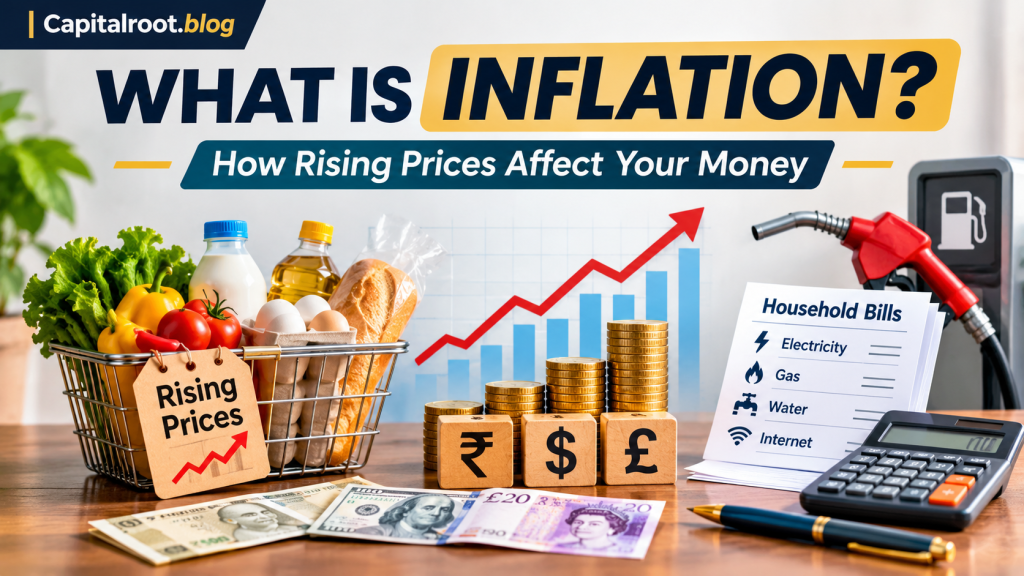

Have you noticed that groceries, fuel, electricity, rent, and other everyday expenses sometimes become more expensive over time? Even when your salary remains the same, you may find that your monthly income does not buy as much as it used to.
One of the main economic concepts behind this change is inflation.
Inflation affects individuals, families, businesses, savings, investments, and entire economies. It is an important financial topic for people who want to manage their money wisely and plan for the future.
Whether you live in India, the United States, or the United Kingdom, understanding inflation can help you make better decisions about budgeting, saving, borrowing, and investing.
In this guide, we will explain what inflation means, why it happens, how it is measured, its effects on everyday life, and practical ways to protect your money from rising prices.
1. What Is Inflation?
Inflation is a sustained increase in the general price level of goods and services in an economy over time.
In simple words, inflation means that the same amount of money may buy fewer goods and services than it could previously.
For example, imagine that a grocery basket costs ₹1,000 today. If the overall price of that same basket increases by 5%, it would cost approximately ₹1,050.
The price increase reduces the purchasing power of your money.
Inflation does not mean that the price of every product increases at the same rate. Some products may become more expensive, while others may remain unchanged or become cheaper.
Economists generally measure inflation by tracking changes in the prices of a representative basket of goods and services.
2. How Does Inflation Work?
Inflation affects the relationship between money and the goods or services people can purchase.
Suppose you have ₹10,000, $100, or £100.
If prices increase over time while your income remains unchanged, you may be able to purchase fewer items with the same amount of money.
Consider this simplified example:
| Item | Earlier Price | New Price |
|---|---|---|
| Grocery basket | ₹1,000 | ₹1,050 |
| Monthly transport | ₹2,000 | ₹2,100 |
| Electricity bill | ₹1,500 | ₹1,575 |
| Household essentials | ₹2,500 | ₹2,625 |
These are hypothetical examples using a 5% increase. They do not represent actual inflation data for any country.
When the prices of many goods and services rise across an economy, the cost of maintaining the same lifestyle can increase.
This is why inflation is closely connected to the cost of living.
3. What Are the Main Causes of Inflation?
Inflation can occur for several reasons. Economists commonly discuss demand-pull inflation, cost-push inflation, and inflation expectations.
1. Demand-Pull Inflation
Demand-pull inflation occurs when demand for goods and services grows faster than the economy’s ability to supply them.
For example, suppose many people suddenly want to purchase a particular product, but manufacturers cannot produce enough units.
When demand exceeds available supply, businesses may increase prices.
Common factors that can contribute to demand-pull inflation include:
- Increased consumer spending
- Rising household incomes
- Lower borrowing costs
- Strong business investment
- Increased government spending
The exact impact depends on economic conditions and the availability of goods and services.
2. Cost-Push Inflation
Cost-push inflation occurs when the cost of producing goods and services increases.
Businesses may face higher expenses for:
- Raw materials
- Electricity and fuel
- Transportation
- Employee wages
- Manufacturing
- Packaging and distribution
For example, if fuel prices increase significantly, transporting products may become more expensive.
Businesses may pass some of these additional costs on to consumers through higher prices.
3. Imported Inflation
Imported inflation can occur when imported products or raw materials become more expensive.
Changes in exchange rates can contribute to this problem.
For example, if a country’s currency loses value against another currency, imported goods may become more expensive in local currency terms.
Countries that depend heavily on imported fuel, food, machinery, or industrial materials may be particularly exposed to certain international price changes.
4. Inflation Expectations
People’s expectations about future prices can also influence inflation.
If businesses expect their costs to rise, they may increase prices in advance.
Similarly, employees may request higher wages if they expect their living expenses to increase.
These decisions can influence future production costs, wages, spending, and prices.
5. Supply Chain Disruptions
Natural disasters, wars, transport problems, shortages, and international trade disruptions can affect the availability of goods.
When supplies become limited, prices may rise.
For example, a poor agricultural harvest may reduce food availability and put upward pressure on certain food prices.
In reality, inflation often results from a combination of several factors rather than a single cause.
4. What Are the Different Types of Inflation?
Economists use different terms to describe the speed and pattern of price increases.
1. Moderate Inflation
Moderate inflation refers to relatively gradual increases in the general price level.
It allows households and businesses to adjust their spending and financial plans more easily than during periods of very high and unstable inflation.
2. Creeping Inflation
Creeping inflation describes a slow and relatively gradual increase in prices over time.
The effect may appear small in the short term but can become significant over many years.
3. Galloping Inflation
Galloping inflation refers to very high and rapidly increasing prices.
It can create serious financial difficulties because wages and savings may struggle to keep up with rising living costs.
4. Hyperinflation
Hyperinflation is an extremely severe form of inflation in which prices rise at an exceptionally rapid rate.
It can seriously damage confidence in a country’s currency and financial system.
Hyperinflation is uncommon compared with ordinary inflation.
5. Stagflation
Stagflation is an economic situation involving high inflation alongside weak economic growth and elevated unemployment.
It can be particularly difficult for policymakers because controlling inflation while supporting employment and growth becomes more challenging.
5. How Is Inflation Measured?
Inflation is commonly measured using price indexes that track changes in the cost of a basket of goods and services.
One widely used measure is the Consumer Price Index (CPI).
What Is the Consumer Price Index (CPI)?
The Consumer Price Index measures changes in the prices paid by consumers for a representative selection of goods and services.
Depending on the country, the basket may include:
- Food and beverages
- Housing
- Transportation
- Healthcare
- Clothing
- Education
- Communication
- Recreation
- Household expenses
The prices of these items are collected and compared over time.
Inflation Rate Formula
A simplified formula for calculating the percentage change in a price index is:
Inflation Rate = [(Current CPI − Previous CPI) ÷ Previous CPI] × 100
For example:
- Previous CPI = 200
- Current CPI = 210
Inflation Rate = [(210 − 200) ÷ 200] × 100
Inflation Rate = 5%
This means the index increased by 5% over the period being compared.
Remember that the CPI is an index, not the price of a single product. Different households may experience different changes in their personal living costs because they purchase different products and services.
6. How Does Inflation Affect Your Daily Life?
Inflation can influence many parts of household finances.
1. Higher Grocery Expenses
When food prices rise, households may need to spend more on groceries to purchase similar quantities of food.
2. Increased Transportation Costs
Higher fuel, vehicle maintenance, public transport, or other travel expenses can affect monthly budgets.
3. Higher Housing Expenses
Rent, maintenance, utilities, and housing-related costs may increase over time.
However, these expenses do not always move at the same rate as overall inflation.
4. Reduced Purchasing Power
If your income does not increase as quickly as prices, your real purchasing power may decline.
For example, if your salary increases by 3% but the relevant price index increases by 5%, your purchasing power may fall.
5. Increased Business Costs
Businesses may experience higher expenses for materials, energy, transportation, and labour.
These higher costs can affect profitability, production decisions, and consumer prices.
6. Pressure on Household Savings
If living expenses increase faster than your savings interest or investment returns, the real value of your savings may decline.
This makes it important to consider inflation when planning long-term financial goals.
7. Inflation vs Deflation: What Is the Difference?
Inflation and deflation describe different movements in the general price level.
| Feature | Inflation | Deflation |
|---|---|---|
| Meaning | General prices increase | General prices decrease |
| Purchasing power | Generally decreases | Generally increases |
| Consumer spending | May be affected by rising costs | Consumers may delay purchases |
| Business impact | Higher input costs may occur | Falling prices may reduce revenue |
| Economic concern | Excessively high or unstable inflation | Persistent deflation can weaken economic activity |
Deflation is not always beneficial.
If consumers expect prices to keep falling, they may postpone purchases. This can reduce demand, business revenue, investment, and employment.
Economists therefore pay attention to both inflation and deflation.
8. Inflation vs Cost of Living: What Is the Difference?
Inflation and cost of living are related, but they are not exactly the same.
Inflation measures the rate at which the general price level changes over time.
Cost of living refers to the amount of money required to maintain a particular standard of living.
For example, inflation may increase the prices of food, housing, transportation, and healthcare.
However, the actual effect on a household depends on its location, income, family size, spending habits, and housing situation.
Two families living in the same city may experience different financial pressure even when the official inflation rate is identical.
9. How Does Inflation Affect Savings and Investments?
Inflation is an important consideration when deciding where to save or invest money.
Savings Accounts
If the interest earned on a savings account is lower than inflation, the purchasing power of the balance may decline over time.
For example, suppose your savings earn 3% annually while inflation is 5%.
Your balance increases in nominal terms, but its purchasing power may decrease.
Fixed Deposits and Similar Products
Fixed deposits may offer a specified interest rate for an agreed period.
However, the real return depends on inflation, applicable taxes, fees, and the product’s conditions.
Bonds
Inflation can affect the purchasing power of future fixed payments.
Some inflation-linked securities are designed to adjust payments or principal according to specified inflation measures, subject to their terms.
Stocks and Mutual Funds
Stocks and mutual funds may offer opportunities for long-term growth, but they involve market risk.
Business earnings, interest rates, valuations, economic conditions, and investor expectations can all affect returns.
Gold and Other Assets
Some people consider gold and other assets when thinking about inflation protection.
However, their prices can fluctuate and they are not guaranteed to outperform inflation.
There is no single investment that protects every investor against inflation in every market condition.
10. How to Protect Your Money from Inflation
You cannot control the overall inflation rate, but you can take practical steps to manage its effect on your personal finances.
1. Prepare a Realistic Monthly Budget
Review your regular income and expenses.
Identify which costs have increased and where you can reduce unnecessary spending.
2. Review Your Savings Strategy
Compare the interest earned on your savings with inflation and consider whether your current savings arrangements suit your goals.
Always maintain accessible money for emergencies.
3. Build an Emergency Fund
An emergency fund can help you handle unexpected expenses without relying entirely on borrowing.
A common planning target is three to six months of essential living expenses, adjusted for your income stability and responsibilities.
4. Explore Long-Term Investment Options
Depending on your country, goals, time horizon, and risk tolerance, you may research diversified investments and retirement savings arrangements.
Do not invest money you need immediately in products that can fluctuate significantly in value.
5. Avoid Unnecessary Debt
High-interest borrowing can make rising living costs more difficult to manage.
Try to pay bills on time and avoid taking loans for unnecessary purchases.
6. Increase Your Earning Potential
Developing professional skills, pursuing additional qualifications, and exploring career opportunities may help improve your earning capacity over time.
7. Review Financial Goals Regularly
A savings target that was realistic several years ago may no longer be sufficient.
Review your goals periodically and adjust them according to changing costs and personal circumstances.
11. Inflation in India
Inflation affects Indian households through changes in food, housing, transportation, healthcare, education, fuel, and other expenses.
The Consumer Price Index (CPI) is an important measure used to understand consumer price changes in India.
The Ministry of Statistics and Programme Implementation (MoSPI) publishes official consumer price inflation statistics.
Factors That Can Influence Inflation in India
Some important factors include:
- Food supply and agricultural production
- Fuel and energy prices
- Imported commodity costs
- Exchange rate movements
- Transportation and distribution expenses
- Domestic consumer demand
- Global economic conditions
Food prices can have a noticeable effect on household budgets because food is an important part of everyday spending.
How Can Indian Households Manage Inflation?
Indian households can consider:
- Tracking monthly expenses.
- Comparing grocery prices and planning purchases.
- Maintaining an emergency fund.
- Reviewing savings and investment options.
- Avoiding unnecessary high-interest borrowing.
- Considering long-term financial goals.
For current official information, visit the Ministry of Statistics and Programme Implementation and Reserve Bank of India websites.
12. Inflation in the USA
Inflation affects American consumers through changes in housing, groceries, healthcare, transportation, energy, and other everyday expenses.
The Consumer Price Index (CPI), published by the US Bureau of Labor Statistics (BLS), is one of the major measures of consumer inflation.
The Federal Reserve also monitors inflation using different economic price indexes, including the Personal Consumption Expenditures (PCE) price index.
Factors That Can Influence Inflation in the USA
- Consumer demand
- Housing and rental costs
- Energy prices
- Labour and production costs
- Supply chain conditions
- Imported goods and exchange rates
- Monetary and fiscal conditions
How Can American Households Manage Inflation?
Consumers may consider:
- Reviewing monthly budgets.
- Comparing insurance and utility costs.
- Reducing high-interest credit card balances.
- Maintaining emergency savings.
- Reviewing retirement contributions.
- Comparing savings account interest rates and fees.
For official data and educational information, visit the US Bureau of Labor Statistics, Federal Reserve, and Consumer Financial Protection Bureau websites.
13. Inflation in the UK
Inflation affects UK households through changes in food, energy, transport, housing, and other living expenses.
The Office for National Statistics (ONS) publishes important inflation measures, including the Consumer Prices Index (CPI) and Consumer Prices Index including owner occupiers’ housing costs (CPIH).
The Bank of England is responsible for monetary policy and works towards maintaining price stability under its inflation target framework.
Factors That Can Influence Inflation in the UK
- Energy and fuel prices
- Food and grocery costs
- Housing-related expenses
- Wage and service-sector costs
- Imported goods
- Exchange rate changes
- Consumer demand
How Can UK Households Manage Inflation?
Some practical steps include:
- Reviewing household budgets.
- Comparing energy and broadband deals.
- Monitoring grocery spending.
- Maintaining emergency savings.
- Reviewing pension and investment goals.
- Managing credit card and personal loan repayments.
For official information, visit the Office for National Statistics, Bank of England, and MoneyHelper websites.
14. What Is the Difference Between Inflation Rate and Interest Rate?
Inflation and interest rates are related economic concepts, but they mean different things.
Inflation rate measures the percentage increase in the general price level over a period.
Interest rate is the cost of borrowing money or the return paid on savings and certain financial products.
Central banks may increase policy interest rates when inflation is too high or persistent.
Higher borrowing costs can reduce spending and borrowing demand, which may help ease inflationary pressure over time.
However, monetary policy works with delays and does not directly control every price in the economy.
The relationship between inflation and interest rates is therefore complex.
15. Common Inflation Myths You Should Know
Myth 1: Inflation Means Every Product Becomes More Expensive
Fact: Inflation refers to a broad increase in the general price level. Individual product prices can rise, fall, or remain unchanged.
Myth 2: Falling Inflation Means Prices Are Falling
Fact: A lower inflation rate usually means prices are rising more slowly, not necessarily decreasing.
Myth 3: Savings Accounts Always Protect Money from Inflation
Fact: If the interest earned is lower than inflation, purchasing power may still decline.
Myth 4: Gold Always Beats Inflation
Fact: Gold prices fluctuate and do not guarantee positive real returns over every period.
Myth 5: Higher Salary Always Means Better Purchasing Power
Fact: If income grows more slowly than relevant living costs, purchasing power may decline.
Frequently Asked Questions (FAQs)
1. What is inflation in simple words?
Inflation is a general increase in the prices of goods and services over time. It reduces the amount of goods and services that the same amount of money can buy.
2. What are the main causes of inflation?
The main causes include increased consumer demand, rising production costs, supply shortages, imported price increases, and inflation expectations.
3. How is inflation calculated?
Inflation is commonly calculated by comparing a consumer price index over two periods and measuring its percentage change.
4. What is the difference between inflation and deflation?
Inflation refers to a general increase in prices, while deflation refers to a general decrease in prices over time.
5. Does inflation reduce the value of money?
Inflation generally reduces the purchasing power of money because the same amount buys fewer goods and services.
6. How does inflation affect savings?
If the interest earned on savings is lower than inflation, the real purchasing power of those savings may decline.
7. What is the Consumer Price Index (CPI)?
CPI is an index that measures changes in the prices paid by consumers for a representative basket of goods and services.
8. Is inflation always bad for the economy?
Not necessarily. Low and stable inflation can be consistent with a healthy economy. Very high, unstable, or persistent inflation can create significant financial and economic problems.
9. How can I protect my money from inflation?
You can review your budget, maintain emergency savings, manage expensive debt, compare savings products, and explore suitable long-term investments based on your financial goals and risk tolerance.
10. What is the difference between inflation and interest rates?
Inflation measures changes in general prices, while interest rates represent the cost of borrowing or the return earned on certain savings and financial products.
Conclusion
Inflation is an important part of personal finance because it affects the purchasing power of money, household expenses, savings, investments, and long-term financial goals.
Although individuals cannot control the overall inflation rate, they can prepare for its effects through better budgeting, responsible borrowing, emergency savings, and informed financial planning.
Whether you live in India, the USA, or the UK, understanding inflation can help you make more practical decisions about your money.
Remember that financial planning is not only about earning and saving more. It is also about understanding how the value of your money changes over time.
Stay informed, review your financial goals, and make decisions that support your long-term financial security.
Financial Disclaimer: This article is for general educational and informational purposes only. It does not constitute personalised financial, investment, tax, or legal advice. Inflation measures, financial products, tax rules, and investment risks vary by country. Verify current information with official institutions before making financial decisions.