
Have you ever wondered how a small amount of money can grow into a much larger amount over time? One of the important financial concepts behind this growth is compound interest.
Compound interest allows you to earn interest not only on your original money but also on the interest accumulated over time. This process is commonly known as the power of compounding.
Whether you are saving money in a bank account, investing for retirement, or planning your long-term financial goals, understanding compound interest can help you make more informed financial decisions.
However, compounding does not always work in your favour. When you borrow money, compound interest can also increase the amount you owe if interest is added to an unpaid balance.
In this complete guide, we will explain what compound interest means, how it works, its formula, practical examples, the difference between simple and compound interest, and how people in India, the USA, and the UK can understand its benefits.
1. What Is Compound Interest?
Compound interest is the interest calculated on the original amount of money as well as the interest accumulated from previous periods.
In simple words, it means earning interest on interest.
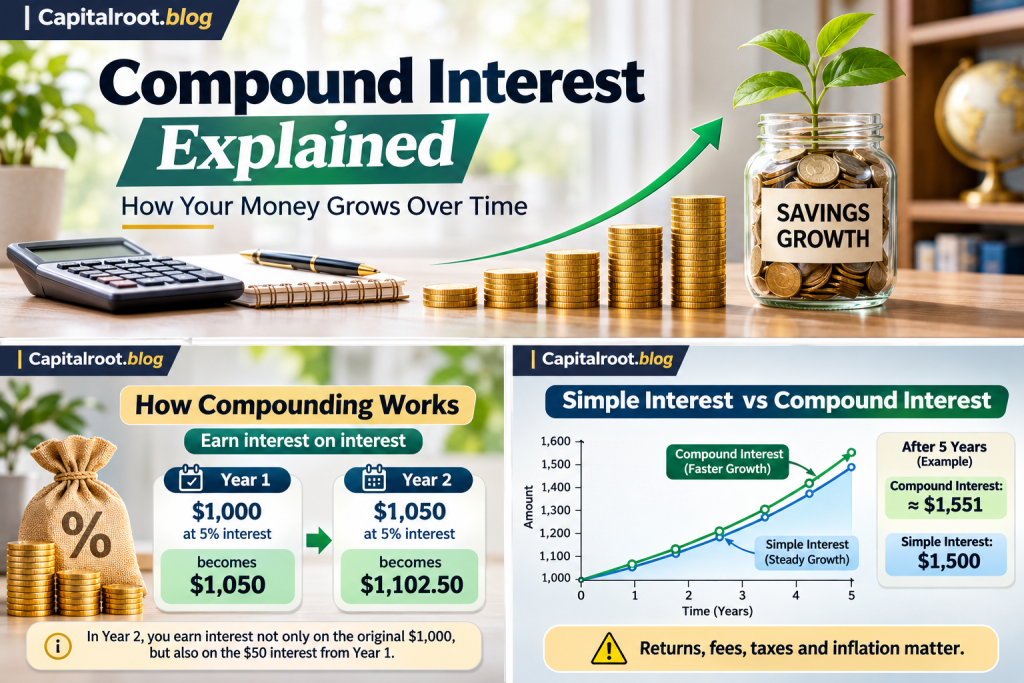
For example, suppose you deposit $1,000 into an account that earns 5% annual interest, with interest compounded once a year.
At the end of the first year, you earn $50 in interest.
Your new balance becomes $1,050.
During the second year, interest is calculated on $1,050 rather than only the original $1,000.
You therefore earn $52.50 in the second year.
Your balance becomes $1,102.50.
This process continues as long as interest is added to the balance and earns further interest.
The same principle applies whether you calculate money in Indian rupees (₹), US dollars ($), or British pounds (£).
2. How Does Compound Interest Work?
Compound interest works by adding earned interest to the original principal amount.
The new total then becomes the principal for the next compounding period.
Let’s understand this with a simple example.
Suppose you deposit $1,000 at an annual interest rate of 5%, compounded yearly.
| Year | Starting Balance | Interest Earned | Ending Balance |
|---|---|---|---|
| Year 1 | $1,000.00 | $50.00 | $1,050.00 |
| Year 2 | $1,050.00 | $52.50 | $1,102.50 |
| Year 3 | $1,102.50 | $55.13 | $1,157.63 |
| Year 4 | $1,157.63 | $57.88 | $1,215.51 |
| Year 5 | $1,215.51 | $60.78 | $1,276.28 |
These figures are rounded to two decimal places.
Notice that the interest earned increases each year because the balance on which interest is calculated becomes larger.
This is the basic principle of compound interest.
3. Compound Interest Formula
The compound interest formula helps calculate the future value of money when interest is compounded at regular intervals.
The standard formula is:
A = P × (1 + r/n)^(n × t)
Where:
- A = Final amount
- P = Original principal amount
- r = Annual interest rate expressed as a decimal
- n = Number of compounding periods per year
- t = Number of years
To calculate compound interest earned:
Compound Interest = A − P
Example Using the Formula
Suppose:
- Principal = $5,000
- Annual interest rate = 6%
- Compounding frequency = Once per year
- Time period = 5 years
First, convert 6% into decimal form:
6 ÷ 100 = 0.06
Now apply the formula:
A = 5,000 × (1 + 0.06/1)^(1 × 5)
A = 5,000 × (1.06)^5
A ≈ $6,691.13
Therefore:
- Original amount = $5,000
- Final amount ≈ $6,691.13
- Compound interest earned ≈ $1,691.13
This is an illustration using a fixed annual rate, not a guaranteed investment return.
4. Simple Interest vs Compound Interest
Simple interest and compound interest are two different ways of calculating interest.
With simple interest, interest is calculated only on the original principal amount.
With compound interest, interest is calculated on the original principal and previously accumulated interest.
Here is a comparison:
| Feature | Simple Interest | Compound Interest |
|---|---|---|
| Interest calculation | Original principal | Principal plus accumulated interest |
| Interest earned | Usually remains constant each period | Can increase over time |
| Growth pattern | Linear | Compounding growth |
| Reinvestment | Not required for the formula | Interest is added to the balance |
| Long-term effect | Generally lower under identical positive rates | Generally higher under identical positive rates |
Example: $1,000 at 5% for 10 Years
Assume interest is calculated annually.
Simple Interest:
Interest = Principal × Rate × Time
Interest = $1,000 × 5% × 10
Interest = $500
Final amount = $1,500
Compound Interest:
Final amount = $1,000 × (1.05)^10
Final amount ≈ $1,628.89
Compound interest earned ≈ $628.89.
Under these assumptions, compound interest produces a higher final balance because previous interest also earns interest.
5. Benefits of Compound Interest
Compound interest can be useful for people who want to build savings and work towards long-term financial goals.
Here are some of its major benefits.
1. Helps Grow Money Over Time
When interest is added to your balance, future interest can be calculated on a larger amount.
This can help savings grow over long periods.
2. Rewards Starting Early
Starting to save or invest earlier can give your money more time to benefit from compounding.
Even small contributions can become meaningful over long periods, although the actual result depends on the interest rate, investment performance, fees, and other factors.
3. Supports Long-Term Financial Goals
Compounding can be relevant when planning for:
- Retirement
- Children’s education
- Buying a home
- Long-term savings
- Future financial independence
4. Encourages Regular Saving
Making regular contributions can increase the amount of money available to earn future interest or returns.
5. Can Support Wealth Creation
When earnings remain invested, they may contribute to further growth.
However, market-linked investments involve risk and do not provide guaranteed compound returns.
6. The Power of Compounding: Why Time Matters
Time is one of the most important factors in compound growth.
The longer money remains invested or deposited under suitable compounding conditions, the more opportunities it has to earn returns on accumulated earnings.
Let’s consider a simple illustration.
Suppose you deposit $1,000 at a fixed annual interest rate of 7%, compounded annually, without making additional contributions or withdrawals.
| Time Period | Approximate Final Value |
|---|---|
| 5 years | $1,402.55 |
| 10 years | $1,967.15 |
| 15 years | $2,759.03 |
| 20 years | $3,869.68 |
| 25 years | $5,427.43 |
| 30 years | $7,612.26 |
This example assumes a constant 7% annual rate, annual compounding, and no taxes or fees.
It is a mathematical illustration, not a prediction of investment performance.
The key lesson is that time can have a significant impact on compound growth.
7. What Is the Rule of 72?
The Rule of 72 is a simple mathematical shortcut used to estimate how long it may take money to double at a particular annual growth rate.
The formula is:
Years to Double ≈ 72 ÷ Annual Rate of Return (%)
For example:
| Annual Rate | Approximate Doubling Time |
|---|---|
| 4% | 18 years |
| 6% | 12 years |
| 8% | 9 years |
| 9% | 8 years |
| 12% | 6 years |
If your money grows at an assumed annual rate of 8%, the Rule of 72 suggests that it may take approximately nine years to double.
This is only an estimate. Actual doubling time depends on the effective rate, compounding frequency, and whether the rate remains constant.
8. What Is the Difference Between Compound Interest and Compound Growth?
These terms are related but are not always identical.
Compound Interest generally refers to interest earned on principal and previously accumulated interest.
It is commonly used when discussing deposits, savings products, and fixed-rate interest arrangements.
Compound Growth is a broader term used for assets whose value increases through reinvested earnings or returns.
For example, mutual funds and stocks may experience compound growth when returns are reinvested.
However, market-linked investments do not earn a guaranteed fixed interest rate. Their values can rise or fall, and investors may lose money.
Understanding this difference is important when comparing savings accounts with investments.
9. How Can You Benefit from Compound Interest?
You can use the concept of compounding to improve your long-term financial planning.
Consider these practical strategies:
1. Start Saving Early
The earlier you begin saving, the more time your money may have to grow.
You do not need to begin with a large amount. Start with an amount that fits your budget.
2. Make Regular Contributions
Consistent deposits or investments can increase your total principal over time.
3. Reinvest Eligible Earnings
When suitable, keeping earned interest or investment distributions invested can help generate further growth.
4. Understand Interest Rates
Compare the effective interest rate, compounding frequency, fees, and conditions of different financial products.
5. Avoid Unnecessary Withdrawals
Frequent withdrawals can reduce the balance available for future compounding.
6. Review Fees and Taxes
Fees and taxes can reduce the amount available to compound.
Always compare the return after considering relevant costs and tax treatment.
10. Compound Interest in India
In India, compound interest is relevant to various savings and investment products.
Examples include eligible bank deposits, recurring deposits, government savings schemes, and certain investment arrangements.
The exact interest calculation and compounding frequency depend on the specific product.
Common Examples
Fixed Deposits (FDs): Depending on the bank and deposit option, interest may be compounded at specified intervals or paid out periodically.
Recurring Deposits (RDs): These allow customers to deposit money regularly. Interest calculation depends on the scheme’s terms.
Public Provident Fund (PPF): PPF follows specific government rules, including annual interest crediting and account conditions.
Mutual Funds: Returns may compound through reinvested earnings and changes in investment value, but returns are market-linked and not guaranteed.
Before choosing any product, check the latest interest rates, eligibility, tax treatment, withdrawal rules, and applicable conditions.
Official resources:
- Reserve Bank of India: Financial Education
- Securities and Exchange Board of India (SEBI): Investor Education
- National Institute of Securities Markets (NISM): Financial Calculators
11. Compound Interest in the USA
Compound interest is an important concept in American savings and financial planning.
People may encounter it through savings accounts, certificates of deposit (CDs), retirement accounts, and other eligible financial products.
Common Examples
High-Yield Savings Accounts: These accounts may offer interest that is credited according to the bank’s terms.
Certificates of Deposit (CDs): CDs generally provide an agreed interest rate for a specified term, subject to their conditions.
Retirement Accounts: Certain retirement accounts may hold investments whose earnings can compound over time. Tax treatment depends on the account type and applicable rules.
Reinvested Investment Earnings: Reinvesting eligible dividends or distributions may contribute to compound growth.
Important Considerations
Before choosing a savings or investment product, compare:
- Annual Percentage Yield (APY), where applicable
- Interest rate and compounding frequency
- Account fees
- Withdrawal restrictions
- Tax implications
- Deposit insurance eligibility
For general financial education, the US Consumer Financial Protection Bureau and Investor.gov provide useful information about compound interest and investing.
12. Compound Interest in the UK
Compound interest also plays an important role in UK savings and long-term financial planning.
People may encounter it through savings accounts, Cash ISAs, fixed-rate savings products, and investments.
Common Examples
Easy-Access Savings Accounts: These accounts allow customers to access savings under the provider’s terms and may pay interest at specified intervals.
Fixed-Rate Savings Accounts: These products generally offer a specified interest rate for an agreed period.
Cash ISAs: Eligible interest earned within a Cash ISA is generally tax-free under applicable UK rules.
Stocks and Shares ISAs: Investments held in these accounts may experience compound growth through reinvested returns, but investment values can fall as well as rise.
Important Considerations
Before selecting a UK savings or investment product, compare:
- Annual Equivalent Rate (AER)
- Gross and net interest rates, where relevant
- Withdrawal conditions
- Account fees
- ISA eligibility and rules
- Investment risks
- Applicable tax treatment
MoneyHelper and the Financial Conduct Authority provide useful consumer education and investment guidance.
13. Can Compound Interest Work Against You?
Yes. Compound interest can increase the amount you owe when interest is added to outstanding debt.
This is particularly important with certain credit card balances, loans, and other borrowing arrangements.
For example, if unpaid interest is added to a debt balance, future interest may be calculated on the increased amount, subject to the agreement and applicable laws.
This can make borrowing more expensive over time.
To avoid unnecessary borrowing costs:
- Pay bills by their due dates.
- Avoid carrying expensive credit card balances.
- Review loan interest rates and repayment conditions.
- Understand whether interest compounds.
- Consider repayment options before taking additional debt.
Remember, compounding can help grow savings, but it can also increase borrowing costs.
14. Common Mistakes to Avoid
Understanding compound interest is useful, but several mistakes can lead to unrealistic financial expectations.
1. Expecting Guaranteed Investment Returns
Market-linked investments do not provide guaranteed fixed returns.
2. Ignoring Inflation
Even if your account balance increases, inflation can reduce the purchasing power of your money.
3. Ignoring Fees and Taxes
Charges and taxes may reduce your actual returns.
4. Withdrawing Money Frequently
Withdrawals can reduce the amount available for future growth.
5. Confusing Interest Rate with APY or AER
Different financial products use different rate conventions. Compare equivalent measures rather than relying only on advertised headline rates.
6. Taking Loans Without Understanding Interest
Borrowers should understand how interest is calculated and whether unpaid interest can be added to the balance.
Frequently Asked Questions (FAQs)
1. What is compound interest in simple words?
Compound interest means earning interest on your original money and on the interest already accumulated over time.
2. What is the formula for compound interest?
The standard formula is A = P × (1 + r/n)^(n × t), where A is the final amount, P is the principal, r is the annual rate, n is the compounding frequency, and t is the number of years.
3. What is the difference between simple interest and compound interest?
Simple interest is calculated on the original principal, while compound interest is calculated on the principal plus accumulated interest.
4. Is compound interest good for savings?
It can help savings grow when interest is added to the balance and earns further interest. Actual growth depends on the account terms and applicable costs.
5. How often can interest be compounded?
Depending on the financial product, interest may be compounded annually, semi-annually, quarterly, monthly, or at another specified frequency.
6. What is the Rule of 72?
The Rule of 72 is a shortcut for estimating how many years it may take money to double. Divide 72 by the assumed annual growth rate.
7. Can compound interest make you rich?
Compounding can contribute to long-term wealth creation, but it does not guarantee wealth. Your contributions, time horizon, returns, costs, taxes, and investment risks all matter.
8. Does compound interest apply to loans?
Yes. Certain loans and credit balances can involve compounding, depending on the agreement and applicable rules. Check how your lender calculates interest.
9. Is compound interest available in India, the USA, and the UK?
Yes. The concept applies internationally. However, financial products, interest calculations, taxes, and consumer protections vary by country.
10. What is the biggest advantage of compound interest?
One of its biggest advantages is that accumulated interest can generate additional interest over time, potentially accelerating long-term savings growth.
Conclusion
Compound interest is one of the most important concepts in personal finance.
It explains how money can grow when interest is earned on both the original principal and previously accumulated interest.
By understanding compounding, starting early, contributing regularly, and keeping savings invested where appropriate, you can work towards your long-term financial goals.
However, remember that investment returns are not guaranteed, and compounding can also increase the cost of certain debts.
Whether you live in India, the USA, or the UK, understanding compound interest can help you make better financial decisions.
Start learning, plan carefully, and give your long-term financial goals the time they need.
Financial Disclaimer: This article is for general educational and informational purposes only. It does not constitute personalised financial, investment, tax, or legal advice. Interest rates, investment returns, fees, taxes, and financial product conditions vary by country and provider. Verify current information with official institutions before making financial decisions.