
Have you ever wanted to purchase a smartphone, laptop, clothing, or another product but did not want to pay the full amount immediately? You may have come across an option called Buy Now, Pay Later (BNPL) while shopping online.
BNPL is a payment and borrowing option that allows eligible customers to purchase products or services immediately and pay for them later, often through multiple instalments.
It has become a familiar feature of online shopping in several countries, including India, the United States, and the United Kingdom. However, although some BNPL plans advertise interest-free payments, they may still involve late fees, repayment obligations, credit checks, or other conditions.
Before choosing this payment option, it is important to understand how it works and what happens if you miss a payment.
In this guide, we will explain the meaning of BNPL, how it works, its advantages and disadvantages, its possible effect on credit scores, and important country-specific rules in India, the USA, and the UK.
1. What Is Buy Now, Pay Later (BNPL)?
Buy Now, Pay Later is a form of short-term consumer credit that allows customers to purchase eligible products or services and repay the amount later.
Instead of paying the full purchase price at checkout, a customer may be allowed to divide the amount into smaller instalments.
For example, suppose you purchase a product worth ₹12,000, $120, or £120.
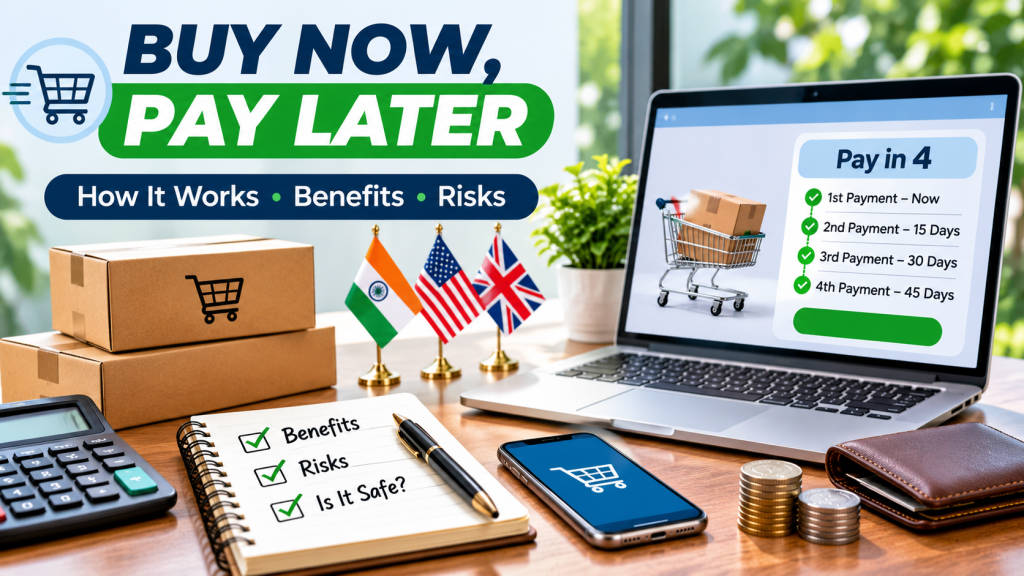
A provider might offer a four-instalment payment arrangement:
| Payment | Amount |
|---|---|
| First payment | 25% |
| Second payment | 25% |
| Third payment | 25% |
| Fourth payment | 25% |
| Total | 100% |
In this simplified example, the customer pays one-fourth of the purchase price in each instalment.
The actual repayment schedule depends on the BNPL provider. Some plans require an initial payment at checkout, while others may start repayments later.
Some BNPL plans are interest-free when payments are made according to the agreement. Others may charge interest, fees, or additional costs.
Important: Interest-free does not automatically mean cost-free. Always check the complete repayment terms before accepting an offer.
2. How Does Buy Now, Pay Later Work?
The BNPL process is usually straightforward.
Many online retailers display a BNPL payment option alongside debit cards, credit cards, and other payment methods.
Here is how a typical BNPL transaction works:
Step 1: Select a Product
Visit an eligible online or physical store and select the product you want to purchase.
Step 2: Choose the BNPL Payment Option
At checkout, select the available Buy Now, Pay Later option.
Step 3: Complete the Eligibility Process
The provider may request information such as your name, contact details, date of birth, and payment information.
Depending on the provider and country, it may also perform identity verification or a credit assessment.
Step 4: Review the Repayment Schedule
Before accepting the agreement, check:
- Total purchase amount
- Initial payment
- Number of instalments
- Repayment dates
- Interest charges, if any
- Late-payment fees
- Other applicable charges
Step 5: Complete Your Purchase
If the application is approved, the retailer processes your purchase according to the payment arrangement.
Step 6: Repay the Instalments
Make each payment by its due date using the permitted payment method.
Missing payments may result in fees, account restrictions, collection activity, or credit-reporting consequences, depending on the agreement and applicable rules.
3. Main Types of BNPL Payment Plans
Not every Buy Now, Pay Later product works in the same way.
Some providers offer short-term interest-free instalments, while others offer longer repayment arrangements.
1. Pay in Four
This is one of the commonly advertised BNPL formats.
The purchase amount is divided into four instalments, often with the first payment due at checkout and the remaining payments scheduled over a short period.
The exact timing varies by provider.
2. Monthly Instalment Plans
Some providers allow customers to repay the purchase amount over several months.
These plans may involve interest or other charges.
Read the agreement carefully because a longer repayment period can increase the total borrowing cost.
3. Deferred Payment Plans
Some BNPL arrangements allow customers to receive the product immediately and make the payment at a later date.
The repayment may be due in one payment or through an agreed instalment schedule.
4. Interest-Bearing BNPL
Some longer-term payment products charge interest.
These products may be closer to traditional instalment credit than the short-term interest-free BNPL plans commonly advertised at checkout.
Always compare the total repayment amount rather than focusing only on the monthly instalment.
4. Benefits of Buy Now, Pay Later
BNPL can offer convenience when used carefully and when the repayments fit within your budget.
1. Flexible Payment Options
BNPL allows eligible customers to divide certain purchases into smaller payments rather than paying the entire amount immediately.
This can help with planned purchases when the repayment schedule is affordable.
2. Convenient Online Shopping
Many online retailers integrate BNPL options directly into their checkout process.
Customers can review available payment arrangements without necessarily applying for a traditional credit card.
3. May Offer Interest-Free Instalments
Some BNPL plans do not charge interest when customers follow the agreed repayment schedule.
However, late fees or other charges may still apply.
4. Simple Application Process
Some short-term BNPL products offer a relatively quick application process.
Depending on the provider, approval may involve identity checks and a creditworthiness assessment.
5. Helps Spread a Planned Purchase
A suitable instalment plan may help customers spread the cost of a necessary purchase over an agreed period.
However, it should not be used as a substitute for an affordable household budget.
5. Risks and Disadvantages of BNPL
Although BNPL offers convenience, it also creates financial obligations.
Understanding the risks is important before using any deferred-payment product.
1. Late Payment Fees
Some providers charge fees when customers miss repayment deadlines.
The amount and conditions vary by provider and country.
Before accepting an agreement, check what happens if you pay late.
2. Multiple Instalments Can Become Difficult to Manage
One BNPL purchase may appear affordable.
However, taking several BNPL plans from different providers can create overlapping repayment dates.
For example, a customer may have:
- One instalment for a smartphone
- Another instalment for clothing
- A third instalment for household electronics
- A fourth instalment for travel expenses
Together, these repayments may place pressure on the monthly budget.
3. Risk of Overspending
Because BNPL reduces the amount payable immediately, customers may be tempted to purchase things they do not actually need.
This can increase financial pressure.
4. Credit Score and Credit Reporting Uncertainty
BNPL products do not all affect credit records in the same way.
Some providers may conduct credit checks or report account information, while others may not report ordinary payment activity.
Missed payments may also be sent to collection agencies or reported under applicable arrangements.
The rules and reporting practices differ between countries and providers.
5. Automatic Payment Problems
Some BNPL providers collect instalments automatically from a linked debit card or bank account.
If sufficient funds are unavailable, the payment may fail.
This could lead to late fees, bank charges, or other consequences depending on your agreement and bank account.
6. Refund and Dispute Complications
If a product is returned, damaged, or never delivered, the refund process may involve both the retailer and BNPL provider.
Do not assume that cancelling an order automatically cancels all scheduled repayments.
Contact the retailer and provider, follow their dispute procedures, and keep your transaction records.
6. Does Buy Now, Pay Later Affect Your Credit Score?
This is one of the most common questions about BNPL.
The answer is: It depends on the provider, product, country, and credit-reporting arrangements.
Some providers may perform a credit check when you apply. Others may use alternative eligibility assessments.
Some report account information to credit bureaus, while others may not report ordinary short-term instalment activity.
A missed payment may still create financial consequences even if the provider does not report every payment to a credit bureau.
For example, an unpaid balance could be referred to a debt collection agency. Information may then be reported according to applicable laws and reporting arrangements.
India
In India, the regulatory treatment depends on the structure of the product and the regulated lender involved.
RBI’s digital lending framework includes customer protection and disclosure requirements for regulated entities and their lending service providers.
RBI’s 2025 directions also address reporting of certain digital lending products, including deferred-payment credit arrangements offered through merchant platforms, to credit information companies.
Do not assume that a BNPL facility will have no effect on your credit history.
USA
In the United States, BNPL reporting practices vary by provider and product.
The Consumer Financial Protection Bureau has explained that many traditional pay-in-four BNPL products have historically not reported ordinary payment activity to the major credit reporting companies.
However, unpaid debts sent to collection agencies may affect credit records.
Some longer-term instalment products may involve different credit checks and reporting arrangements.
Always ask the provider whether it reports account openings, balances, and repayment activity.
UK
In the UK, BNPL credit arrangements may have different reporting and regulatory treatment depending on the product and provider.
The Financial Conduct Authority began regulating certain Deferred Payment Credit agreements on 15 July 2026.
This change includes requirements relating to affordability assessments, customer information, and support for borrowers facing financial difficulty.
However, not every payment arrangement falls within the same regulatory scope.
7. Buy Now, Pay Later in India
BNPL services have been offered in India through different financial and merchant arrangements.
Customers may encounter deferred payment options when shopping online or using eligible digital payment platforms.
However, it is important to understand who is actually providing the credit.
Some arrangements may involve banks or Non-Banking Financial Companies (NBFCs), while others may have different commercial structures.
Important RBI Guidelines
The Reserve Bank of India issued the Digital Lending Directions, 2025, which address digital lending activities carried out by regulated entities.
Important areas include:
- Assessing borrower creditworthiness
- Disclosing loan-related information
- Explaining the Annual Percentage Rate (APR)
- Providing clear repayment information
- Protecting borrower data
- Establishing grievance redressal arrangements
RBI directions also address reporting of certain structured digital lending products involving deferred payments to credit information companies.
What Should Indian Customers Check?
Before accepting a BNPL offer in India:
- Identify the actual bank or NBFC providing the credit.
- Check the total repayment amount.
- Review the Key Facts Statement where applicable.
- Understand the APR and applicable charges.
- Read the repayment and late-payment conditions.
- Review the privacy policy and data permissions.
- Check how the facility may be reported to credit information companies.
For regulatory information, refer to the official Reserve Bank of India website.
8. Buy Now, Pay Later in the USA
BNPL is available through various online retailers and financial service providers in the United States.
Customers may encounter pay-in-four plans and longer-term instalment arrangements.
Important Things American Consumers Should Know
Some short-term BNPL plans divide a purchase into four payments, while other products offer longer repayment periods.
The costs and consumer protections can differ significantly.
The Consumer Financial Protection Bureau (CFPB) provides consumer education about BNPL loans, late payments, credit reporting, and borrowing risks.
One important regulatory update is that the CFPB withdrew its 2024 BNPL interpretive rule on May 12, 2025.
Therefore, consumers should not assume that the withdrawn interpretive rule provides a current blanket regulatory framework for all BNPL products.
Applicable federal and state laws, product structures, and provider agreements still matter.
Safety Tips for US Consumers
- Review the total repayment amount.
- Check whether the provider performs a hard or soft credit inquiry.
- Understand late fees and collection policies.
- Check whether payments are reported to credit bureaus.
- Keep enough money available for scheduled automatic payments.
- Review refund and dispute procedures.
Consumers can use the CFPB’s official website for educational information about BNPL products.
9. Buy Now, Pay Later in the UK
BNPL has been used by UK consumers for online and in-store purchases.
However, an important regulatory change took effect in 2026.
FCA Regulation from 15 July 2026
The Financial Conduct Authority (FCA) began regulating certain Deferred Payment Credit (DPC) agreements, commonly associated with interest-free BNPL.
The relevant agreements generally involve interest-free credit repayable in 12 or fewer instalments over 12 months or less, subject to the legal scope.
For covered agreements provided by third-party lenders, the FCA’s framework includes:
- Appropriate affordability checks
- Clear information about borrowing and repayments
- Information about late fees
- Support for customers experiencing financial difficulty
- Access to complaint procedures, including the Financial Ombudsman Service where applicable
There are important exceptions.
For example, certain arrangements provided by the same business that sells the goods or services may fall outside this specific regulation. Agreements taken out before 15 July 2026 also remain outside the new protections described by the FCA.
What UK Customers Should Check
Before using BNPL in the UK:
- Check whether the lender is authorised or has relevant temporary permission.
- Understand the repayment schedule.
- Review late-payment charges.
- Check whether affordability assessments apply.
- Understand your complaint and refund rights.
- Read the provider’s agreement carefully.
The FCA’s official website provides the latest information about regulated BNPL providers and consumer protections.
10. BNPL vs Credit Card: What Is the Difference?
BNPL and credit cards both allow customers to pay for purchases over time, but their repayment structures can differ.
| Feature | BNPL | Credit Card |
|---|---|---|
| Payment structure | Usually purchase-based instalments | Revolving credit facility or other card arrangements |
| Repayment | Scheduled instalments | Monthly statement repayment |
| Interest | May be zero or interest-bearing | Interest may apply to unpaid balances |
| Credit checks | Depends on provider and product | Usually involves a credit assessment |
| Credit reporting | Varies by provider | Commonly reported by issuers |
| Rewards | Depends on provider | May offer rewards and cashback |
| Late fees | May apply | May apply |
| Borrowing flexibility | Often linked to individual purchases | Available up to the card’s credit limit |
Which Is Better?
Neither option is automatically better.
A credit card may be more suitable for people who understand their repayment obligations and can manage the full statement balance responsibly.
BNPL may be suitable for a planned purchase when the repayment schedule is clear, affordable, and does not encourage unnecessary borrowing.
Always compare the total cost and applicable protections.
11. How to Use BNPL Responsibly
If you decide to use Buy Now, Pay Later, follow these practical steps.
1. Purchase Only What You Need
Avoid using BNPL simply because it is available at checkout.
Ask yourself whether you would still purchase the item if instalments were not offered.
2. Check Your Monthly Budget
Before accepting a plan, calculate your existing bills, loan EMIs, credit card repayments, and other BNPL instalments.
Make sure the additional payment fits comfortably within your budget.
3. Read the Complete Agreement
Do not focus only on the advertised instalment amount.
Check the total repayment, interest, late fees, payment dates, and cancellation conditions.
4. Avoid Multiple BNPL Plans
Taking several instalment plans simultaneously can make repayment difficult.
Keep a record of all active agreements.
5. Set Payment Reminders
Use calendar reminders or suitable automatic payment arrangements.
Ensure sufficient funds are available before scheduled deductions.
6. Understand Credit Reporting
Check whether the provider reports applications, account balances, and payment history to credit reporting agencies.
7. Contact the Provider if You Face Financial Difficulty
If you cannot make a scheduled repayment, contact the provider as early as possible.
Ask about available support and repayment options.
Do not ignore missed payments or collection notices.
12. Common BNPL Mistakes to Avoid
Here are some common mistakes that can create financial difficulties:
Mistake 1: Assuming BNPL Is Free
Some plans charge interest, late fees, or other costs.
Mistake 2: Ignoring Repayment Dates
Missing payment dates can lead to additional charges and other consequences.
Mistake 3: Using Multiple Providers Without Tracking Payments
Overlapping instalments can make monthly budgeting difficult.
Mistake 4: Assuming BNPL Never Affects Credit Scores
Credit checks and reporting practices vary.
Mistake 5: Buying Unnecessary Products
Easy instalments can encourage spending beyond your actual needs.
Mistake 6: Ignoring Refund Conditions
Returning a product does not always mean your repayment arrangement is immediately cancelled.
Mistake 7: Not Checking the Actual Lender
Always understand which company is providing the credit and which company is processing the purchase.
13. Is Buy Now, Pay Later Safe?
BNPL can be used responsibly, but its safety depends on the provider, agreement, customer behaviour, and applicable consumer protection rules.
A reliable provider should clearly explain the payment schedule, total amount due, charges, repayment conditions, and complaint procedures.
Before signing up, check:
- Provider identity and regulatory status where applicable
- Total repayment amount
- Interest and late-payment fees
- Credit assessment and reporting policies
- Privacy and data protection practices
- Refund and dispute procedures
- Customer support availability
Never share your banking password, card PIN, or one-time authentication code with anyone claiming to help you activate a BNPL service.
Remember: Being approved for BNPL does not necessarily mean you can comfortably afford the purchase.
Frequently Asked Questions (FAQs)
1. What does Buy Now, Pay Later mean?
Buy Now, Pay Later is a payment or credit arrangement that allows customers to receive a product or service immediately and repay its cost later according to an agreed schedule.
2. Is Buy Now, Pay Later interest-free?
Some BNPL plans are interest-free when customers follow the agreed payment schedule. Other products may charge interest or fees. Always review the terms.
3. Does BNPL affect your credit score?
It can, depending on the provider, product, country, credit checks, and reporting arrangements. Missed payments may also lead to debt collection and possible credit-reporting consequences.
4. What happens if you miss a BNPL payment?
You may face late fees, account restrictions, collection activity, or credit-reporting consequences depending on the agreement and applicable laws.
5. Is BNPL available in India?
Yes, customers may encounter deferred-payment and instalment credit options through eligible financial institutions and merchant arrangements in India. Check the actual lender and applicable RBI requirements.
6. Is BNPL regulated in the USA?
BNPL products may be subject to applicable federal and state laws depending on their structure. The CFPB withdrew its 2024 BNPL interpretive rule in May 2025, so consumers should check current applicable rules and provider terms.
7. Is BNPL regulated in the UK?
Certain Deferred Payment Credit agreements became subject to FCA regulation from 15 July 2026. The scope includes important exceptions, so not every BNPL arrangement is covered in the same way.
8. Can students use BNPL?
Some providers may offer BNPL to eligible students who meet their age, identity, and affordability requirements. Approval is not guaranteed, and students should carefully assess their repayment ability.
9. Is BNPL better than a credit card?
Neither is universally better. BNPL may offer structured instalments, while credit cards provide a different borrowing and repayment structure. Compare the cost, terms, and protections before deciding.
10. Can I cancel a BNPL purchase?
Cancellation and refund procedures depend on the retailer, provider, and applicable consumer laws. Contact both parties where necessary and confirm that scheduled repayments have been adjusted.
Conclusion
Buy Now, Pay Later has changed how many people pay for online and in-store purchases. It can provide convenient instalment options, but it also creates financial obligations that should not be ignored.
Before using BNPL, understand the repayment schedule, check all charges, review the provider’s terms, and make sure the instalments fit within your monthly budget.
Consumers in India, the USA, and the UK should also understand that BNPL rules, credit reporting, and consumer protections vary by country.
The best financial decision is not simply choosing the easiest payment option. It is choosing a payment method that supports your needs without creating unnecessary debt.
Use BNPL carefully, borrow responsibly, and always plan your repayments before making a purchase.
Financial Disclaimer: This article is for general educational and informational purposes only. It does not constitute personalised financial, legal, credit, or borrowing advice. BNPL products, regulatory requirements, fees, and consumer protections vary by country and provider. Always review the latest agreement and official regulatory guidance before using a BNPL service.