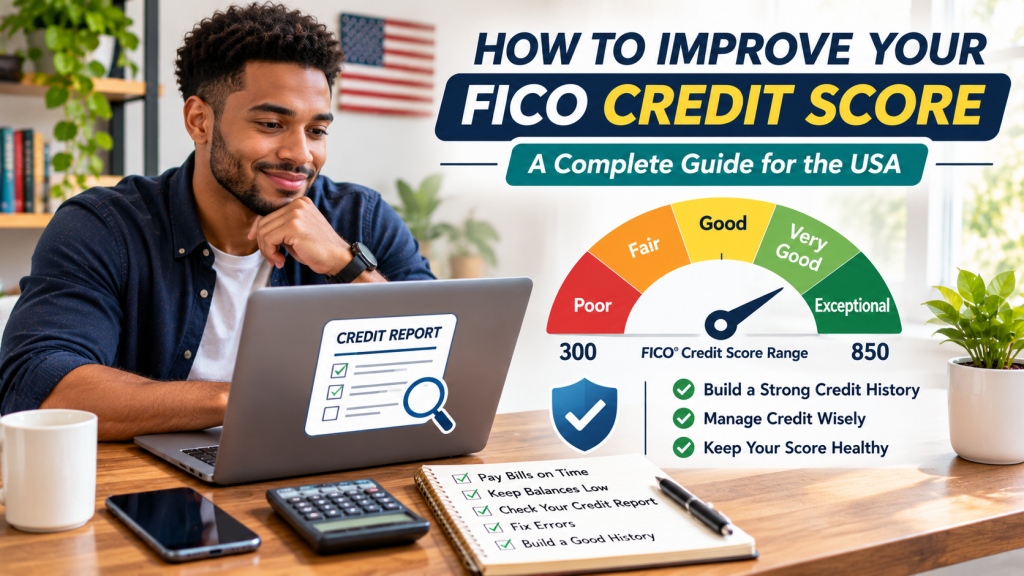


Your credit score can play an important role in your financial life in the United States. Whether you want to apply for a credit card, finance a car, rent an apartment or qualify for a mortgage, your credit history may influence the options available to you.
One of the most widely used credit scoring systems in the USA is the FICO Score. A stronger FICO Score may help you qualify for more favourable borrowing terms, although lenders also consider other factors such as income, debts and their own eligibility requirements.
If your credit score is low or you are just starting to build credit, there are practical steps you can take to improve your credit profile over time.
In this guide, you will learn how FICO Scores work, what affects your score, how to check your credit reports and 12 practical ways to build a stronger credit history.
1. What Is a FICO Credit Score?
A FICO Score is a three-digit credit score developed by Fair Isaac Corporation (FICO). It helps lenders estimate how likely a person is to repay borrowed money as agreed.
FICO Scores are calculated using information in your credit reports from the three major credit reporting companies:
- Equifax
- Experian
- TransUnion
Your credit report contains information about your credit accounts, payment history, balances, credit inquiries and other credit-related records.
FICO uses this information to calculate a score. A higher score generally indicates lower credit risk, while a lower score may indicate a greater risk to lenders.
Important: FICO is a specific brand of credit score. Other companies also calculate credit scores using different models. Therefore, the score you see in a free credit-monitoring app may not be the same FICO Score a lender uses.
2. What Is a Good FICO Score in the USA?
Most commonly used base FICO Scores range from 300 to 850. The following categories are commonly used to describe these scores.
| FICO Score range | Rating |
|---|---|
| 300–579 | Poor |
| 580–669 | Fair |
| 670–739 | Good |
| 740–799 | Very Good |
| 800–850 | Exceptional |
These are general FICO score categories, not guaranteed approval thresholds.
A lender may approve an applicant with a lower score or reject someone with a higher score depending on income, debt, credit history, loan type and other underwriting criteria.
For example, a person with a FICO Score of 720 may receive different loan offers from different lenders. There is no single score that guarantees the best interest rate for every financial product.
3. How Is Your FICO Score Calculated?
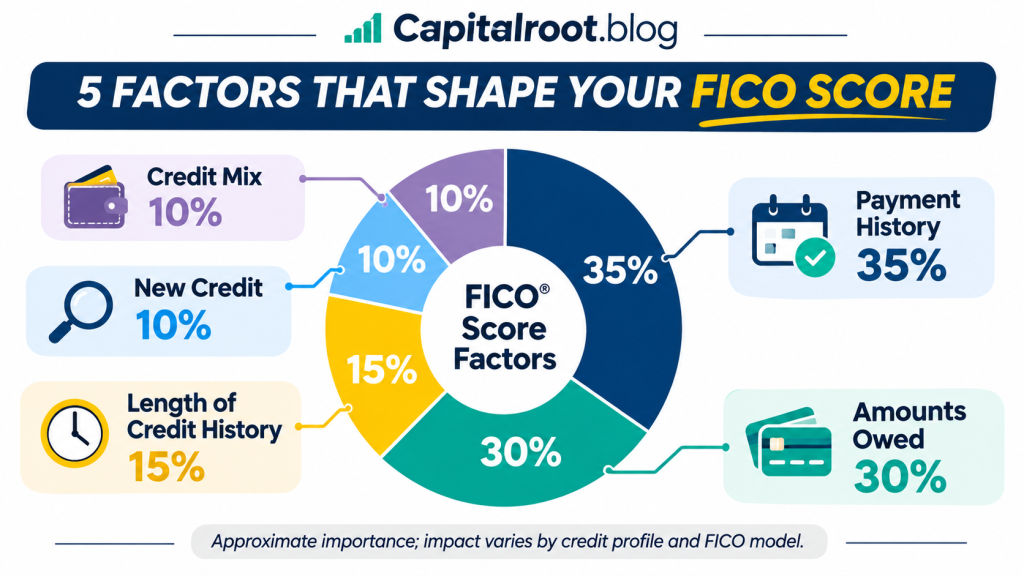
FICO Scores consider five main categories of information from your credit report.
The commonly published approximate weightings for these categories are:
| FICO scoring factor | Approximate importance |
|---|---|
| Payment history | 35% |
| Amounts owed | 30% |
| Length of credit history | 15% |
| New credit | 10% |
| Credit mix | 10% |
These percentages are general guidelines, not fixed calculations for every individual. The actual impact of each factor depends on your overall credit profile and the scoring model being used.
A. Payment History – 35%
Payment history is generally the most important FICO scoring category.
It considers whether you have paid your credit accounts as agreed. This may include:
- Credit card payments
- Auto loan payments
- Mortgage payments
- Personal loan payments
- Other reported credit obligations
Late payments, accounts sent to collections and certain other negative credit events may damage your credit history.
Tip: Set up payment reminders or automatic payments for at least the minimum amount due. Make sure your bank account has enough money to cover scheduled payments.
B. Amounts Owed – 30%
This category considers how much debt you owe and how much of your available revolving credit you are using.
An important part of this factor is called credit utilization.
For example:
If your total credit card limit is $5,000 and your reported balance is $2,000, your utilization ratio is:
($2,000 ÷ $5,000) × 100 = 40%
A high utilization ratio can negatively affect your score.
Many financial educators recommend keeping utilization below 30%, while lower utilization may be beneficial for some credit profiles. There is no universal percentage that guarantees a particular score.
C. Length of Credit History – 15%
This factor considers how long you have been using credit.
It may include:
- The age of your oldest credit account
- The age of your newest account
- The average age of your accounts
- How long individual accounts have been active
A longer history of responsible credit use can be helpful.
This is one reason you should think carefully before closing an old credit card account, particularly if it has no annual fee and you can manage it responsibly.
D. New Credit – 10%
Opening several credit accounts within a short period may indicate greater credit risk.
When you apply for credit, a lender may request a copy of your credit report. This can create a hard inquiry.
Hard inquiries can affect your score, although the impact is usually limited and depends on your credit profile.
Avoid applying for several credit cards or loans simply to collect introductory offers.
E. Credit Mix – 10%
Credit mix refers to the different types of credit accounts in your credit history.
Examples include:
- Credit cards
- Auto loans
- Mortgage loans
- Personal installment loans
- Retail credit accounts
You do not need to open every type of credit account to achieve a good FICO Score. Never take out unnecessary debt simply to improve your credit mix.
4. How to Check Your FICO Credit Score and Credit Report for Free
Before trying to improve your score, understand what is currently included in your credit history.
The three major credit bureaus are Equifax, Experian and TransUnion.
You can request free credit reports through the official website:
https://www.AnnualCreditReport.com/
This is the federally authorized website for requesting credit reports from the three nationwide credit reporting companies.
According to current CFPB guidance, consumers can access their reports online for free once a week from each of the three major bureaus.
Steps to Check Your Credit Report
- Visit AnnualCreditReport.com.
- Choose the credit bureau or bureaus whose reports you want.
- Complete the identity verification process.
- Review your credit accounts and payment history.
- Check for incorrect balances, unfamiliar accounts and inaccurate late-payment records.
- Save a copy of your reports securely for future reference.
Checking your own credit report is a soft inquiry and does not lower your credit score.
Remember: A free credit report does not necessarily include a free FICO Score. Some banks, credit card issuers and financial services provide free scores to eligible customers. Check whether the score is actually a FICO Score or another scoring model.
5. 12 Practical Ways to Improve Your FICO Credit Score
Improving your FICO Score takes responsible habits and time. There is no guaranteed shortcut, but the following steps can help strengthen your credit profile.
1. Always Pay Your Bills on Time
Payment history is the most influential FICO scoring category.
Even one reported late payment can have a negative effect, depending on your credit history and the scoring model.
To avoid missing payments:
- Set automatic payment reminders.
- Use autopay if you can maintain enough money in your account.
- Check payment due dates regularly.
- Pay at least the minimum amount due by the deadline.
- Contact your lender immediately if you are having financial difficulties.
If you have missed payments in the past, focus on bringing accounts current and maintaining on-time payments going forward.
2. Keep Your Credit Card Utilization Low
Credit utilization is the percentage of your available revolving credit that you are using.
For example:
| Detail | Amount |
|---|---|
| Total credit limit | $10,000 |
| Current reported balance | $2,000 |
| Credit utilization | 20% |
Keeping balances relatively low can help your credit profile.
Practical ways to reduce utilization include:
- Paying down outstanding balances.
- Avoiding unnecessary credit card purchases.
- Making payments before the statement closing date if you want a lower balance reported.
- Not using your credit cards close to their limits.
You do not need to carry a balance or pay interest to build a good credit score. Paying your statement balance in full by the due date is generally a sensible way to manage credit card costs.
3. Avoid Missing Minimum Payments
If you cannot pay your full credit card balance, try to make at least the minimum payment by the due date.
This may help you avoid a late payment being reported, although interest and other charges can still apply.
If you are struggling financially, contact your card issuer before missing a payment and ask whether hardship assistance is available.
4. Avoid Applying for Too Many Credit Cards
Every new credit application may result in a hard inquiry.
Several applications in a short period can make lenders concerned about your recent borrowing activity.
Before applying:
- Compare card features and fees.
- Check eligibility requirements.
- Consider whether you actually need another account.
- Avoid applying just because an advertisement promises rewards or bonuses.
Apply selectively rather than submitting multiple applications without a plan.
5. Keep Older Credit Card Accounts Open When Appropriate
The length of your credit history can influence your FICO Score.
Closing an old credit card may reduce your available credit limit and increase your overall utilization ratio if you still have balances on other cards.
However, keeping an account open is not always the best choice.
Consider closing an account if:
- It has an expensive annual fee.
- Its terms are unsuitable.
- Keeping it open makes overspending more likely.
- You are concerned about fraud or account security.
Review the costs and benefits before deciding.
6. Check Your Credit Reports for Errors
Incorrect information on your credit report can damage your credit profile.
Look for:
- Accounts you never opened.
- Incorrect late-payment records.
- Wrong account balances.
- Duplicate debts.
- Accounts listed as open after being closed.
- Incorrect personal information.
- Signs of identity theft.
If you find an error, dispute it with the credit bureau and the company that supplied the information.
You can learn more about disputes from the Federal Trade Commission:
https://consumer.ftc.gov/articles/disputing-errors-your-credit-reports
7. Consider a Secured Credit Card if You Are Starting from Scratch
If you have little or no credit history, a secured credit card may be one option to consider.
A secured card generally requires a refundable security deposit, which often determines your starting credit limit.
For example:
- You provide a $300 security deposit.
- The issuer may offer a $300 credit limit.
- You make purchases using the card.
- You pay the bill according to the terms.
- The issuer may eventually return your deposit if the account is closed in good standing or converted under its policies.
Before applying, check:
- Annual fees
- Interest rates
- Deposit requirements
- Whether the issuer reports payments to all three major credit bureaus
A secured card is not automatically free or risk-free. Use it only if you can manage the payments responsibly.
8. Become an Authorized User Carefully
Some credit card issuers allow a cardholder to add another person as an authorized user.
If the primary cardholder maintains a positive payment history and low balance, the account may help the authorized user build credit, depending on the issuer’s reporting practices and the scoring model.
However, this strategy has risks.
If the primary cardholder misses payments or carries high balances, the account information reported may not help your credit profile.
Only consider this option with someone you trust, and confirm that the issuer reports authorized-user accounts to the credit bureaus.
9. Manage Existing Debt Before Taking on More
If you already have several outstanding balances, focus on managing them rather than opening new accounts.
You can:
- List every balance and interest rate.
- Pay at least the required minimums.
- Direct extra payments toward high-interest debt.
- Avoid new unnecessary borrowing.
- Contact lenders if you are facing payment difficulties.
Reducing debt can help lower your credit utilization and improve your overall financial position.
10. Build a Longer Record of Responsible Credit Use
Credit history develops over time.
There is no instant way to create several years of responsible payment history.
Keep existing accounts in good standing, avoid unnecessary applications and make payments on time.
If you are new to credit, consider a suitable credit-building product from a bank or credit union after reviewing its costs and reporting practices.
11. Review Your Credit Regularly
Make a habit of checking your credit reports for changes.
Regular reviews can help you notice:
- New accounts
- Unfamiliar credit inquiries
- Incorrect balances
- Unexpected collection accounts
- Possible identity theft
You do not need to pay for an expensive monitoring service just to review your federally available free credit reports.
12. Be Patient and Avoid Credit Repair Scams
Some companies promise to remove negative information or increase credit scores by a fixed number of points.
Be careful with these claims.
Accurate negative information generally cannot be removed simply because you pay a credit repair company. You can dispute inaccurate information yourself without paying a company.
Avoid services that:
- Guarantee a specific score increase.
- Promise to erase accurate negative records.
- Ask you to create a false identity.
- Tell you to dispute every item regardless of accuracy.
- Demand large upfront fees for unrealistic promises.
Improving credit is a process. Focus on accurate reporting and responsible financial habits.
6. How Long Does It Take to Improve a FICO Score?
There is no fixed timeline for improving a FICO Score.
Your progress depends on:
- Your current credit score and credit history.
- Whether you have missed payments.
- Your current credit utilization.
- How much debt you owe.
- The type and age of your credit accounts.
- When lenders report updated information.
For example, paying down a high credit card balance may affect your score after the lower balance is reported and included in a new score calculation.
However, rebuilding a history affected by serious negative events may take considerably longer.
Do not trust advertisements promising a guaranteed increase of 50, 100 or 200 points within a few days.
7. How to Improve a FICO Score from 600 to 700
Moving from a FICO Score of 600 toward 700 may be a useful goal, but the steps depend on what is holding your score back.
Here is a practical approach:
| Step | Action |
|---|---|
| 1 | Review all three credit reports |
| 2 | Dispute any inaccurate information |
| 3 | Bring overdue accounts current where possible |
| 4 | Make every future payment on time |
| 5 | Reduce high credit card balances |
| 6 | Avoid unnecessary hard inquiries |
| 7 | Keep suitable older accounts in good standing |
| 8 | Review your reports and progress regularly |
For someone with high utilization but no late payments, reducing card balances may be a useful first priority.
For someone with recent missed payments, getting current and building a consistent record of on-time payments may matter more.
There is no guaranteed timeframe for reaching 700. Your score may respond differently depending on your complete credit profile.
8. Does Checking Your Own Credit Score Lower It?
No. Checking your own credit report or score is generally treated as a soft inquiry and does not lower your FICO Score.
There are two common types of credit inquiries.
Soft Inquiry
A soft inquiry may occur when:
- You check your own credit.
- A company performs a permitted background or account review.
- A credit card issuer checks an account for a promotional offer.
Soft inquiries do not affect your FICO Score.
Hard Inquiry
A hard inquiry may occur when you apply for:
- A credit card.
- A personal loan.
- An auto loan.
- A mortgage.
Hard inquiries can affect your FICO Score, although the impact varies.
FICO generally considers inquiries from the previous 12 months in its scoring calculations, even though inquiries may remain on credit reports for up to two years.
When shopping for certain types of loans, such as mortgages or auto loans, eligible inquiries made within a short rate-shopping period may be treated as a single inquiry by the applicable FICO model. The time window depends on the model.
9. What to Do If You Find an Error on Your Credit Report
If your credit report contains incorrect information, you have the right to dispute it.
Follow these steps:
- Obtain your credit reports from the relevant bureaus.
- Identify the specific information you believe is incorrect.
- Collect supporting documents, such as payment receipts or account statements.
- Submit a dispute to the credit reporting company.
- Contact the lender or company that supplied the information.
- Keep copies of your dispute and supporting documents.
- Review the investigation results and updated report.
Credit bureaus generally have 30 days to investigate a dispute, although certain circumstances can extend the period.
You can submit disputes through the relevant bureau’s official website or by following the instructions provided with your credit report.
Do not dispute accurate information just because it is negative. Focus on genuine errors and incomplete records.
10. Protect Your Credit from Identity Theft
Identity theft can create unfamiliar credit accounts, hard inquiries and collection records in your name.
To protect yourself:
- Use strong and unique passwords.
- Enable multifactor authentication where available.
- Avoid sharing sensitive financial information through suspicious links.
- Review your credit reports regularly.
- Report unfamiliar accounts promptly.
- Consider a credit freeze if you suspect identity theft or want to prevent new creditors from accessing your reports.
A security freeze is free to place and lift at the three nationwide credit bureaus. It does not lower your credit score, but you may need to lift it when applying for new credit.
If you believe your identity has been stolen, visit the official Federal Trade Commission resource:
https://www.IdentityTheft.gov/
11. Common FICO Credit Score Myths
There is a lot of confusing information about credit scores. Here are some common myths and the facts behind them.
Myth 1: You Must Carry a Credit Card Balance to Build Credit
Fact: You do not need to carry interest-bearing debt to build a good credit history. Paying your statement balance in full and on time is generally a better way to manage card costs.
Myth 2: Checking Your Own Credit Score Lowers It
Fact: Checking your own credit is generally a soft inquiry and does not lower your score.
Myth 3: Having a High Income Automatically Gives You a High FICO Score
Fact: Income is not a direct factor in calculating a FICO Score. Lenders may still consider income separately when reviewing an application.
Myth 4: Closing a Credit Card Always Improves Your Credit
Fact: Closing an account may reduce your available credit and increase utilization. Its effect depends on your overall credit profile.
Myth 5: A Credit Repair Company Can Guarantee a Higher Score
Fact: No company can legitimately guarantee a particular FICO Score increase. Accurate negative information cannot simply be erased for a fee.
12. Frequently Asked Questions (FAQs)
Q1. What is the fastest way to improve a FICO Score?
There is no guaranteed fast method. If high credit card utilization is lowering your score, paying down balances may help after updated information is reported. Consistent on-time payments and accurate credit reports are also important.
Q2. What is a good FICO Score in the USA?
A FICO Score of 670–739 is commonly categorized as Good, 740–799 as Very Good and 800–850 as Exceptional. Lenders use their own approval standards, so these categories do not guarantee loan approval.
Q3. Does paying off a credit card improve my credit score?
Paying down a credit card can reduce your utilization ratio, which may help your score. Paying your statement balance in full by the due date can also help you avoid interest when your card’s terms provide a grace period.
Q4. How much credit utilization should I maintain?
Keeping utilization below 30% is a common educational guideline, but lower utilization may be beneficial. There is no single percentage that guarantees a particular FICO Score.
Q5. How often should I check my credit report?
You can access your credit reports online for free once a week through AnnualCreditReport.com. Checking your own report does not hurt your credit score.
Q6. Can I improve my FICO Score without a credit card?
Yes. Other reported credit accounts, such as certain installment loans, may contribute to your credit history. However, you should never borrow money unnecessarily just to build a score.
Q7. How long do hard inquiries stay on a credit report?
Hard inquiries may remain on your credit report for up to two years. FICO Scores generally consider inquiries from the most recent 12 months.
Q8. Can a secured credit card help build credit?
Yes, if the card issuer reports the account and payment history to the credit bureaus. Make sure you understand the deposit, fees and interest rate before applying.
Q9. Can I remove a late payment from my credit report?
If a late payment is inaccurate, you can dispute it with the credit bureau and the company that reported it. If it is accurate, you can ask the lender whether it is willing to consider a goodwill adjustment, but it is not required to remove accurate information.
Q10. Does closing an old credit card lower my FICO Score?
It can affect your score, particularly if closing the account reduces your total available credit and increases utilization. The effect varies, so review the account’s fees and benefits before closing it.
Conclusion
Improving your FICO credit score in the USA is not about finding a shortcut. It is about building a reliable credit history through responsible financial habits.
Start by checking your credit reports, paying bills on time, keeping credit card balances low and applying for new credit only when necessary. Correct genuine reporting errors and protect your identity from fraud.
Remember that your credit score may take time to improve, and different lenders may use different scoring models. Focus on the habits that strengthen your overall financial position rather than chasing a particular number.
Disclaimer: This article is for general educational purposes only and does not provide individualized financial, legal or credit advice. FICO scoring models, lender requirements and credit reporting practices may vary. Check your current credit information and consult official sources before making financial decisions.