

Choosing the right life insurance policy is an important part of financial planning, especially if your family depends on your income. In the United States, two common types of life insurance are term life insurance and whole life insurance.
Both policies can provide financial protection for your beneficiaries if you pass away while the policy is in force. However, they work differently. Term life insurance provides coverage for a specific period, while whole life insurance is designed to provide lifelong coverage and build cash value.
So, which one should you choose?
The answer depends on your financial responsibilities, budget, long-term goals, and the type of protection you need. This guide explains the differences between term life insurance and whole life insurance in simple language.
1. What Is Term Life Insurance?
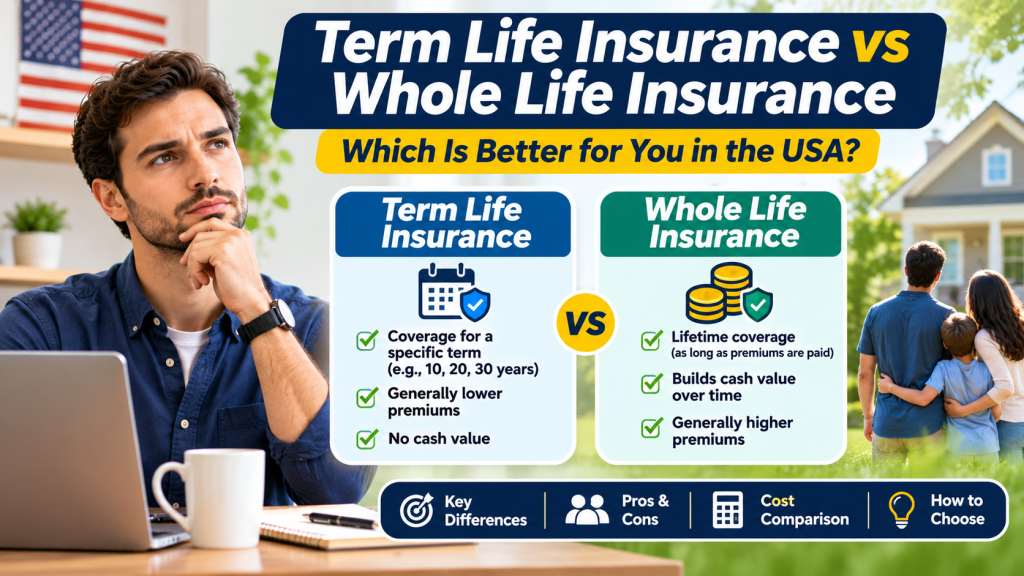
Term life insurance is a policy that provides coverage for a specific period, known as the policy term.
Common term lengths include 10, 15, 20, or 30 years, although available options vary by insurer and product.
If the insured person dies while the policy is active during the covered term, the insurance company generally pays the agreed death benefit to the named beneficiaries, subject to the policy’s terms and conditions.
If the insured person outlives the policy term, the coverage normally ends and no death benefit is paid under a standard term policy.
Key Features of Term Life Insurance
- Coverage lasts for a selected period.
- Premiums are generally lower than those for comparable whole life coverage at the same age and underwriting class.
- Standard term policies generally do not build cash value.
- The death benefit is paid if the insured dies during the covered term.
- Some policies offer renewal or conversion options.
- Renewal premiums may be significantly higher than the original premium.
Example of Term Life Insurance
Suppose a 35-year-old parent purchases a 20-year term life insurance policy with a $500,000 death benefit.
If the insured dies while the policy is active during those 20 years, the beneficiaries may receive the $500,000 death benefit, subject to the policy terms.
If the insured lives beyond the 20-year term, the standard coverage ends without a death benefit. The policyholder may have options to renew or convert the policy if the contract allows it.
This example is for illustration only. Actual premiums and eligibility depend on the applicant and insurer.
2. What Is Whole Life Insurance?
Whole life insurance is a type of permanent life insurance designed to provide coverage for the insured person’s entire lifetime, as long as the policy remains in force and its requirements are met.
Unlike standard term life insurance, whole life insurance includes a cash value component.
Part of the premium helps pay for insurance costs and expenses, while another portion contributes to the policy’s cash value according to the contract.
Traditional whole life policies generally offer:
- Lifetime death benefit protection, subject to policy conditions.
- Premiums that are designed to remain level under the contract.
- A cash value component that grows according to policy guarantees and terms.
- The ability to borrow against available cash value, subject to interest and policy rules.
- Possible dividends on certain participating policies, which are not guaranteed.
Example of Whole Life Insurance
Suppose a person purchases a whole life policy with a $250,000 death benefit.
The policy may build cash value over time. The policyholder may be able to borrow against that cash value or surrender the policy for its available surrender value.
If the insured dies while the policy is active, the insurer generally pays the death benefit according to the contract. Outstanding policy loans and interest may reduce the amount received by beneficiaries.
The actual cash value and benefits depend on the policy’s guarantees, expenses, and any non-guaranteed elements.
3. Term Life Insurance vs Whole Life Insurance: Key Differences
The biggest difference is the duration of coverage and whether the policy builds cash value.
| Feature | Term Life Insurance | Whole Life Insurance |
|---|---|---|
| Coverage period | Specific term | Designed for lifetime |
| Premium cost | Generally lower initially | Generally higher |
| Cash value | No cash value in standard policies | Builds cash value |
| Death benefit | If death occurs during the covered term | Generally payable whenever the insured dies while coverage is in force |
| Premium structure | Often level for the selected term | Generally designed to remain level |
| Savings component | No | Yes |
| Policy loans | No cash value to borrow against | May be available against cash value |
| Dividends | Not typical | Possible on participating policies; not guaranteed |
| Main purpose | Affordable protection for a specific period | Lifelong protection with a cash value feature |
The exact features depend on the policy contract. Not every product has identical terms.
4. Which Life Insurance Is More Affordable?
For many people, term life insurance is more affordable than whole life insurance when comparing similar applicants and death benefit amounts.
This is because term life insurance provides protection for a limited period and does not build cash value.
Whole life insurance generally costs more because it is designed to provide lifetime coverage and includes a cash value component.
Factors That Affect Life Insurance Premiums
Your premium may depend on:
- Age
- Health history
- Tobacco or nicotine use
- Family medical history, where permitted
- Coverage amount
- Policy type
- Policy term
- Occupation and lifestyle factors
- Underwriting results
- Insurer-specific pricing
There is no single premium that applies to everyone.
Why Should You Compare Quotes?
Two insurance companies may offer different premiums for similar coverage.
Before buying a policy, compare:
- Premium amount
- Guaranteed death benefit
- Coverage duration
- Renewal conditions
- Conversion options
- Cash value guarantees
- Policy expenses
- Exclusions and limitations
Do not select a policy based only on the lowest advertised premium.
5. Understanding Cash Value in Whole Life Insurance
Cash value is one of the most important differences between term and whole life insurance.
A whole life policy gradually builds cash value under its contractual terms. This value is different from the death benefit.
The cash value may be available to the policyholder through a policy loan or surrender, depending on the contract.
How Can You Access Cash Value?
There are generally three ways to access the value, depending on the policy:
1. Policy Loan
You may borrow against the available cash value. Interest is charged, and an unpaid loan may reduce the death benefit.
2. Partial Withdrawal
Some policies allow withdrawals, but the rules and consequences depend on the contract. A withdrawal may reduce the cash value or death benefit.
3. Policy Surrender
You may choose to end the policy and receive its available surrender value after applicable charges and outstanding loans.
Surrendering a policy means giving up the coverage.
Important Things to Understand
- Cash value may grow slowly during the early years.
- The surrender value may be lower than the total premiums paid, particularly in the early years.
- Policy loans generally accrue interest.
- Unpaid loans can reduce the death benefit.
- A policy may lapse if its requirements are not maintained.
- Certain policy transactions may have tax consequences.
Ask the insurer for a year-by-year illustration showing guaranteed and non-guaranteed values before purchasing a whole life policy.
6. Advantages and Disadvantages of Term Life Insurance
Advantages
1. Lower Initial Premiums
Term life insurance generally provides a larger amount of coverage for a lower initial premium than comparable whole life insurance.
2. Simple Structure
It is usually easier to understand because it focuses on providing a death benefit for a specific period.
3. Useful for Temporary Financial Responsibilities
A term policy may help protect a family while a mortgage, education expense, or other major financial responsibility is outstanding.
4. Flexible Coverage Periods
You may choose a policy term that matches the period when your family needs financial protection.
Disadvantages
1. Coverage Can End
A standard term policy ends after the selected term unless it is renewed or converted under the contract.
2. No Standard Cash Value
You generally do not receive a savings balance from a standard term policy.
3. Renewal Can Be Expensive
Renewing coverage at an older age may result in significantly higher premiums.
4. New Coverage May Be Difficult to Obtain
If your health changes, applying for a new policy after your existing term ends may be more difficult or expensive.
7. Advantages and Disadvantages of Whole Life Insurance
Advantages
1. Lifetime Coverage Design
Whole life insurance is designed to provide coverage for the insured person’s lifetime, subject to policy conditions.
2. Cash Value Growth
The policy builds cash value according to its contractual terms.
3. Predictable Premium Structure
Traditional whole life policies generally have premiums designed to remain level.
4. Potential Policy Loans
The policyholder may be able to borrow against available cash value, subject to interest and policy rules.
5. Estate and Legacy Planning
Some people use permanent life insurance as part of a broader estate or legacy plan.
Disadvantages
1. Higher Premiums
Whole life insurance generally costs more than comparable term coverage.
2. Slow Early Cash Value Growth
The cash surrender value may be limited during the early years of the policy.
3. Loans Can Reduce Benefits
Unpaid policy loans and interest may reduce the death benefit and can contribute to policy lapse.
4. Complex Policy Structure
Cash value, dividends, surrender charges, and policy loans can make whole life insurance more difficult to understand.
5. Long-Term Premium Commitment
You must be confident that you can maintain the required premiums over the long term.
8. Who Should Consider Term Life Insurance?
Term life insurance may be worth considering if you:
- Have children or other financial dependents.
- Have a mortgage or major outstanding debt.
- Want income protection for your family.
- Need coverage until your children become financially independent.
- Want a relatively affordable way to obtain a larger death benefit.
- Prefer to keep insurance and investing decisions separate.
Example
A 30-year-old parent has a mortgage and two young children. They want financial protection until the children become independent and the mortgage is mostly paid off.
A 20- or 30-year term policy may be worth comparing because the family’s financial responsibilities are expected to be greatest during that period.
The appropriate coverage amount and term should be based on the family’s actual financial needs and budget.
9. Who Should Consider Whole Life Insurance?
Whole life insurance may be worth evaluating if you:
- Need permanent life insurance coverage.
- Have long-term estate or legacy planning goals.
- Can comfortably afford the higher premiums.
- Understand the policy’s cash value and loan provisions.
- Want contractual cash value features.
- Have already considered your emergency savings, retirement contributions, and other financial priorities.
Whole life insurance is not automatically the right choice for every high-income household. It should be evaluated based on your overall financial plan.
Example
A person wants lifelong coverage as part of a long-term estate plan and has enough income to maintain the required premiums.
They may compare whole life policies to understand the guaranteed death benefit, cash value growth, policy expenses, and surrender conditions.
A qualified financial or insurance professional can help evaluate whether the policy fits their objectives.
10. Term Life vs Whole Life: A Simple Example
Consider two hypothetical applicants comparing life insurance options.
| Detail | Term Life | Whole Life |
|---|---|---|
| Applicant age | 35 years | 35 years |
| Illustrative coverage | $500,000 | $500,000 |
| Coverage duration | 20 years | Designed for lifetime |
| Cash value | No | Yes |
| Premium | Depends on quote | Generally higher |
| Main objective | Family protection during working years | Permanent protection and cash value |
This comparison does not include actual premiums because insurance prices vary significantly by health, underwriting class, insurer, policy design, and state.
To compare fairly, request quotes for the same applicant profile and review the complete policy illustrations.
11. Is Whole Life Insurance a Good Investment?
Whole life insurance includes a cash value feature, but it should not automatically be treated as a replacement for a retirement account or a diversified investment portfolio.
Before purchasing it, understand:
- The guaranteed cash value schedule.
- Any non-guaranteed dividends or projected growth.
- Policy expenses and surrender charges.
- The impact of loans and withdrawals.
- The amount your beneficiaries may receive.
- How long you expect to keep the policy.
A policy illustration may show values that depend on assumptions. Non-guaranteed values can change and should not be treated as promises.
Compare whole life insurance with other ways of meeting your financial goals. Consider seeking independent financial advice if the policy is being presented as an investment strategy.
12. Can You Have Both Term Life and Whole Life Insurance?
Yes. Some people hold both types of coverage if each policy serves a different purpose.
For example:
- A whole life policy may provide a permanent death benefit.
- A term policy may provide additional protection during the years when mortgage payments, childcare costs, and income replacement needs are high.
This approach may provide flexibility, but it also means paying for multiple policies.
Before combining policies, calculate the total premiums and confirm that the coverage is necessary and affordable.
13. Important Questions to Ask Before Buying Life Insurance
Before purchasing either type of policy, ask the insurer or licensed insurance professional:
- How much death benefit does the policy guarantee?
- How long will the coverage remain active?
- Are premiums fixed or can they change?
- Does the policy build cash value?
- Which cash value figures are guaranteed?
- Are dividends guaranteed or only projected?
- What happens if I miss a premium payment?
- Can I renew or convert my term policy?
- Are there surrender charges?
- How will policy loans affect the death benefit?
- What exclusions and contestability provisions apply?
- Is the insurer licensed in my state?
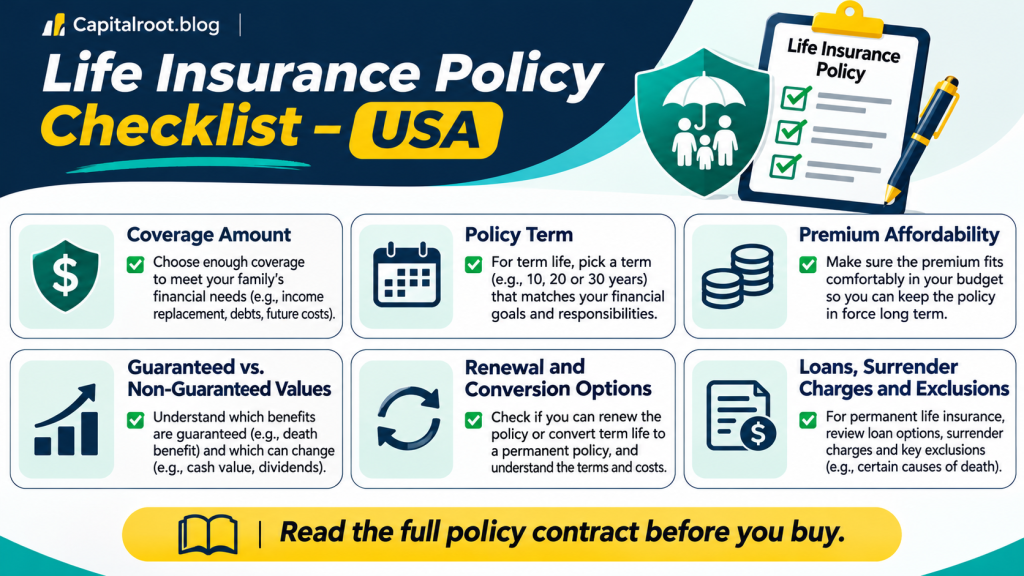
Read the policy documents carefully before signing.
14. How to Choose the Right Life Insurance Policy
Follow these steps to make a more informed decision.
Step 1: Identify Your Financial Responsibilities
Calculate how much your family may need for living expenses, outstanding debts, childcare, education, and other obligations.
Step 2: Decide How Long Coverage Is Needed
If your primary goal is to protect your family until a mortgage is paid or children become independent, a term policy may be suitable to compare.
If you need lifelong coverage, evaluate permanent insurance options.
Step 3: Set a Realistic Premium Budget
Do not buy a policy with premiums that could become difficult to maintain.
Step 4: Compare Multiple Insurers
Review policy features, insurer financial strength, premiums, exclusions, and service quality.
Step 5: Review the Policy Illustration
For whole life insurance, distinguish guaranteed values from non-guaranteed projections.
Step 6: Read the Contract
Understand renewal rights, conversion deadlines, cash value, loans, surrender charges, exclusions, and premium requirements.
Step 7: Review Your Coverage Regularly
Your financial responsibilities can change after marriage, having children, buying a home, or changing jobs. Review your coverage when major life events occur.
15. Frequently Asked Questions (FAQs)
1. Is term life insurance better than whole life insurance?
Neither is universally better. Term life may suit people who need affordable coverage for a specific period. Whole life may suit people who need permanent coverage and understand its cash value features.
2. Why is whole life insurance more expensive?
Whole life insurance is designed to provide lifetime coverage and includes a cash value component. These features generally make it more expensive than comparable term life coverage.
3. Does term life insurance build cash value?
Standard term life insurance generally does not build cash value. Its primary purpose is to provide a death benefit during the selected policy term.
4. Can I get my money back from term life insurance?
A standard term policy generally does not return premiums if you outlive the policy term. Some products may offer a return-of-premium feature, usually at a higher cost and subject to contract conditions.
5. Can I borrow money from whole life insurance?
You may be able to borrow against available cash value. The loan generally accrues interest, and unpaid amounts can reduce the death benefit or affect whether the policy remains active.
6. What happens when a term life insurance policy expires?
Coverage generally ends at the end of the term. Depending on the contract, you may be able to renew the policy, convert it to permanent coverage, or apply for a new policy.
7. Are whole life insurance dividends guaranteed?
No. Dividends on participating whole life policies are generally not guaranteed. They depend on the insurer’s experience and policy terms.
8. Can I switch from term life insurance to whole life insurance?
Some term policies include a conversion option that allows you to convert to an eligible permanent policy during a specified period. Check the contract for deadlines, available products, and conversion rules.
9. Are life insurance death benefits taxable in the USA?
Life insurance proceeds paid to a beneficiary because of the insured person’s death are generally excluded from federal gross income. Exceptions can apply, and interest paid on proceeds may be taxable. Estate and other tax rules can also matter.
10. Should young adults buy term or whole life insurance?
Young adults should first consider whether anyone depends on their income or whether they have financial responsibilities that require coverage. If life insurance is needed, term and permanent policies can be compared based on cost, duration, and financial goals.
Conclusion
Term life insurance and whole life insurance serve different financial needs.
Term life insurance generally offers lower-cost protection for a specific period and may be suitable for families who need income protection during important financial years.
Whole life insurance is designed to provide lifetime coverage and build cash value, but it usually requires higher premiums and a longer-term financial commitment.
Before choosing either policy, evaluate your family’s needs, compare insurer quotes, understand the guarantees, and make sure the premiums fit your budget.
The right policy is the one that provides appropriate protection without creating unnecessary financial pressure.
Disclaimer: This article is for general educational purposes only and does not constitute financial, insurance, legal, or tax advice. Policy availability, premiums, benefits, exclusions, and regulations vary by insurer and state. Review the full policy contract and consult a qualified professional before making an insurance decision.