

Planning for retirement is one of the most important financial decisions you can make. In the United States, Individual Retirement Accounts (IRAs) offer a way to save and invest for the future while receiving certain tax advantages.
Two popular options are the Roth IRA and the Traditional IRA. Both can help you build retirement savings, but they work differently when it comes to taxes, contributions and withdrawals.
So, which one should you choose?
The answer depends on your current income, expected tax rate in retirement, eligibility and financial goals. This guide explains the differences between a Roth IRA and a Traditional IRA, including the 2026 contribution limits, tax benefits, withdrawal rules and practical examples.
What Is an Individual Retirement Account (IRA)?
An Individual Retirement Account, commonly called an IRA, is a tax-advantaged account designed to help individuals save and invest for retirement.
Unlike a workplace retirement plan such as a 401(k), you can generally open an IRA yourself through an eligible bank, brokerage firm or other financial institution.
The two common types are:
- Traditional IRA: Contributions may be tax-deductible, while withdrawals are generally taxable.
- Roth IRA: Contributions are made with after-tax money, while qualified withdrawals are generally tax-free.
An IRA is an account, not an investment itself. Depending on the provider, you may be able to invest the money in mutual funds, exchange-traded funds (ETFs), stocks, bonds and other eligible investments.
What Is a Traditional IRA?
A Traditional IRA is a retirement account that may allow you to deduct eligible contributions from your taxable income.
The main benefit is that you may receive a tax deduction in the year you contribute. Your investments can grow without annual taxation inside the account, and you generally pay income tax when you withdraw the money in retirement.
Key Features of a Traditional IRA
- Contributions may be tax-deductible, depending on your income and workplace retirement-plan coverage.
- Investment growth is generally tax-deferred.
- Withdrawals are generally taxed as ordinary income.
- Required minimum distributions (RMDs) generally begin at age 73.
- Early withdrawals may trigger an additional 10% tax unless an exception applies.
Example of a Traditional IRA
Suppose you earn $70,000 annually and contribute $5,000 to a Traditional IRA.
If the full contribution is deductible, it may reduce your taxable income for the year by $5,000. Your actual tax savings depend on your tax bracket and other tax circumstances.
Later, when you withdraw deductible contributions and investment earnings, those amounts are generally included in your taxable income.
Important: Not everyone qualifies for a full deduction. Income limits and workplace retirement-plan coverage can affect the deduction.
What Is a Roth IRA?
A Roth IRA is a retirement account funded with money on which you have generally already paid income tax.
Unlike a Traditional IRA, Roth IRA contributions are not tax-deductible. However, qualified withdrawals in retirement are generally tax-free, including investment earnings.
Key Features of a Roth IRA
- Contributions are made with after-tax money.
- Contributions are not tax-deductible.
- Qualified withdrawals are generally tax-free.
- You can withdraw your regular contributions at any time without income tax or an early-withdrawal penalty, subject to IRS ordering rules.
- The original account owner does not have to take lifetime RMDs.
Example of a Roth IRA
Suppose you contribute $5,000 to a Roth IRA using money from your after-tax income.
If the account grows to $25,000 over time, a qualified withdrawal of the full amount can generally be tax-free.
This can be useful if you expect your tax rate in retirement to be higher than it is today.
Roth IRA vs Traditional IRA: Key Differences
The biggest difference is when you receive the tax benefit.
With a Traditional IRA, you may receive a tax deduction now and pay taxes when withdrawing the money later.
With a Roth IRA, you pay taxes on the money before contributing, but qualified withdrawals can be tax-free.
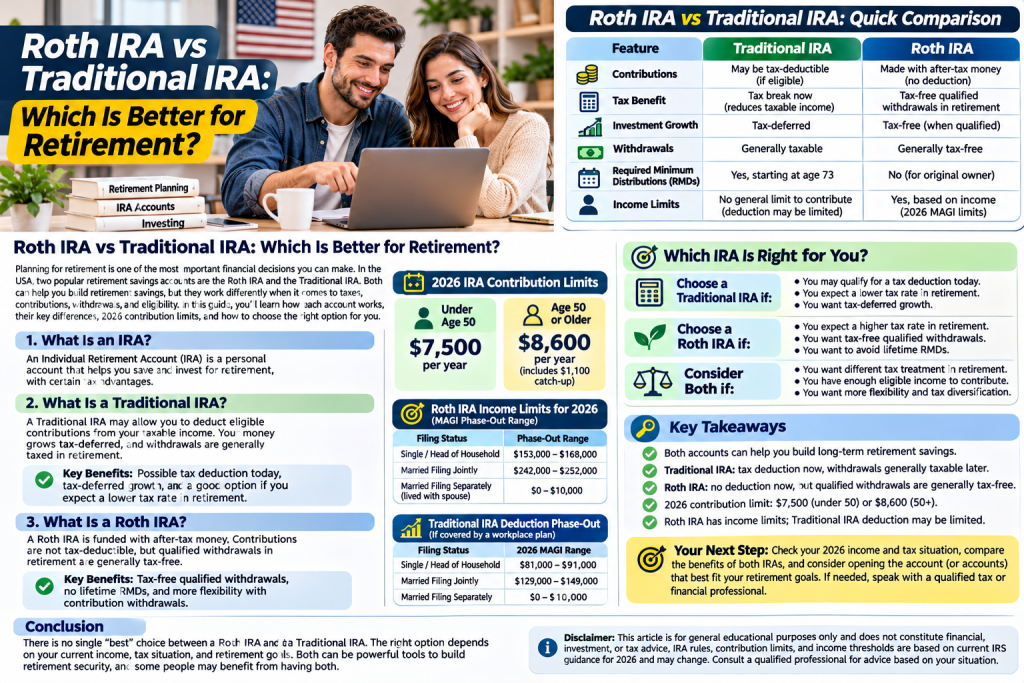
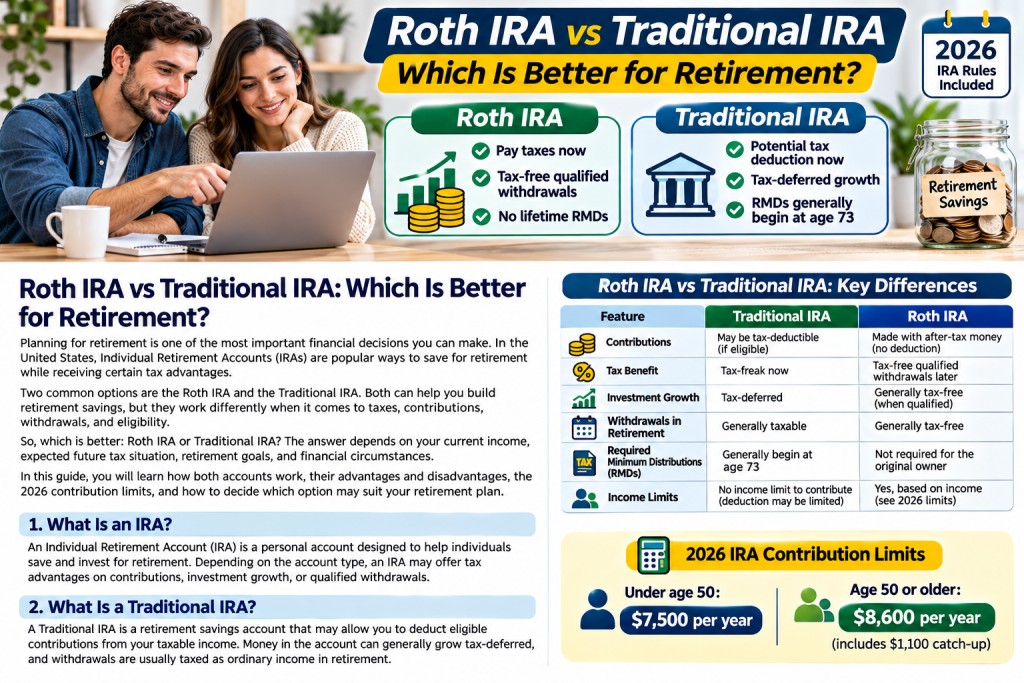
| Feature | Traditional IRA | Roth IRA |
|---|---|---|
| Contributions | Pre-tax or after-tax, depending on deduction eligibility | After-tax |
| Tax deduction | May be deductible | Not deductible |
| Investment growth | Generally tax-deferred | Generally tax-free when qualified |
| Retirement withdrawals | Generally taxable | Qualified withdrawals generally tax-free |
| Income restrictions | No general income limit to contribute, but deductions may be limited | Income limits apply to direct contributions |
| Early withdrawal | Taxes and possible additional tax may apply | Regular contributions can generally be withdrawn tax- and penalty-free |
| Required minimum distributions | Generally begin at age 73 | No lifetime RMDs for original owner |
2026 IRA Contribution Limits
The IRS sets an annual limit on how much you can contribute to Traditional and Roth IRAs.
For the 2026 tax year:
- Under age 50: Up to $7,500
- Age 50 or older: Up to $8,600, including the $1,100 catch-up contribution
This is the combined limit across your Traditional and Roth IRAs, not a separate limit for each account.
Your total contribution also cannot exceed your eligible taxable compensation for the year.
For example, if you are under 50 and contribute $4,000 to a Traditional IRA, you can generally contribute no more than another $3,500 to a Roth IRA for 2026, subject to Roth income eligibility.
Roth IRA Income Limits for 2026
Unlike a Traditional IRA, direct Roth IRA contributions are restricted by income.
For 2026, the modified adjusted gross income (MAGI) phase-out ranges are:
| Tax filing status | 2026 MAGI range |
|---|---|
| Single or Head of Household | $153,000–$168,000 |
| Married Filing Jointly | $242,000–$252,000 |
| Married Filing Separately (and lived with spouse) | $0–$10,000 |
If your income is below the relevant phase-out range, you may qualify for the full contribution. If it falls within the range, your permitted contribution is reduced. At or above the upper limit, you generally cannot make a direct Roth IRA contribution for that year.
Special rules apply to married taxpayers filing separately who did not live with their spouse during the year.
Always calculate your eligibility using the IRS rules for your filing status and tax year.
Traditional IRA Deduction Limits for 2026
Traditional IRA contributions may be deductible, but the deduction can be limited if you or your spouse are covered by a retirement plan at work.
For 2026, if you are covered by a workplace retirement plan, the deduction phase-out ranges are:
- Single or Head of Household: $81,000–$91,000 MAGI.
- Married Filing Jointly: $129,000–$149,000 MAGI.
- Married Filing Separately: $0–$10,000 MAGI, if the relevant workplace-plan coverage rules apply.
If you are not covered by a workplace retirement plan, different rules apply. Your spouse’s workplace-plan coverage can also affect your deduction if you file jointly.
You may still be able to make a non-deductible Traditional IRA contribution even when you cannot claim a deduction, provided you meet the contribution requirements.
Because these rules can be complicated, check IRS Publication 590-A or consult a qualified tax professional before filing.
Roth IRA vs Traditional IRA: Tax Benefits Explained
Understanding the tax treatment is essential when choosing between these accounts.
Traditional IRA Tax Benefits
A deductible Traditional IRA contribution may reduce your taxable income for the year.
For example, if you earn $60,000 and make a fully deductible $5,000 contribution, your taxable income may be reduced by $5,000.
You generally pay income tax when you withdraw deductible contributions and earnings.
Roth IRA Tax Benefits
Roth IRA contributions do not reduce your taxable income today.
However, qualified withdrawals are generally tax-free. This means you can potentially withdraw both your original contributions and investment earnings without federal income tax if you meet the applicable requirements.
Which Tax Benefit Is Better?
A Traditional IRA may be attractive if you expect to be in a lower tax bracket after retirement.
A Roth IRA may be attractive if you expect your tax rate to be higher in the future or prefer tax-free qualified withdrawals.
Nobody can predict future tax rates with certainty, so consider your current situation and long-term plans.
Roth IRA Withdrawal Rules
Roth IRAs offer flexibility, but the IRS has specific rules for withdrawals.
Withdrawing Your Contributions
You can generally withdraw your regular Roth IRA contributions at any time without income tax or the 10% early-withdrawal additional tax.
However, withdrawals of investment earnings are subject to separate rules.
Qualified Roth IRA Withdrawals
A distribution is generally qualified when:
- The Roth IRA five-year holding-period requirement has been met, and
- You meet an applicable qualifying condition, such as reaching age 59½, disability, death or a qualifying first-time home purchase (subject to a $10,000 lifetime limit).
Other detailed rules may apply depending on your circumstances.
Before withdrawing money, check the IRS ordering rules and the tax treatment of your specific distribution.
Traditional IRA Withdrawal Rules
Traditional IRA withdrawals are generally included in your taxable income, except for any portion representing non-deductible contributions that has already been taxed.
If you withdraw money before age 59½, you may owe ordinary income tax plus a 10% additional tax.
Some exceptions are available, including certain qualified education expenses, eligible first-time home purchases (subject to limits), certain medical expenses and other circumstances specified by the IRS.
Do not assume every early withdrawal is penalty-free. Review the IRS rules before taking money out.
Required Minimum Distributions (RMDs)
Required Minimum Distributions are amounts that certain retirement account owners must withdraw each year after reaching a specified age.
- Traditional IRA: You generally must begin taking RMDs at age 73.
- Roth IRA: The original account owner is not required to take lifetime RMDs.
Beneficiaries who inherit either type of IRA may have separate distribution requirements.
The absence of lifetime RMDs is one reason some people prefer Roth IRAs for long-term retirement planning.
Roth IRA vs Traditional IRA: A Practical Example
Imagine two people, Alex and Jordan. Both contribute $5,000 annually to retirement accounts.
- Alex chooses a Traditional IRA and receives a tax deduction for eligible contributions.
- Jordan chooses a Roth IRA and contributes after-tax money.
Assume both accounts earn the same investment returns over time.
Alex may benefit from a tax deduction today, but withdrawals in retirement will generally be taxable.
Jordan does not receive a deduction today, but qualified withdrawals can generally be tax-free.
The better outcome depends on factors such as:
- Their current tax brackets.
- Their expected tax brackets in retirement.
- How long they invest.
- Investment performance and fees.
- Their income and eligibility.
This example is for understanding the tax structure only. It does not predict investment returns or guarantee which account will produce more after-tax money.
Advantages and Disadvantages of a Traditional IRA
Advantages
- Contributions may reduce taxable income.
- Investment growth is generally tax-deferred.
- Can be useful for people who expect a lower tax rate in retirement.
- Available through many financial institutions.
Disadvantages
- Withdrawals are generally taxable.
- Deduction eligibility may be limited by income and workplace-plan coverage.
- RMDs generally begin at age 73.
- Early withdrawals may result in additional taxes.
Advantages and Disadvantages of a Roth IRA
Advantages
- Qualified withdrawals are generally tax-free.
- No lifetime RMDs for the original account owner.
- Regular contributions can generally be withdrawn at any time without tax or penalty.
- May be attractive for people who expect higher tax rates in retirement.
Disadvantages
- Contributions are not tax-deductible.
- Direct contributions are subject to income limits.
- Earnings withdrawals must meet qualification rules to be tax-free.
- Paying tax upfront may not suit every financial situation.
Can You Have Both a Roth IRA and a Traditional IRA?
Yes. You can generally have both types of IRA at the same time if you meet the applicable requirements.
However, the annual contribution limit is shared between the two accounts.
For 2026, your combined regular contributions generally cannot exceed $7,500 if you are under 50 or $8,600 if you are 50 or older, and they cannot exceed your eligible compensation.
For example, you could contribute $3,000 to a Traditional IRA and $4,500 to a Roth IRA if you are under 50 and otherwise eligible.
Having both accounts may provide tax flexibility in retirement, but it is important to track contributions carefully.
How to Choose Between Roth IRA and Traditional IRA
There is no single account that is best for everyone. Consider the following points before deciding.
1. Compare Your Current and Future Tax Brackets
If you expect your tax rate to be lower in retirement, a deductible Traditional IRA may be worth considering.
If you expect your tax rate to be higher in retirement, a Roth IRA may be attractive.
2. Check Your Income Eligibility
Review the Roth IRA income limits before making a direct contribution.
For a Traditional IRA, check whether your contribution will be deductible based on your income and workplace retirement-plan coverage.
3. Consider Your Retirement Timeline
If you have many years before retirement, the potential benefit of qualified tax-free Roth withdrawals may be valuable.
However, investment time alone does not determine the best choice. Your tax situation and financial needs matter too.
4. Think About Withdrawal Flexibility
Roth IRA contributions can generally be withdrawn at any time without tax or penalty, subject to IRS ordering rules.
Traditional IRA withdrawals are generally taxable, and early withdrawals may trigger an additional tax.
5. Review Your Workplace Retirement Plan
If your employer offers a 401(k) match, understand the matching rules before prioritising IRA contributions. Employer matching contributions can be an important part of your overall retirement strategy.
Common IRA Mistakes to Avoid
Avoid these common mistakes when planning retirement savings:
- Exceeding the annual contribution limit: Remember that the limit is shared across Traditional and Roth IRAs.
- Ignoring Roth income limits: Check your modified adjusted gross income and filing status.
- Assuming every Traditional IRA contribution is deductible: Workplace-plan coverage and income can affect the deduction.
- Withdrawing money without checking tax rules: Early distributions may result in taxes and additional penalties.
- Forgetting RMDs: Traditional IRA owners generally need to begin RMDs at age 73.
- Treating an IRA as an investment: You still need to select investments that match your goals and risk tolerance.
- Ignoring fees: Compare account fees, fund expenses and other charges before choosing a provider.
Frequently Asked Questions (FAQs)
1. Is a Roth IRA better than a Traditional IRA?
Neither is automatically better. A Roth IRA may suit people who expect higher tax rates in retirement, while a Traditional IRA may suit those who can benefit from a tax deduction today and expect lower taxes later.
2. What is the IRA contribution limit for 2026?
The combined contribution limit for Traditional and Roth IRAs is $7,500 for people under age 50 and $8,600 for people age 50 or older, subject to eligible compensation and other IRS rules.
3. Can I contribute to both a Roth IRA and a Traditional IRA?
Yes. You can generally contribute to both, but the total amount across both accounts must stay within the annual IRA contribution limit.
4. Can I withdraw money from a Roth IRA anytime?
You can generally withdraw your regular contributions at any time without income tax or the 10% early-withdrawal additional tax. Earnings have separate withdrawal rules.
5. At what age can I withdraw from an IRA without penalty?
The general age threshold for avoiding the 10% early-distribution additional tax is 59½. Exceptions may apply, and ordinary income tax can still be due on Traditional IRA withdrawals.
6. Do Roth IRAs have required minimum distributions?
The original Roth IRA owner does not have to take lifetime RMDs. Beneficiaries may have distribution requirements after inheriting the account.
7. Are Traditional IRA contributions tax-deductible?
They may be fully or partially deductible, depending on your income, filing status and whether you or your spouse is covered by a workplace retirement plan.
8. Can I convert a Traditional IRA into a Roth IRA?
Yes, a Traditional IRA can generally be converted into a Roth IRA. The taxable portion of the conversion is usually included in income for the year of conversion. Consider the tax impact before converting.
9. Can I open an IRA without an employer?
Yes. You can generally open an IRA independently through an eligible financial institution, provided you meet the contribution requirements.
10. Which IRA is better for young investors?
A Roth IRA may be attractive to eligible young investors who expect their income and tax rate to rise over time. However, the right choice depends on individual circumstances, not age alone.
Final Thoughts
Choosing between a Roth IRA and a Traditional IRA is an important part of retirement planning in the United States.
A Traditional IRA may provide a tax deduction today, while a Roth IRA may offer tax-free qualified withdrawals in retirement. Both accounts can help you build long-term savings when used appropriately.
Before opening an account, compare your tax situation, income eligibility, contribution limits, investment choices and withdrawal needs. You may also consider speaking with a qualified tax or financial professional.
Start by understanding the tax benefits of each account and choose the option that fits your long-term retirement goals.
Disclaimer: This article is for educational and informational purposes only. It is not tax, legal or investment advice. IRA rules and limits can change. Verify current information with the IRS or consult a qualified professional before making financial decisions.