
 Unexpected expenses can happen at any time. Your car may break down, your boiler may stop working, you could lose your job or an urgent household repair may suddenly become necessary.
Without savings, these situations can create financial stress and force you to depend on credit cards, overdrafts or personal loans.
This is why building an emergency fund is an important part of managing your money.
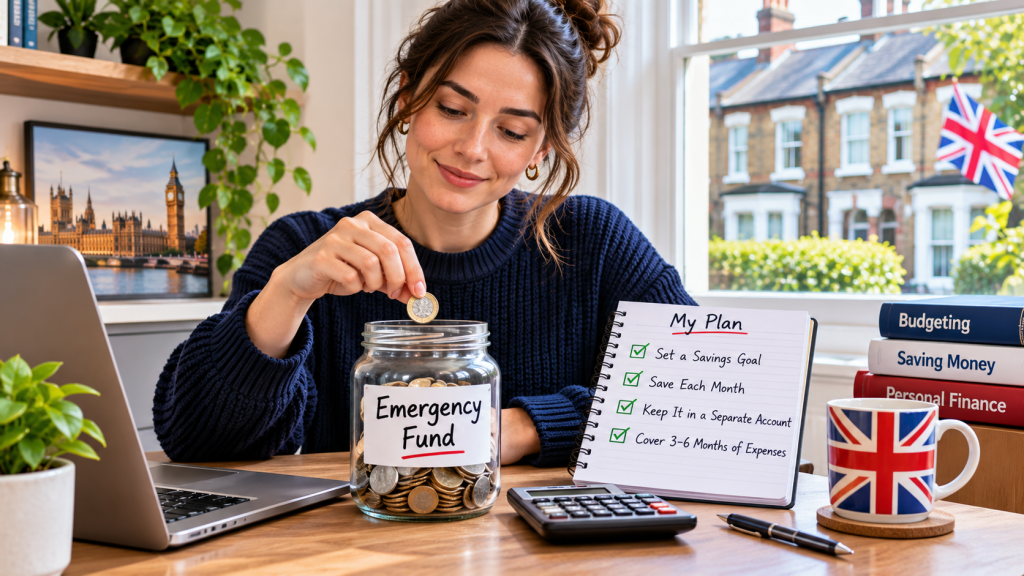
An emergency fund is money you save specifically for unexpected financial situations. It acts as a safety net and can help you manage difficult circumstances without disrupting your everyday budget.
In the UK, many financial experts recommend gradually building savings equal to three to six months of essential living expenses.
But what if you have a low income or find it difficult to save every month?
The good news is that you do not need thousands of pounds to get started. Even small, regular contributions can help you build financial security over time.
In this guide, we explain how to build an emergency fund in the UK, how much you should save, where to keep your money and practical ways to reach your savings goal.
1. What Is an Emergency Fund?
An emergency fund is a separate amount of money reserved for unexpected expenses or financial difficulties.
It is not meant for holidays, shopping, entertainment or regular monthly bills.
Instead, it is designed to help you handle situations that you did not plan for.
Examples include:
- Losing your job or experiencing a sudden reduction in income.
- Emergency car repairs.
- A broken boiler or washing machine.
- Unexpected home repairs.
- Essential travel due to a family emergency.
- Urgent expenses that cannot reasonably be postponed.
- A temporary period without regular income.
For example, imagine your car suddenly needs an £800 repair and you need it to travel to work.
If you already have an emergency fund, you may be able to pay for the repair without using a high-interest credit card or taking out a loan.
This is the main purpose of an emergency fund: giving you financial support when life does not go according to plan.
2. Why Is an Emergency Fund Important in the UK?
The cost of living, rent, mortgage payments, energy bills and everyday expenses can put pressure on household finances.
Even people with regular employment can experience unexpected financial difficulties.
Here are some reasons why having emergency savings is important.
1. Protection Against Job Loss
If you lose your job, it may take time to find another one.
An emergency fund can help cover essential expenses while you look for employment.
2. Help With Unexpected Repairs
Cars, boilers, household appliances and plumbing systems can break down without warning.
Emergency savings can help you pay for essential repairs.
3. Avoid High-Interest Borrowing
Without savings, you may need to use a credit card, overdraft or short-term loan.
Depending on the interest rate and repayment terms, borrowing can make an unexpected expense much more expensive.
4. Reduce Financial Stress
Knowing that you have money available for emergencies can make unexpected situations easier to manage.
5. Protect Your Monthly Budget
You do not have to use money reserved for rent, food, utilities or other planned expenses every time an emergency happens.
6. Greater Financial Independence
An emergency fund can reduce your dependence on family members, friends or borrowing when unexpected expenses arise.
3. How Much Emergency Savings Should You Have in the UK?
One of the most common questions is how much money should be kept in an emergency fund.
A widely used guideline is to save enough to cover three to six months of essential living expenses.
The amount should be based on essential outgoings rather than your full monthly salary.
Essential expenses generally include:
- Rent or mortgage payments.
- Council Tax.
- Electricity and gas.
- Water bills.
- Groceries.
- Essential transport.
- Insurance payments.
- Minimum debt repayments.
- Other necessary household costs.
Example: Emergency Fund Based on Monthly Expenses
Suppose your essential monthly expenses are £1,500.
Your savings targets could look like this:
| Savings Period | Emergency Fund Target |
|---|---|
| 1 month | £1,500 |
| 2 months | £3,000 |
| 3 months | £4,500 |
| 4 months | £6,000 |
| 5 months | £7,500 |
| 6 months | £9,000 |
For this household, a three-month emergency fund would be £4,500, while a six-month fund would be £9,000.
These are illustrative calculations. Your own target will depend on your actual essential expenses.
Should Everyone Save Six Months of Expenses?
Not necessarily.
A three-month fund may be a reasonable initial target for someone with stable employment, predictable income and relatively low financial responsibilities.
A larger fund may be more appropriate if you:
- Are self-employed.
- Have an irregular income.
- Are the main earner in your household.
- Have children or other dependants.
- Work in an industry with uncertain employment.
- Have high essential monthly expenses.
- Would find it difficult to replace your income quickly.
Start with a realistic target and increase it as your financial situation improves.
4. How to Calculate Your Emergency Fund Target
Before saving, calculate how much money you actually need.
Follow these steps.
Step 1: Calculate Your Essential Monthly Expenses
Write down the expenses you must continue paying even if your income suddenly stops.
For example:
| Essential Expense | Monthly Amount |
|---|---|
| Rent | £650 |
| Council Tax | £120 |
| Energy and Water | £150 |
| Groceries | £250 |
| Transport | £100 |
| Insurance and Essential Bills | £80 |
| Minimum Debt Repayments | £100 |
| Total | £1,450 |
Step 2: Choose Your Savings Period
Decide whether you want to save one, three or six months of essential expenses.
For this example:
£1,450 × 3 months = £4,350.
Therefore, the three-month emergency fund target is £4,350.
Step 3: Subtract Existing Emergency Savings
Suppose you already have £850 in a separate emergency savings account.
Your remaining target would be:
£4,350 − £850 = £3,500.
You now need another £3,500 to reach your three-month target.
Step 4: Decide How Much You Can Save Monthly
Choose an amount that fits your budget without making it difficult to pay essential bills.
You can increase your monthly savings when your income improves or expenses decrease.
5. How to Build an Emergency Fund From Zero
Starting from zero can feel difficult, especially if your monthly income is limited.
However, building an emergency fund does not require a large initial deposit.
Follow this practical approach.
Step 1: Start With a Small Target
Do not immediately focus on saving £5,000 or £10,000.
Start with a smaller milestone, such as £100, £200 or £500.
Reaching a small target can help you develop the habit of saving.
Step 2: Open a Separate Savings Account
Keep your emergency money separate from the account you use for everyday spending.
This makes it easier to track your progress and reduces the temptation to spend it.
Step 3: Save a Fixed Amount Every Month
Choose an amount you can comfortably afford.
For example:
- £10 per week.
- £25 per week.
- £50 per month.
- £100 per month.
Consistency is more important than starting with a large amount.
Step 4: Automate Your Savings
Set up a standing order from your current account to your emergency savings account.
You can arrange the transfer shortly after payday.
This helps make saving a regular part of your financial routine.
Step 5: Increase Your Savings Gradually
When you receive a pay rise, bonus or additional income, consider putting some of it into your emergency fund.
You do not need to increase your savings every month. Even occasional increases can help.
Step 6: Review Your Progress
Check your savings balance every month.
If you reach your first target, move on to the next one.
For example:
£200 → £500 → £1,000 → £2,000 → Three months of expenses.
6. How Much Should You Save Every Month?
The right monthly savings amount depends on your income, essential expenses and financial responsibilities.
Here is an illustrative savings table showing how different monthly contributions can grow over time.
| Monthly Savings | After 6 Months | After 12 Months | After 24 Months |
|---|---|---|---|
| £25 | £150 | £300 | £600 |
| £50 | £300 | £600 | £1,200 |
| £100 | £600 | £1,200 | £2,400 |
| £150 | £900 | £1,800 | £3,600 |
| £200 | £1,200 | £2,400 | £4,800 |
| £250 | £1,500 | £3,000 | £6,000 |
These calculations exclude savings interest and assume you make every contribution on time.
The table shows that even a small monthly contribution can become meaningful over a longer period.
If you cannot save £100 every month, start with £10 or £20. The important thing is to choose an amount you can maintain.
7. How to Build an Emergency Fund on a Low Income
Saving money on a low income can be challenging because most of your earnings may already be committed to essential expenses.
However, there are practical ways to start.
1. Track Every Expense
Write down your income and spending.
Identify expenses that can be reduced without affecting essential needs.
2. Review Subscriptions
Check whether you are paying for streaming services, memberships or apps that you rarely use.
Cancel services that do not provide enough value.
3. Plan Your Grocery Shopping
Create a weekly shopping list and plan meals before visiting the supermarket.
Compare prices and avoid buying unnecessary items.
4. Reduce Food Waste
Use ingredients you already have before buying more groceries.
Preparing meals at home can also help control food expenses.
5. Save Small Amounts Regularly
Even £5 or £10 per week can help you begin.
Do not compare your savings with people who earn more than you.
6. Save Unexpected Extra Income
If you receive a refund, cash gift, bonus or money from selling unused items, consider putting part of it into your emergency fund.
7. Look for Better Household Deals
Review your mobile phone, broadband, insurance and energy arrangements where possible.
Compare the full terms and costs before switching providers.
8. Avoid New Unnecessary Debt
Try not to use credit for non-essential purchases while building your financial safety net.
However, do not ignore essential bills or existing debt obligations.
8. Where Should You Keep Your Emergency Fund?
An emergency fund should be safe and accessible.
It is generally not suitable to keep all your emergency money in investments that can fall in value or take time to sell.
Here are some options to consider.
1. Easy-Access Savings Account
An easy-access savings account allows you to withdraw money when you need it, subject to the provider’s terms.
Advantages:
- Convenient access.
- Separate from everyday spending.
- May earn interest.
- Suitable for unexpected expenses.
This is often a practical option for emergency savings.
2. Instant-Access Savings Account
Some accounts allow withdrawals quickly without notice or withdrawal penalties.
Check how quickly transfers are processed and whether any limits apply.
3. Cash ISA
A Cash ISA can provide tax-free interest.
However, check the withdrawal rules, access conditions and whether the account is flexible.
An emergency fund should not be placed in an account that makes it difficult or expensive to access your money.
4. Premium Bonds
Premium Bonds are offered by NS&I and provide the opportunity to win tax-free prizes instead of earning a guaranteed interest rate.
They can be considered by some savers, but returns are not guaranteed and withdrawals are not necessarily immediate.
They may not be suitable as the only place for emergency savings.
Where Should You Avoid Keeping Emergency Money?
Avoid relying entirely on:
- Stocks and Shares ISAs.
- Individual shares.
- Cryptocurrency.
- High-risk investments.
- Fixed-term products with restrictive withdrawal conditions.
These options may expose your emergency money to investment losses or delays when you need it.
9. Is Your Emergency Fund Protected by FSCS?
Safety matters when choosing a savings provider.
The Financial Services Compensation Scheme (FSCS) protects eligible deposits held with authorised UK banks, building societies and credit unions.
From 1 December 2025, the standard deposit protection limit increased to:
£120,000 per eligible person, per authorised firm.
This means that if an eligible authorised deposit-taking institution fails, FSCS may compensate eligible customers up to that limit.
Remember:
- The limit applies per authorised firm, not necessarily per banking brand.
- Several brands may share one banking licence.
- Eligible temporary high balances may receive additional protection under specific rules.
- Not every financial product is covered by deposit protection.
Before opening an account, check the provider’s authorisation and the FSCS protection arrangements.
10. Emergency Fund vs Rainy Day Fund: What Is the Difference?
These two terms are sometimes used interchangeably, but they can represent different savings purposes.
Emergency Fund
An emergency fund is generally intended for major unexpected financial situations.
Examples:
- Losing your job.
- A serious home repair.
- Unexpected loss of income.
- An urgent financial situation.
Rainy Day Fund
A rainy day fund is usually intended for smaller, occasional expenses that are not part of your regular monthly budget.
Examples:
- Replacing a small household appliance.
- Paying for a routine car repair.
- Buying an essential replacement item.
- Covering a modest unexpected bill.
You can keep separate savings pots for both purposes.
This helps prevent smaller expenses from reducing the money reserved for major emergencies.
11. Should You Pay Off Debt or Build an Emergency Fund First?
This depends on the type of debt and your financial circumstances.
If you have expensive debt, such as high-interest credit card balances, payday loans or an unauthorised overdraft, paying it down may save you money over time.
However, having absolutely no emergency savings can also create problems.
A balanced approach may be more practical.
Consider These Priorities
First: Keep Priority Bills Up to Date
Make sure you are dealing with essential commitments such as rent or mortgage payments, Council Tax, energy bills and other priority debts.
Do not ignore arrears.
Second: Build a Small Emergency Buffer
If your essential bills are under control, try to build a small savings buffer for unexpected expenses.
A starter target such as £200 or £500 may be useful.
Third: Deal With Expensive Debt
Focus on reducing high-interest borrowing while maintaining essential payments.
Fourth: Grow Your Emergency Fund
Once expensive debt is under control, work towards three to six months of essential expenses.
The correct order can vary depending on your circumstances.
If you are struggling with debt or missed payments, free guidance from MoneyHelper or a debt advice organisation can help you understand your options.
12. Can People Receiving Benefits Save Money in the UK?
Yes, people receiving benefits may be able to save money, but different benefits have different rules.
For example, some means-tested benefits take savings and capital into account when calculating eligibility or payments.
This means that building a savings fund could affect the amount of support you receive in certain circumstances.
Before building a larger savings balance, check the rules for the benefits you receive.
What Is Help to Save?
Help to Save is a government-backed savings scheme for eligible people on certain benefits.
It offers a 50% government bonus on eligible savings.
Key features include:
- You can save between £1 and £50 per calendar month.
- You can save for up to four years.
- The maximum amount you can pay in over four years is £2,400.
- The maximum government bonus is £1,200.
- You do not need to save every month.
Eligibility rules apply. Check the current GOV.UK guidance to find out whether you qualify.
This scheme can be useful for eligible low-income savers who want to build savings gradually.
13. What Financial Help Is Available if You Have an Emergency?
Sometimes an emergency is too large to manage with your existing savings.
Depending on where you live and your circumstances, there may be additional support.
1. Local Council Support
People on low incomes may be able to get help from their local council with essential costs.
In England, check the current Crisis and Resilience Fund arrangements and local support available through your council.
Scotland, Wales and Northern Ireland have their own support arrangements.
2. Universal Credit Advance
If you receive Universal Credit, you may be eligible for certain advances or other financial support in specific circumstances.
An advance normally has to be repaid through future Universal Credit payments.
Check the repayment terms before accepting one.
3. Budgeting Loan
Some people receiving qualifying benefits may be able to apply for a Budgeting Loan.
It can help with certain essential one-off costs.
Eligibility and repayment rules apply.
4. Free Money Guidance
MoneyHelper provides free and impartial guidance on budgeting, savings and debt.
If you are struggling to pay bills, it may be useful to seek advice before taking out additional borrowing.
14. Common Emergency Fund Mistakes to Avoid
Building savings is useful, but certain mistakes can make the process harder.
1. Setting an Unrealistic Target
Trying to save £10,000 immediately can feel overwhelming.
Start with a smaller goal and increase it gradually.
2. Using Emergency Savings for Shopping
Avoid using your emergency fund for holidays, entertainment or unnecessary purchases.
Keep separate savings for planned spending.
3. Not Saving Regularly
Saving only when you have money left over can make it difficult to build a habit.
Set a realistic automatic transfer whenever possible.
4. Keeping All Your Money in a Restricted Account
Your emergency savings should be accessible when you need them.
Check withdrawal conditions carefully.
5. Ignoring High-Interest Debt
Expensive debt can reduce your financial stability.
Consider a balanced approach to debt repayment and emergency saving.
6. Forgetting to Rebuild Your Fund
If you use your emergency savings, start rebuilding the fund when your financial situation allows.
7. Not Reviewing Your Target
Your essential expenses may increase after moving home, having children or taking on a mortgage.
Review your emergency fund target when your circumstances change.
15. A Simple 12-Month Emergency Fund Savings Plan
If you are starting from zero, a 12-month savings plan can help you stay organised.
Here is an illustrative example using a monthly contribution of £100.
| Month | Monthly Saving | Total Savings |
|---|---|---|
| 1 | £100 | £100 |
| 2 | £100 | £200 |
| 3 | £100 | £300 |
| 4 | £100 | £400 |
| 5 | £100 | £500 |
| 6 | £100 | £600 |
| 7 | £100 | £700 |
| 8 | £100 | £800 |
| 9 | £100 | £900 |
| 10 | £100 | £1,000 |
| 11 | £100 | £1,100 |
| 12 | £100 | £1,200 |
After one year, you would have saved £1,200 before interest.
If £100 per month is too much, you can use a smaller amount.
For example, saving £25 per month would give you £300 after one year, before interest.
The best plan is one you can maintain without missing essential payments.
16. Practical Tips to Maintain Your Emergency Fund
Once you start saving, the next challenge is maintaining your progress.
Here are some useful habits.
- Keep emergency savings in a separate account.
- Set a monthly savings reminder or standing order.
- Review your expenses every month.
- Avoid withdrawing money for non-emergency purchases.
- Compare savings account rates regularly.
- Use bonuses and unexpected extra income to increase savings.
- Rebuild your fund after using it.
- Increase your target when your essential expenses rise.
- Check the protection offered by your savings provider.
- Keep a record of your savings progress.
Remember, your emergency fund is not a competition. It is a financial safety net designed around your needs.
17. Frequently Asked Questions (FAQs)
1. How much emergency savings should I have in the UK?
A common guideline is to save three to six months of essential living expenses. The right amount depends on your income stability, household responsibilities and financial commitments.
2. Can I start an emergency fund with £10?
Yes. You can start with £10 or any amount you can comfortably afford. Regular contributions can help you develop a savings habit.
3. Where is the best place to keep an emergency fund in the UK?
An easy-access savings account with an eligible FSCS-protected provider is a practical option for many people. Check withdrawal rules, interest rates and provider protection.
4. Should I invest my emergency fund?
Generally, emergency money should not be exposed to investments that can fall in value or take time to sell. It is usually better to keep it in accessible cash savings.
5. Is £1,000 enough for an emergency fund?
£1,000 can be a useful starting buffer, but it may not cover three months of essential expenses for many households. Calculate your own target using your monthly outgoings.
6. Should I save money while paying off credit card debt?
It depends on the interest rate, your essential expenses and whether you have missed payments. You may need a small emergency buffer while prioritising expensive debt.
7. Can I use my emergency fund for car repairs?
Yes, if the repair is unexpected and necessary. If you use the fund, try to rebuild it when your budget allows.
8. Is an emergency fund the same as a rainy day fund?
Not always. A rainy day fund often covers smaller unexpected costs, while an emergency fund is intended for larger financial difficulties such as job loss or major repairs.
9. Can I keep my emergency savings in a Cash ISA?
Yes, if the Cash ISA offers suitable access and its withdrawal rules meet your needs. An easy-access Cash ISA may be appropriate, but check whether it is flexible and whether withdrawals have restrictions.
10. Does FSCS protect emergency savings?
Eligible deposits with authorised UK banks, building societies and credit unions are generally protected up to £120,000 per eligible person, per authorised firm under the current FSCS deposit protection limit.
11. Can I build an emergency fund on Universal Credit?
You may be able to save while receiving Universal Credit, but capital rules can affect eligibility and payments. Check the current benefit rules before building a larger savings balance.
12. How long does it take to build an emergency fund?
It depends on your savings target and monthly contribution. For example, saving £100 each month gives you £1,200 after 12 months, before interest.
Conclusion
Building an emergency fund is one of the most useful steps you can take towards financial stability.
Unexpected expenses, job loss, household repairs and changes in income can happen to anyone. Having money set aside can help you deal with these situations without immediately relying on borrowing.
You do not need to save a large amount at once.
Start with a small target, open a separate savings account, set up regular contributions and gradually work towards three to six months of essential expenses.
If you have expensive debts or are struggling to pay essential bills, consider getting free financial guidance and creating a realistic plan.
The most important thing is to start saving consistently and protect your progress.
A well-managed emergency fund can give you greater financial confidence and help you prepare for life’s unexpected challenges.
Disclaimer
This article is for general educational and informational purposes only. It does not constitute personal financial, investment, debt or tax advice.
Savings products, interest rates, government support schemes, benefit eligibility and FSCS protection rules may change. Always check the latest official guidance and the terms of your chosen savings provider before making financial decisions.
If you receive means-tested benefits or have significant debt, consider seeking free guidance from MoneyHelper or a qualified adviser before changing your savings arrangements.