

Managing a monthly salary wisely is one of the most important steps towards achieving financial stability. Whether you earn ₹15,000, ₹30,000, ₹50,000 or more, knowing how to use your income properly can help you pay your bills, save money, avoid unnecessary debt and prepare for future financial goals.
Many people work hard throughout the month but struggle to save anything after paying rent, groceries, electricity bills, transportation costs and other expenses. The problem is not always a low salary. Sometimes, a lack of budgeting and proper financial planning makes it difficult to manage money.
The good news is that you do not need a high income to develop good financial habits. With a realistic monthly budget, controlled spending and consistent savings, you can improve your financial situation over time.
In this guide, we will explain how to manage your monthly salary wisely in India, divide your income, control expenses and build a strong financial foundation.
1. Understand Your Monthly Income
The first step towards managing your salary is understanding how much money you actually receive every month.
Your gross salary and take-home salary may be different because of deductions such as:
- Provident Fund (PF), where applicable.
- Professional tax, where applicable.
- Income tax and TDS.
- Other employer-related deductions.
For budgeting purposes, focus on your actual take-home salary — the amount credited to your bank account.
For example, if your monthly gross salary is ₹35,000 but you receive ₹31,500 after deductions, prepare your monthly budget using ₹31,500.
Also consider any additional income, such as freelance work, incentives or rental income. However, do not depend on uncertain income to pay essential monthly bills.
2. Follow the 50/30/20 Budget Rule
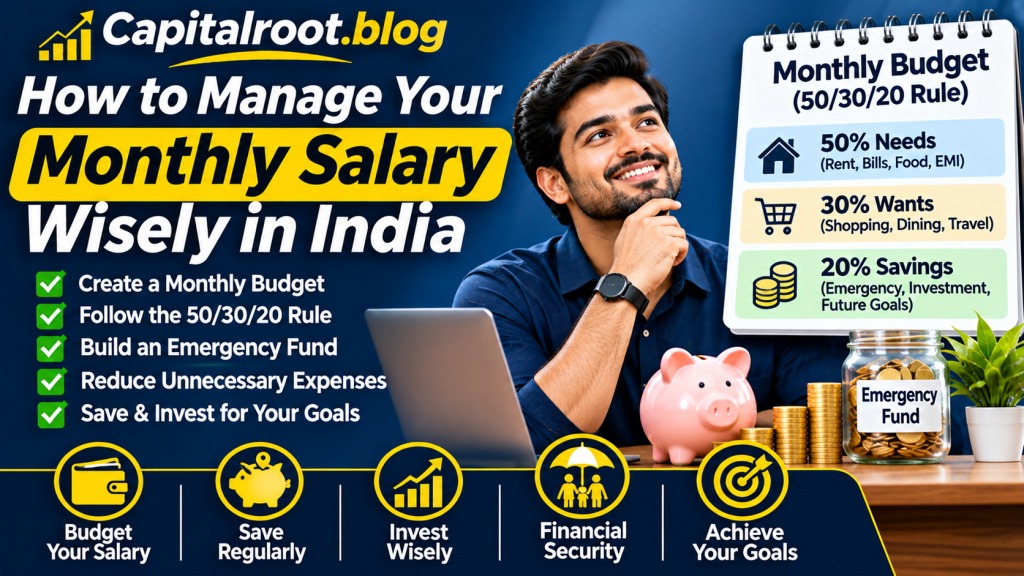
One simple way to organise your monthly salary is the 50/30/20 budgeting rule.
It divides your take-home income into three broad categories:
50% for Needs
Spend approximately 50% of your income on essential expenses, such as:
- House rent or home expenses.
- Groceries and food.
- Electricity and water bills.
- Transportation.
- School or education expenses.
- Essential medicines.
- Necessary loan EMIs.
30% for Wants
Use around 30% for non-essential spending, such as:
- Shopping.
- Restaurants and entertainment.
- Online subscriptions.
- Vacations.
- Personal hobbies.
- Eating outside.
20% for Savings and Financial Goals
Try to allocate approximately 20% towards:
- Emergency fund.
- Savings.
- Retirement planning.
- Suitable investments.
- Additional loan repayment, where appropriate.
These percentages are guidelines, not strict rules. If you have a low salary, high rent or family responsibilities, you may need to adjust them.
3. Create a Monthly Salary Budget
A monthly budget helps you understand where your money goes and prevents unnecessary spending.
Consider this example for someone earning ₹30,000 per month.
| Budget Category | Monthly Amount |
|---|---|
| Rent and household expenses | ₹8,000 |
| Groceries and food | ₹4,000 |
| Transportation | ₹2,000 |
| Electricity, phone and internet | ₹1,500 |
| Other essential expenses | ₹1,500 |
| Shopping and entertainment | ₹3,000 |
| Emergency fund and savings | ₹4,000 |
| Investments and future goals | ₹3,000 |
| Other or flexible expenses | ₹3,000 |
| Total | ₹30,000 |
This is only an illustrative budget. Your actual spending should depend on your income, location, family responsibilities and financial priorities.
The most important thing is to give every rupee a purpose.
4. Pay Yourself First
One common financial mistake is saving whatever money remains at the end of the month.
Unfortunately, many people spend most of their salary before they get a chance to save anything.
A better approach is to pay yourself first.
As soon as your salary arrives:
- Transfer a fixed amount into your savings account.
- Set aside money for your emergency fund.
- Allocate money for essential bills and EMIs.
- Use the remaining amount for other expenses.
Even if you can save only ₹500 or ₹1,000 initially, consistency matters more than the starting amount.
You can gradually increase your savings whenever your income improves.
5. Build an Emergency Fund
An emergency fund is money kept aside for unexpected financial situations.
Examples include:
- Medical emergencies.
- Sudden job loss.
- Urgent home repairs.
- Unexpected travel.
- Essential vehicle repairs.
Without emergency savings, people may have to borrow money or use credit cards during difficult situations.
A common long-term target is to build an emergency fund covering approximately 3–6 months of essential expenses. People with irregular income or more dependants may need a larger reserve.
For example, if your essential monthly expenses are ₹15,000, a three-month emergency fund would be ₹45,000.
Start with a smaller target if necessary. Build it gradually and keep it in an accessible, relatively low-risk place rather than investing all of it in volatile assets.
6. Control Unnecessary Expenses
Small expenses can become surprisingly large when repeated every day.
For example:
- Ordering food frequently.
- Buying items you do not need.
- Paying for unused subscriptions.
- Making impulse purchases.
- Spending excessively on online shopping.
- Taking expensive entertainment subscriptions.
Here are some practical ways to control spending:
Make a shopping list: Buy necessary items instead of purchasing everything that catches your attention.
Compare prices: Check prices before making significant purchases.
Use a waiting rule: Wait 24 hours before making a non-essential purchase. For expensive items, consider waiting longer.
Review subscriptions: Cancel services that you rarely use.
Set a spending limit: Decide how much you can spend on entertainment and shopping each month.
You do not need to stop enjoying life. The goal is to spend intentionally instead of spending without a plan.
7. Avoid Unnecessary Loans and Credit Card Debt
Loans and credit cards can be useful financial tools when managed responsibly. However, borrowing without understanding the repayment obligation can create long-term financial problems.
Before taking a loan:
- Understand the interest rate.
- Check processing fees and other charges.
- Calculate the EMI.
- Review the repayment period.
- Check the total repayment amount.
- Borrow only what you genuinely need.
For credit cards, try to pay the full statement balance by the due date whenever possible. Paying only the minimum amount can allow interest to accumulate on the unpaid balance.
Avoid taking a new loan simply to pay for unnecessary shopping or lifestyle expenses.
8. Save Money Automatically
Automatic savings make financial planning easier because you do not have to remember to transfer money every month.
You can:
- Set up a recurring transfer to a savings account.
- Use a recurring deposit (RD) if its terms suit your needs.
- Automate contributions towards suitable long-term investments.
- Schedule transfers shortly after your salary arrives.
Before choosing a financial product, understand its risk, liquidity, charges, lock-in period and tax treatment.
Do not invest emergency money in products that may be difficult to access when you need it.
9. Set Clear Financial Goals
Saving money becomes easier when you know why you are saving.
Divide your goals into three categories:
Short-Term Goals
These are goals you may want to achieve within the next 1–2 years.
Examples:
- Buying a smartphone.
- Planning a vacation.
- Purchasing a laptop.
- Building an initial emergency fund.
Medium-Term Goals
These may take approximately 3–5 years.
Examples:
- Saving for a vehicle.
- Planning a home renovation.
- Building funds for higher education.
- Preparing for a major family expense.
Long-Term Goals
These generally require a longer investment horizon.
Examples:
- Retirement planning.
- Buying a house.
- Children’s education.
- Long-term wealth creation.
Choose savings or investment options based on the time available, risk tolerance and purpose of each goal.
10. Choose Suitable Savings and Investment Options
Once you have organised your monthly expenses and built an emergency fund, you can explore suitable financial products.
Some options available in India include:
Savings Account
A savings account can be useful for regular transactions and keeping accessible money. Compare interest rates, minimum balance rules and bank charges.
Fixed Deposit (FD)
A fixed deposit allows you to deposit a lump sum for a specified period at an agreed interest rate. Check premature withdrawal conditions and applicable tax rules.
Recurring Deposit (RD)
An RD allows you to deposit a fixed amount regularly for a selected tenure. It may suit people who prefer disciplined monthly saving.
Mutual Funds
Mutual funds pool money from multiple investors and invest according to a scheme’s objectives. Different funds carry different levels of risk. Understand the scheme documents and risk level before investing.
Public Provident Fund (PPF)
PPF is a government-backed long-term savings scheme with specific contribution, withdrawal and maturity rules. Check the current rules before investing.
Remember that investment returns are not guaranteed in market-linked products. Do not choose an investment simply because someone promises high returns.
11. Review Your Salary and Expenses Every Month
Creating a budget once is not enough. Your income and expenses may change over time.
At the end of every month, review:
- Total salary received.
- Total essential expenses.
- Shopping and entertainment expenses.
- Amount saved.
- Outstanding loan EMIs.
- Progress towards financial goals.
If you spent more than planned in one category, identify the reason and make adjustments for the next month.
A simple spreadsheet or budgeting app can make this process easier.
12. Increase Your Savings When Your Salary Increases
When you receive a salary increment, avoid increasing your lifestyle expenses immediately.
For example, if your salary increases by ₹5,000, you could direct part of the additional income towards:
- Emergency savings.
- Retirement planning.
- Existing debt repayment.
- Long-term financial goals.
This approach helps prevent lifestyle inflation, where expenses rise every time income increases.
Common Salary Management Mistakes to Avoid
Avoid these common mistakes:
- Spending the entire salary before saving.
- Not tracking monthly expenses.
- Ignoring emergency savings.
- Using credit cards without a repayment plan.
- Taking unnecessary personal loans.
- Investing without understanding the risks.
- Ignoring insurance needs.
- Not reviewing financial goals.
- Increasing spending immediately after a salary increment.
- Depending on uncertain income for essential expenses.
Avoiding these mistakes can help you build better financial habits over time.
Frequently Asked Questions (FAQs)
1. How should I manage my monthly salary in India?
Start by calculating your take-home salary, listing essential expenses, setting a monthly budget and saving a fixed amount regularly. Review your spending every month.
2. What is the 50/30/20 salary rule?
It is a budgeting guideline that allocates approximately 50% of income to needs, 30% to wants and 20% to savings and financial goals. You can adjust these percentages according to your circumstances.
3. How much of my salary should I save every month?
There is no fixed amount suitable for everyone. Saving around 20% can be a useful target if affordable, but even a smaller consistent amount is a good starting point.
4. How can I manage a ₹15,000 monthly salary?
Prioritise essential expenses, avoid unnecessary borrowing, track every expense and start with small savings. Adjust the budget according to rent, family responsibilities and location.
5. How much emergency fund should I maintain?
A common target is 3–6 months of essential living expenses. Build it gradually according to your income stability and responsibilities.
6. Should I save money before paying expenses?
Set aside a realistic savings amount after accounting for essential bills and required loan payments. Automating savings immediately after salary credit can help you stay consistent.
7. Where should I keep my monthly savings?
Keep short-term and emergency savings in accessible, suitable low-risk options. For longer-term goals, compare financial products according to your risk tolerance and investment horizon.
8. Is the 50/30/20 rule suitable for low-income earners?
Not always. People with lower incomes or high essential expenses may need to allocate more than 50% to needs. A realistic budget is better than following fixed percentages.
9. How can I stop overspending?
Track purchases, set spending limits, avoid impulse buying, review subscriptions and plan shopping in advance.
10. What is the best way to become financially disciplined?
Build simple habits: save regularly, spend according to a budget, avoid unnecessary debt and review your financial progress every month.
Conclusion
Managing your monthly salary wisely does not require a high income or complicated financial strategies. It starts with understanding your take-home salary, controlling expenses, saving consistently and setting realistic financial goals.
Whether you earn ₹15,000 or ₹50,000 per month, a proper budget can help you make better financial decisions and reduce unnecessary money-related stress.
Start with small changes, remain consistent and gradually improve your financial habits. Over time, these simple steps can help you build emergency savings, manage debt and work towards long-term financial security.
Remember: Financial discipline is not about earning more money alone. It is also about managing the money you already earn.