
Introduction
Running a business means dealing with customers, visitors, suppliers and members of the public. Even when a business follows safety procedures, accidents can happen. A customer may slip on a wet floor, a visitor may be injured by falling equipment, or business activities may accidentally damage someone else’s property.
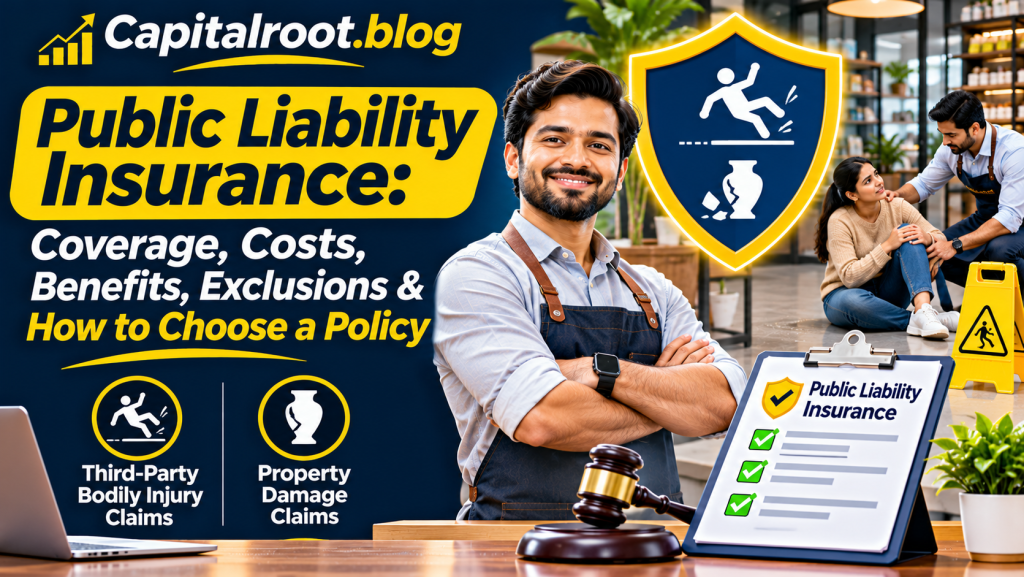
These incidents can lead to compensation demands, legal expenses and unexpected financial pressure. Public liability insurance is designed to protect a business against certain third-party injury and property damage claims arising from its business activities.
This guide explains how public liability insurance works, what it may cover, who should consider it, which exclusions to check and how businesses in India, the USA and the UK can approach this type of protection.
Important: Insurance coverage depends on the wording, limits, exclusions and conditions of the actual policy. The term and structure of liability insurance also differ between countries.
1. What Is Public Liability Insurance?
Public liability insurance is a type of business liability protection that may cover a company or business owner if a member of the public makes a claim for accidental bodily injury or property damage connected with the business’s activities.
For example, imagine a customer visits a retail store and slips on an unmarked wet floor. If the customer alleges that the business failed to take reasonable safety precautions and seeks compensation, a suitable liability policy may help cover eligible legal defence costs and compensation, subject to its terms.
The policy is generally intended for claims made by third parties, such as customers, visitors, clients or members of the public. It is not a substitute for every other type of business insurance.
2. How Does Public Liability Insurance Work?
The basic process usually involves these steps:
- An incident occurs: A customer, visitor or another third party suffers an injury or property damage connected with the business.
- A claim is made: The affected person alleges that the business is legally responsible.
- The insurer is notified: The business informs its insurer within the policy’s required timeframe.
- The claim is assessed: The insurer reviews the incident, policy wording, evidence and legal liability.
- The claim is handled: If covered, the insurer may arrange or fund legal defence and pay eligible compensation, within policy limits and subject to conditions.
A policy does not automatically pay every demand. The business may need to establish that the claim falls within the policy’s coverage.
3. What Does Public Liability Insurance Cover?
Depending on the policy, public liability insurance may include:
A. Third-Party Bodily Injury
This may cover eligible claims when a customer, visitor or member of the public suffers physical injury connected with the insured business’s operations.
Examples include:
- A customer slipping on a wet shop floor.
- A visitor being injured by an unsecured display.
- A guest getting hurt at a business-organised event.
B. Third-Party Property Damage
A policy may cover eligible claims involving accidental damage to property belonging to another person.
Examples include:
- A contractor accidentally damaging a client’s furniture.
- Business equipment damaging a visitor’s property.
- An employee accidentally breaking a customer’s property while carrying out an insured activity.
C. Legal Defence Costs
Some policies cover reasonable legal expenses incurred in defending an insured claim, subject to policy wording and insurer consent requirements.
D. Compensation Payments
If the business is legally liable for a covered incident, the policy may pay eligible compensation to the affected third party, up to the applicable limit.
E. Incidents at Business Premises or External Locations
Depending on the policy, protection may apply to incidents:
- At a shop, office or other business premises.
- At a customer’s premises.
- At an exhibition or trade show.
- At an event organised by the business.
- During other declared business activities.
Always confirm which locations and activities are included.
4. What Is Usually Not Covered?
Public liability insurance is not unlimited protection. Common exclusions or areas requiring separate cover may include:
- Employee injuries: These are generally dealt with through employers’ liability or workers’ compensation insurance, depending on the country.
- Professional mistakes: Negligent advice, design errors or professional service failures generally require professional indemnity or professional liability insurance.
- Motor vehicle accidents: Business vehicle liability normally requires appropriate motor or commercial auto insurance.
- Intentional or deliberate damage: Deliberate acts are generally excluded.
- Damage to the business’s own property: This usually requires property or commercial property insurance.
- Product-related claims: Product liability may be included in some commercial general liability policies, but businesses should verify this rather than assume it.
- Contractual liability: Liability accepted only under a contract may be restricted or excluded, subject to policy terms.
- Known incidents or circumstances: Claims arising from circumstances known before the policy began may not be covered.
Exclusions vary significantly. Read the policy schedule, wording and endorsements before purchasing.
5. Who Needs Public Liability Insurance?
Businesses that interact with customers, visitors or the public should consider whether they need this protection.
Examples include:
Retail Shops and Supermarkets
Customers visit the premises regularly, creating potential risks involving slips, falls, displays and other accidents.
Restaurants, Cafes and Hotels
Food-service and hospitality businesses interact with customers throughout the day and may face premises-related injury claims.
Contractors and Tradespeople
Electricians, plumbers, decorators and maintenance contractors may accidentally damage a client’s property while working.
Event Organisers
Public gatherings, exhibitions, conferences and other events can create risks involving visitors, equipment and temporary structures.
Salons and Fitness Centres
Customers may be exposed to risks involving premises, equipment and day-to-day operations.
Small Businesses and Freelancers
A business operating from home or visiting client locations should check whether its existing insurance covers business-related third-party claims.
6. Benefits of Public Liability Insurance
Financial Protection
A covered claim can involve substantial compensation and legal expenses. Insurance may reduce the financial burden on the business.
Support With Legal Defence
Where included, legal defence cover can help the business respond to eligible claims.
Greater Business Confidence
Business owners can plan operations with a clearer understanding of how certain third-party risks are insured.
Support for Contracts and Events
Some landlords, clients, venues or event organisers may ask businesses to provide evidence of liability insurance before allowing work or participation.
Protection of Business Continuity
A serious uninsured claim may disrupt cash flow. Suitable insurance can help manage the financial impact of covered incidents.
7. How Much Does Public Liability Insurance Cost?
There is no single premium that applies to every business. The cost depends on the insurer, location, business activity, coverage limit and risk profile.
Factors that may affect the premium include:
- Type of business and industry.
- Annual turnover or revenue.
- Number of employees.
- Number of customers or visitors.
- Business premises and operating locations.
- Nature of work performed away from the premises.
- Previous claims history.
- Chosen liability limit.
- Policy excess or deductible.
- Additional coverages and endorsements.
A small office-based business may have a different risk profile from a construction contractor or an event organiser. Obtain quotes based on accurate business information rather than relying on a general online estimate.
8. How to Choose the Right Public Liability Insurance Policy
Compare policies carefully instead of selecting one based only on its premium.
Step 1: Identify Your Business Risks
List the activities your business performs, the people who visit your premises and the locations where work takes place.
Step 2: Check the Coverage Limit
Choose a limit that reflects the potential severity of claims, contractual requirements and your business’s risk exposure.
Step 3: Review Exclusions
Check exclusions for contractors, subcontractors, products, rented premises, events and work performed outside your normal location.
Step 4: Understand Legal Defence Costs
Find out whether defence costs are included within the liability limit or paid separately, and whether the insurer must approve legal expenses.
Step 5: Check the Excess or Deductible
This is the amount the business may need to contribute towards an eligible claim.
Step 6: Compare Insurers and Policy Wording
Review the insurer’s authorisation, claim process, financial strength information where available, service and policy conditions.
Step 7: Disclose Information Accurately
Describe your business activities honestly. Incorrect or incomplete information can create problems when a claim is made.
9. Public Liability Insurance vs Other Business Insurance
| Insurance type | Main purpose |
|---|---|
| Public liability | Third-party injury or property damage claims connected with business activities |
| Professional indemnity | Claims involving professional negligence, errors or omissions |
| Employers’ liability | Certain employee injury or illness claims |
| Workers’ compensation | Statutory employee injury or occupational illness benefits, where applicable |
| Product liability | Claims involving injury or damage caused by products |
| Commercial property | Damage to the business’s own insured property |
Some policies combine several liability protections. Check the actual wording to understand what is included.
10. Public Liability Insurance in India
In India, businesses should distinguish between general commercial public liability cover and the specific statutory framework under the Public Liability Insurance Act, 1991.
The Act is designed to provide immediate relief to people affected by accidents occurring while handling hazardous substances. It applies to owners of undertakings covered by the Act and its requirements; it should not be treated as a universal rule requiring every shop, freelancer or small business to purchase the same policy.
Businesses may also explore commercial public liability products offered by insurers. These policies can provide cover for eligible third-party bodily injury and property damage claims, depending on their wording.
Before buying, Indian businesses should:
- Identify whether their operations involve hazardous substances covered by the Act.
- Check applicable statutory requirements.
- Review the policy’s geographical scope and coverage limits.
- Confirm whether legal expenses and off-site operations are included.
- Check the insurer’s current authorisation and product details.
Official reference: India Code and the Ministry of Environment, Forest and Climate Change.
11. Public Liability Insurance in the USA
In the United States, similar protection is commonly provided through Commercial General Liability (CGL) insurance rather than a product always labelled public liability insurance.
A CGL policy may cover certain claims involving bodily injury, property damage, personal and advertising injury, subject to the policy terms. Product and completed-operations coverage may also be relevant for businesses that manufacture, sell or install products.
US businesses should check:
- State-specific legal and contractual requirements.
- Whether premises and operations are covered.
- Product and completed-operations coverage.
- Limits per occurrence and aggregate limits.
- Deductibles and exclusions.
- Whether a Business Owners Policy (BOP) includes suitable general liability protection.
The National Association of Insurance Commissioners (NAIC) provides consumer guidance on small-business insurance and general liability.
12. Public Liability Insurance in the UK
In the United Kingdom, public liability insurance can cover eligible claims from members of the public for injury or property damage connected with business activities.
It is generally not a universal legal requirement for every business, although a client, landlord, venue or contract may require it. Certain specific activities may have separate requirements.
Public liability insurance should not be confused with employers’ liability insurance. Employers’ liability insurance is generally compulsory for businesses with employees in Great Britain, subject to legal exceptions.
UK businesses should:
- Check whether clients or venues require a minimum cover limit.
- Review cover for off-site work and events.
- Confirm whether subcontractors are included.
- Consider separate employers’ liability insurance where legally required.
The Association of British Insurers (ABI) and GOV.UK provide useful guidance.
13. What Should You Do After a Public Liability Incident?
If an incident occurs, take these steps:
- Make sure the injured person receives appropriate assistance.
- Take reasonable steps to prevent further injury or damage.
- Record the date, time, location and circumstances.
- Preserve photographs, CCTV footage and relevant documents.
- Collect witness details where appropriate.
- Notify your insurer promptly and follow its instructions.
- Do not admit legal liability or agree to compensation without consulting your insurer.
- Cooperate with the insurer’s investigation and provide requested information.
Follow the notification deadlines and claim conditions in your policy.
14. Common Mistakes to Avoid
- Buying a policy without understanding its exclusions.
- Choosing a low coverage limit only to reduce the premium.
- Assuming employee injuries are covered under public liability insurance.
- Failing to disclose all business activities.
- Assuming every product includes off-site work.
- Ignoring contractual insurance requirements.
- Delaying notification after an incident.
- Assuming professional negligence is covered by a public liability policy.
Frequently Asked Questions (FAQs)
1. What is public liability insurance in simple words?
It is business insurance that may protect a business against eligible claims for injury to members of the public or damage to their property arising from business activities.
2. Is public liability insurance compulsory?
It depends on the country, industry and activity. In the UK it is generally not compulsory for every business. In India, the Public Liability Insurance Act, 1991 applies to specified undertakings handling hazardous substances; it is not a universal requirement for all businesses. In the USA, requirements may depend on state law, contracts and business activities.
3. Does public liability insurance cover customers?
It may cover eligible claims made by customers or other third parties for bodily injury or property damage connected with the insured business.
4. Does it cover employee injuries?
Usually not. Employee injury protection is generally addressed through employers’ liability or workers’ compensation arrangements, depending on the jurisdiction.
5. Does public liability insurance cover professional mistakes?
Generally, no. Professional negligence, incorrect advice and errors in professional services usually require professional indemnity or professional liability insurance.
6. Does it cover accidents outside business premises?
Some policies cover off-site work, events and other declared business activities. Check the policy wording and schedule.
7. How much public liability insurance should a small business buy?
There is no universal amount. Consider the type of business, potential severity of an incident, client or venue requirements and available policy limits. A qualified broker or insurer can help assess suitable limits.
8. Does public liability insurance cover legal costs?
Many policies include legal defence costs for covered claims, but the treatment of those costs and any insurer-consent requirements vary.
9. Can a home-based business buy public liability insurance?
Yes, suitable business liability policies may be available. The owner should disclose business activities and confirm whether customer visits and off-site work are covered.
10. What is the difference between public liability and general liability insurance?
Public liability commonly refers to third-party injury and property damage protection. In the USA, commercial general liability is a broader standard policy form that may also include personal and advertising injury and other defined coverages.
Conclusion
Public liability insurance can be an important part of risk management for businesses that interact with customers, visitors and members of the public. A covered accident can lead to legal costs and compensation claims, and the financial impact may be difficult for a small business to absorb.
Before choosing a policy, understand your business risks, compare coverage limits, review exclusions and check whether separate protection is needed for employees, professional services, products or vehicles.
The right policy is not necessarily the cheapest one. It is the policy whose wording and limits match your actual business activities and legal or contractual obligations.