
Introduction
Saving money is an important part of financial planning. Whether you are earning a salary, running a business, studying, or managing household expenses, having a safe place to keep your money can make financial management easier.
A Savings Account is one of the most common banking products used by individuals to deposit money, earn interest, and access funds whenever required.
Most banks offer savings accounts with facilities such as ATM cards, online banking, mobile banking, fund transfers, and account statements. However, interest rates, minimum balance requirements, and account features vary between banks.
A savings account can help you manage everyday finances while keeping money available for future needs.
In this guide, we will explain what a savings account is, how it works, its different types, benefits, interest rates, risks, and how to open one in India, the USA, and the UK.
What Is a Savings Account?
A Savings Account is a bank account that allows individuals to deposit and withdraw money while earning interest on their account balance.
It is mainly designed for people who want to keep their money accessible while earning some interest.
For example, suppose you deposit ₹50,000 into a savings account. The bank may pay interest on your eligible balance according to its interest rate and calculation method.
You can generally use the account to:
- Deposit and withdraw money.
- Receive your salary or other payments.
- Transfer money to other bank accounts.
- Pay bills and make digital payments.
- Save money for future expenses.
- Earn interest on your account balance.
A savings account is useful for everyday money management and maintaining accessible savings.
How Does a Savings Account Work?
A savings account works through deposits, withdrawals, and interest payments.
Here is how it generally works:
- Open an account: Choose a bank and complete its account-opening process.
- Deposit money: Add money through cash deposits, bank transfers, salary payments, or other supported methods.
- Maintain your balance: Keep the required minimum balance if your account has one.
- Earn interest: The bank calculates interest according to its applicable balance calculation and payment rules.
- Withdraw money: Access your money through supported channels such as ATMs, branches, or online transfers.
- Manage your account: Use mobile banking or internet banking to check balances and transactions.
The exact facilities depend on the bank and the type of savings account you choose.
Key Features of a Savings Account
Before opening a savings account, understand its main features.
1. Interest on Deposits
Banks generally pay interest on eligible savings account balances. The interest rate varies between banks and account types.
2. Easy Access to Money
You can usually withdraw or transfer your money whenever needed, subject to applicable account and transaction rules.
3. Debit Card Facility
Many banks provide debit cards that allow customers to withdraw cash and make payments.
4. Online and Mobile Banking
Customers can check account balances, transfer money, download statements, and manage banking services digitally.
5. Account Statements
Banks provide transaction records that help customers monitor their income, expenses, deposits, and withdrawals.
6. Automatic Payments
Some banks allow customers to set up standing instructions for recurring payments, bills, and other eligible transactions.
7. Minimum Balance Requirements
Some accounts require customers to maintain a minimum balance, while others offer zero-balance facilities. Requirements depend on the bank and account type.
Types of Savings Accounts
Banks offer different savings account options to meet the needs of different customers.
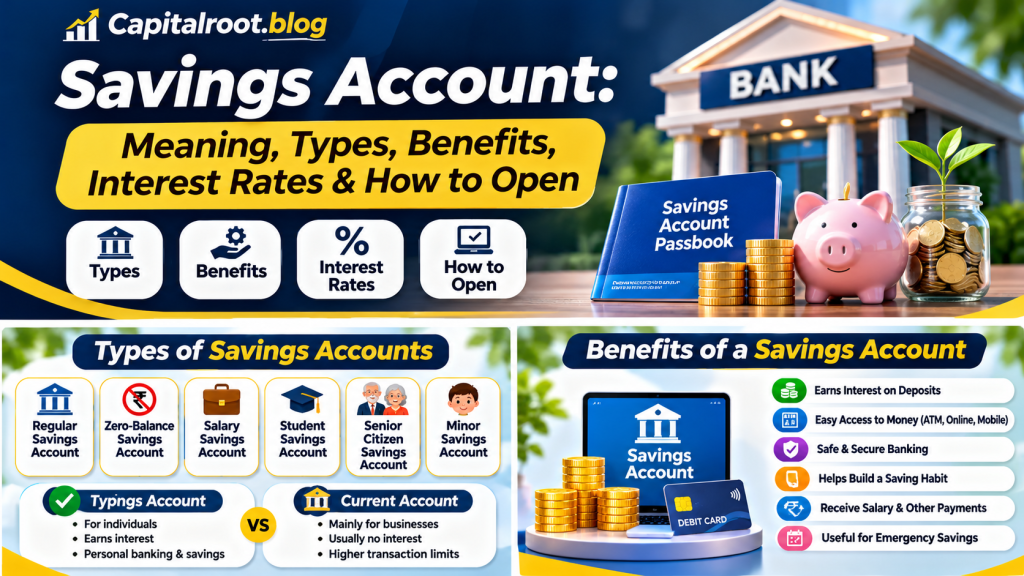
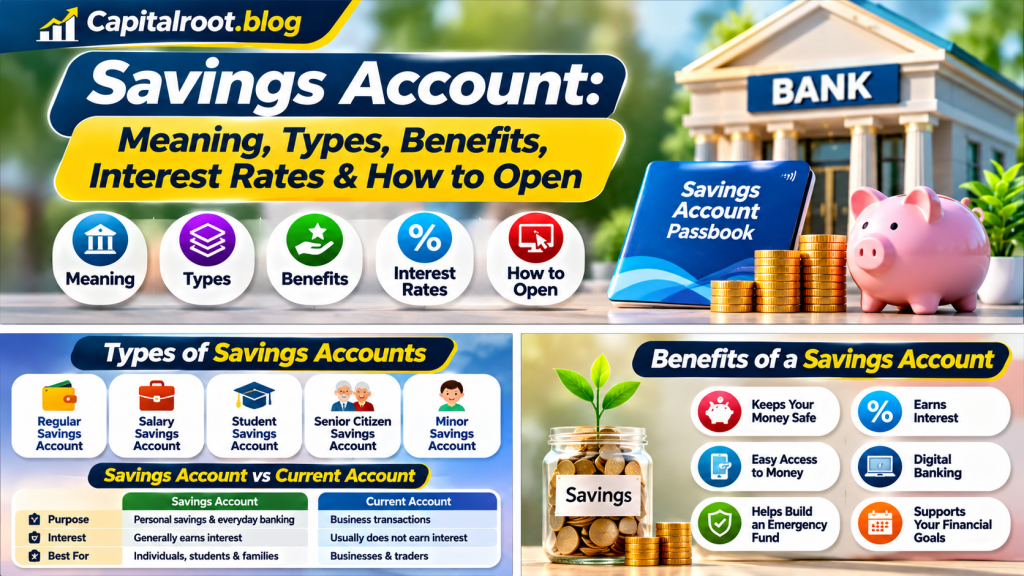
1. Regular Savings Account
A regular savings account is designed for individuals who want to deposit money, withdraw funds, and earn interest.
It generally includes basic banking services such as debit cards, online banking, and account statements.
2. Zero-Balance Savings Account
A zero-balance savings account does not require customers to maintain a specified minimum balance.
It can be useful for students, beginners, and people who want basic banking facilities without worrying about minimum balance requirements.
However, other account conditions and service charges may still apply.
3. Salary Savings Account
A salary account is generally opened through an employer’s banking arrangement to receive monthly salary payments.
Depending on the bank and employer agreement, it may offer benefits such as zero minimum balance requirements, debit card facilities, and selected banking services.
4. Student Savings Account
Student savings accounts are designed for eligible students.
Some banks offer lower balance requirements, simplified banking facilities, or special features for young customers.
Age limits and eligibility conditions vary by bank.
5. Senior Citizen Savings Account
Some banks provide savings accounts with special facilities for senior citizens.
Depending on the institution, these may include dedicated customer support, selected service benefits, or different interest conditions.
A senior citizen savings account should not be confused with government-backed senior citizen investment schemes.
6. Minor Savings Account
A minor savings account is designed for children below the age of majority.
It may be opened and operated by a parent or legal guardian according to the bank’s rules. Some banks also allow minors above a specified age to operate accounts with restrictions.
7. Digital Savings Account
A digital savings account can be opened and managed through a bank’s official website or mobile application.
Some banks provide paperless onboarding and video-based identity verification where permitted.
Always verify that the bank is regulated and use its official application or website.
Benefits of a Savings Account
A savings account offers several benefits for everyday financial management.
1. Keeps Your Money Accessible
One of the biggest advantages is that you can generally access your money when required.
This makes a savings account useful for daily expenses and short-term financial needs.
2. Helps Build a Saving Habit
Depositing a fixed amount regularly can help you develop financial discipline.
Even small deposits can gradually build a useful savings balance.
3. Earns Interest on Deposits
Unlike keeping money idle at home, a savings account may earn interest on eligible balances.
The actual return depends on the bank’s interest rate and applicable conditions.
4. Supports Digital Payments
Most modern savings accounts provide access to digital banking facilities.
Depending on the country and bank, these may include:
- Online fund transfers.
- Mobile banking.
- Debit card payments.
- Bill payments.
- QR-based payments.
- Account balance checking.
5. Useful for Emergency Savings
A savings account can be used to keep money for unexpected expenses such as medical bills, urgent travel, or temporary income disruptions.
Keeping emergency money accessible can reduce the need to borrow during difficult situations.
6. Helps Receive Payments
You can use a savings account to receive salary, pensions, government benefits, refunds, and other eligible payments.
7. Provides Transaction Records
Bank statements help you understand where your money comes from and how you spend it.
These records can also help with budgeting and financial planning.
Savings Account Interest Rates: What Should You Know?
Interest rates are an important factor when choosing a savings account.
Different banks offer different interest rates. Some banks may provide different rates depending on the account balance or customer category.
Before opening an account, compare:
- Annual interest rate.
- How interest is calculated.
- How frequently interest is credited.
- Minimum balance requirements.
- Monthly or annual service charges.
- Debit card fees.
- ATM withdrawal limits.
- Other account conditions.
Does a Higher Interest Rate Always Mean a Better Account?
Not necessarily.
A bank may advertise a higher interest rate but also have minimum balance requirements, transaction restrictions, or additional charges.
For example, an account with a slightly lower interest rate but no maintenance fee may be more suitable for someone who maintains a small balance.
Always compare the overall benefits and costs rather than looking only at the advertised interest rate.
Important: Savings account interest rates change over time. Check the latest rate directly on the official website of the bank before opening an account.
How Is Savings Account Interest Calculated?
Savings account interest is calculated according to the bank’s applicable method.
In India, many banks calculate savings interest using the daily closing balance and credit the interest periodically according to their policy and applicable regulations.
Example of Savings Account Interest
Suppose your savings account maintains an eligible balance of ₹50,000 throughout a year.
For illustration, assume an annual interest rate of 3%.
Estimated interest for one year:
₹50,000 × 3% = ₹1,500
Therefore:
- Starting balance: ₹50,000
- Assumed annual interest rate: 3%
- Estimated interest: ₹1,500
- Balance after interest: ₹51,500
This is a simplified example. Actual interest may differ because of daily balance changes, interest calculation methods, crediting frequency, taxes, and bank terms.
You can check the bank’s official website or savings interest calculator for a more accurate estimate.
Savings Account vs Current Account: What Is the Difference?
Savings accounts and current accounts are both banking products, but they serve different purposes.
| Feature | Savings Account | Current Account |
|---|---|---|
| Main purpose | Personal savings and everyday banking | Business transactions |
| Interest | Generally earns interest | Usually does not earn interest |
| Suitable for | Individuals, students and families | Businesses, traders and companies |
| Transactions | Subject to account limits and terms | Designed for frequent transactions |
| Minimum balance | Depends on account type | Depends on bank and account type |
| Main use | Saving and managing personal money | Managing business payments and receipts |
Which Account Should You Choose?
Choose a savings account if you want to manage personal income, expenses, and savings.
Choose a current account if you operate a business and need banking facilities for frequent business transactions.
The right choice depends on your financial activities and banking requirements.
How to Open a Savings Account
Opening a savings account is generally simple. Most banks provide online and branch-based application options.
Follow these steps:
Step 1: Choose a Bank
Compare banks based on their interest rates, account features, service charges, minimum balance requirements, and customer support.
Step 2: Select the Account Type
Choose a regular, zero-balance, salary, student, senior citizen, or other eligible savings account.
Step 3: Complete the Application Form
Visit the bank’s official website, mobile application, or branch and complete the account-opening application.
Step 4: Submit Required Documents
Provide the identity, address, tax, and other documents required by the bank.
Step 5: Complete Verification
The bank may verify your identity through document checks, OTP verification, video verification, or an in-person process.
Step 6: Make the Initial Deposit
Some accounts require an initial deposit, while others may allow account opening without one.
Step 7: Activate Banking Services
After account approval, activate the available services, such as:
- Debit card.
- Mobile banking.
- Internet banking.
- SMS alerts.
- Online fund transfers.
Always read the account terms before activating additional services.
Documents Required to Open a Savings Account
The documents depend on the country, bank, and account type.
Documents Commonly Required in India
Banks may request:
- PAN card or Form 60, where applicable.
- Aadhaar or another officially accepted identity document.
- Address proof.
- Recent photograph, if required.
- Mobile number and email address.
- Additional documents depending on customer category.
The exact requirements depend on applicable KYC rules and the bank’s process.
Documents Commonly Required in the USA
Banks may request:
- Government-issued photo identification.
- Social Security Number (SSN) or Individual Taxpayer Identification Number (ITIN), where applicable.
- Residential address.
- Date of birth.
- Contact information.
- Initial deposit, if required.
Requirements vary by financial institution and customer circumstances.
Documents Commonly Required in the UK
Banks may request:
- Proof of identity.
- Proof of residential address.
- Date of birth.
- Contact details.
- Tax residency information, where applicable.
Some banks may accept digital identity verification or alternative documents.
Savings Accounts in India, the USA and the UK
Savings account facilities and regulations vary between countries.
Savings Accounts in India
Savings accounts are widely offered by public sector banks, private banks, small finance banks, regional rural banks, and other eligible institutions.
Customers can compare:
- Interest rates.
- Minimum balance requirements.
- Zero-balance account options.
- ATM and debit card facilities.
- Digital banking services.
- Account maintenance charges.
In India, eligible bank deposits are insured by the Deposit Insurance and Credit Guarantee Corporation (DICGC) up to ₹5 lakh per depositor per bank, including principal and interest, subject to applicable rules.
The insurance limit applies to the combined eligible deposits held by the depositor in the same right and capacity at the same bank, not separately to each account.
Customers should verify that their bank is covered by DICGC.
Savings Accounts in the USA
In the United States, savings accounts are offered by banks and credit unions.
Customers can compare traditional savings accounts, high-yield savings accounts, and other deposit products.
Before opening an account, check:
- Annual Percentage Yield (APY).
- Minimum opening deposit.
- Monthly maintenance fees.
- Minimum balance requirements.
- Withdrawal and transfer conditions.
- Whether the institution is FDIC-insured or the credit union is federally insured by the NCUA.
The standard FDIC deposit insurance limit is $250,000 per depositor, per insured bank, for each account ownership category.
FDIC insurance applies to eligible deposit products, not investments such as mutual funds, stocks, or cryptocurrencies.
Savings Accounts in the UK
In the United Kingdom, customers can choose from several savings products, including:
- Easy-access savings accounts.
- Regular savings accounts.
- Fixed-term savings accounts.
- Cash Individual Savings Accounts (Cash ISAs), subject to eligibility and rules.
Before opening an account, compare interest rates, access restrictions, minimum deposits, and tax conditions.
Eligible deposits held with authorised UK banks, building societies, and credit unions may be protected by the Financial Services Compensation Scheme (FSCS).
The standard FSCS deposit protection limit is £120,000 per eligible person, per authorised firm. Joint account protection is generally calculated separately for each eligible account holder.
Always check the provider and its authorised firm status.
Common Mistakes to Avoid When Opening a Savings Account
Avoid these mistakes when selecting a savings account:
1. Ignoring Minimum Balance Requirements
Some accounts require customers to maintain a minimum balance. Falling below the required amount may result in charges.
2. Choosing Only on the Basis of Interest Rates
A higher interest rate does not automatically make an account better. Check service charges and other conditions.
3. Ignoring Account Maintenance Fees
Review debit card fees, SMS charges, ATM charges, and other applicable costs.
4. Not Checking Deposit Protection
Confirm whether the bank or financial institution is covered by the relevant deposit protection scheme.
5. Sharing Banking Details
Never share your password, PIN, OTP, or other confidential banking information with unknown people.
6. Ignoring Account Statements
Review your transactions regularly and report any unauthorised activity to your bank immediately.
Tips to Manage Your Savings Account Effectively
Follow these practical tips to make better use of your savings account:
- Save regularly: Transfer a fixed amount into your savings account after receiving your income.
- Maintain an emergency fund: Keep accessible money for unexpected expenses.
- Compare interest rates: Review available savings account options periodically.
- Avoid unnecessary charges: Understand minimum balance and service fee rules.
- Use digital banking carefully: Access your account through official banking applications and websites.
- Monitor transactions: Check account statements and transaction alerts regularly.
- Protect your information: Never share your PIN, OTP, or password.
- Set financial goals: Separate money for emergency needs, planned purchases, and other goals.
Frequently Asked Questions (FAQs)
1. What is a Savings Account?
A savings account is a bank account that allows individuals to deposit money, withdraw funds, and earn interest on eligible balances. It is commonly used for personal savings and everyday banking.
2. Is a Savings Account safe?
A savings account with an eligible regulated bank can provide a relatively secure place to keep money. Deposit protection depends on the country, institution, account ownership, and applicable insurance limits.
3. How much money can I keep in a Savings Account?
The maximum balance depends on the bank, account type, applicable regulations, and any special account conditions. Check the bank’s terms for limits and reporting requirements.
4. Do all Savings Accounts pay interest?
Many traditional savings accounts pay interest, but rates and conditions vary. Some specialised accounts may have different interest arrangements.
5. Can I open a Savings Account online?
Yes, many banks allow eligible customers to open savings accounts online through official websites or mobile applications. Identity verification requirements vary by institution.
6. What is the minimum balance required for a Savings Account?
The minimum balance depends on the bank and account type. Some accounts require a minimum balance, while zero-balance accounts may not have this requirement.
7. Can students open a Savings Account?
Yes, many banks offer savings accounts for eligible students. Age requirements, guardian involvement, and documentation rules vary by institution.
8. What is the difference between a Savings Account and a Current Account?
A savings account is generally used by individuals to manage personal money and earn interest. A current account is mainly designed for businesses that need frequent transactions.
9. Can I withdraw money from my Savings Account anytime?
Most savings accounts allow withdrawals when required, but transaction limits, withdrawal methods, and other conditions may apply.
10. Does a Savings Account help build an emergency fund?
Yes. A savings account can be a convenient place to keep emergency money because funds are generally accessible when unexpected expenses arise.
11. Is interest earned on a Savings Account taxable?
Tax treatment depends on the country and the individual’s circumstances. Check the current rules issued by the relevant tax authority.
12. Can I have multiple Savings Accounts?
In many countries, individuals can hold multiple savings accounts, subject to bank rules and applicable regulations. However, managing too many accounts may make financial tracking difficult.
Conclusion
A Savings Account is one of the most useful banking products for managing everyday finances and building a regular savings habit.
It allows individuals to deposit money, access funds when needed, make digital payments, and earn interest on eligible balances.
Whether you are a student, salaried employee, business owner, or managing household finances, choosing the right savings account can make your financial life more organised.
Before opening an account, compare interest rates, minimum balance requirements, service charges, digital banking facilities, and deposit protection.
Choose an account that matches your financial needs rather than selecting one only because it advertises a higher interest rate.