

Saving money regularly is one of the most important habits for building a secure financial future. However, many people find it difficult to save a large amount of money at once. This is where a Recurring Deposit (RD) can be useful.
A Recurring Deposit is a savings product offered by banks and certain financial institutions that allows customers to deposit a fixed amount regularly, usually every month, for a selected period.
At the end of the deposit period, the customer receives the total deposited amount along with the interest earned.
For example, if you deposit ₹2,000 every month for one year, your total contribution will be ₹24,000. You will receive this amount along with applicable interest when the RD matures.
A recurring deposit can be a useful option for salaried employees, students, beginners, and anyone who wants to develop a regular savings habit.
In this guide, we will explain how recurring deposits work, their benefits, interest rates, risks, and the process of opening an RD account.
How Does a Recurring Deposit Work?
A recurring deposit works through regular contributions over a fixed period.
Unlike a Fixed Deposit (FD), where you generally invest a lump sum at once, an RD allows you to save smaller amounts at regular intervals.
Here is how it generally works:
- Choose a monthly deposit amount: Decide how much you can comfortably save every month.
- Select the deposit period: Choose an available tenure according to your financial goal.
- Open an RD account: Apply through the bank’s website, mobile application, or branch.
- Make regular deposits: Deposit the selected amount on or before the monthly due date.
- Earn interest: Your deposits earn interest according to the institution’s applicable terms.
- Receive the maturity amount: At the end of the tenure, you receive your deposits along with the interest earned.
Many banks also provide automatic monthly debit facilities from a linked savings account. This makes it easier to maintain regular payments.
Key Features of a Recurring Deposit
Before opening an RD account, understand its main features.
1. Fixed Monthly Deposit
You deposit a predetermined amount at regular intervals, usually every month.
2. Flexible Tenure Options
Banks offer different deposit periods. The available tenure depends on the institution and its RD scheme.
3. Interest Earnings
Your deposits earn interest according to the rate and calculation method applicable to your account.
4. Regular Savings Habit
An RD encourages you to save money consistently instead of spending your entire monthly income.
5. Small Starting Amount
Some banks allow customers to begin with relatively small monthly deposits. The minimum amount varies between institutions.
6. Automatic Payment Facility
Many banks allow automatic instalment payments through standing instructions or linked bank accounts.
Benefits of a Recurring Deposit
A recurring deposit offers several benefits, especially for people who want a structured way to save money.
1. Develops a Regular Saving Habit
One of the biggest advantages of an RD is that it encourages monthly saving.
Instead of waiting until the end of the month to save whatever money remains, you commit to saving a fixed amount regularly.
2. No Need for a Large Initial Investment
You do not need a large amount of money to start saving through an RD.
You can begin with a manageable monthly contribution and gradually build your savings.
3. Helps Achieve Financial Goals
An RD can help you save towards specific short-term or medium-term goals, such as:
- Buying a smartphone or laptop
- Paying education fees
- Planning a family vacation
- Purchasing household appliances
- Saving for an upcoming expense
4. Predictable Savings Plan
You know how much you need to deposit every month and how long you need to continue.
This makes financial planning easier.
5. Generally Less Exposed to Market Fluctuations
Unlike stocks and equity mutual funds, a traditional bank RD does not directly depend on daily stock-market movements.
However, you should still check the institution’s reliability and applicable deposit-protection rules.
6. Convenient Account Management
Many banks provide online RD opening, automatic payments, account statements, and maturity information through their digital banking services.
RD Interest Rates: What Should You Know?
Interest rates are one of the most important factors to consider before opening a recurring deposit.
Different banks and financial institutions offer different RD interest rates. Rates may also depend on the selected tenure, deposit amount, customer category, and prevailing market conditions.
Before choosing an RD, compare the following:
- Annual interest rate
- Deposit tenure
- Interest compounding frequency
- Maturity amount
- Premature withdrawal conditions
- Late payment penalties
- Tax treatment of interest
Some banks offer different rates to senior citizens or other eligible customer categories.
Important: RD interest rates can change over time. Always check the latest rates on the official website of the bank or financial institution before opening an account.
How Is RD Interest Calculated?
The interest earned on a recurring deposit depends on several factors, including:
- Monthly deposit amount
- Deposit tenure
- Applicable annual interest rate
- Interest compounding frequency
- Deposit dates and payment schedule
Unlike a lump-sum Fixed Deposit, RD instalments are deposited at different times. Therefore, each instalment earns interest for a different period.
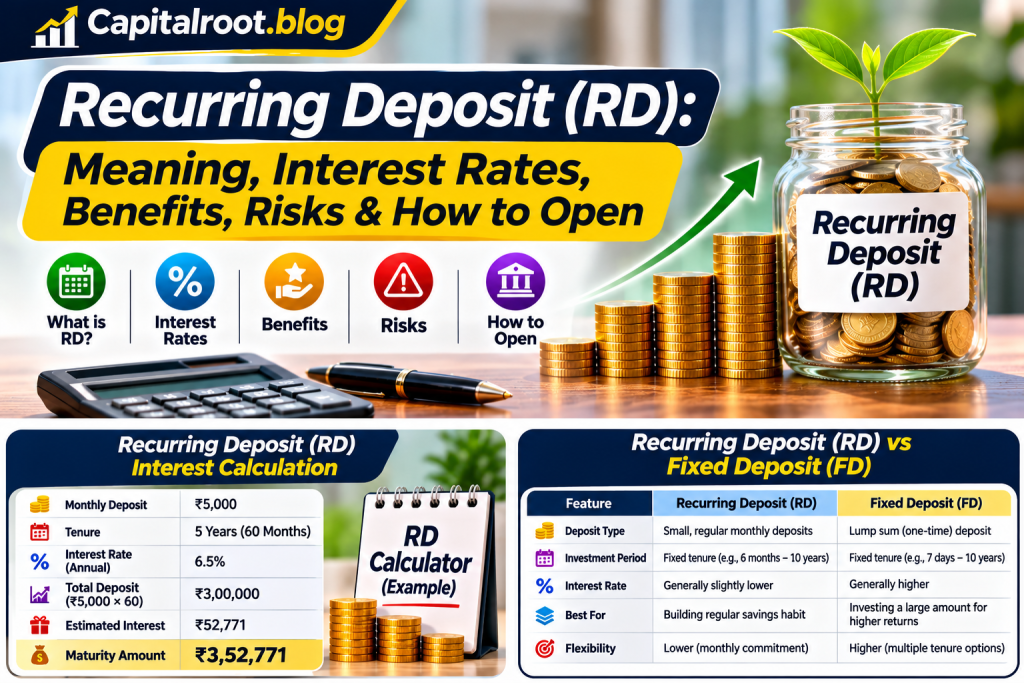
Example of RD Savings
Suppose you want to save ₹5,000 every month for five years.
| Details | Amount |
|---|---|
| Monthly deposit | ₹5,000 |
| Deposit period | 5 years |
| Total instalments | 60 |
| Total amount deposited | ₹3,00,000 |
| Interest rate | Depends on the bank |
| Maturity amount | Depends on the bank’s calculation |
The maturity amount will generally be higher than your total contributions because of the interest earned.
You can use an RD calculator available on your bank’s official website to estimate the maturity amount.
Remember that an online calculator provides an estimate. The bank’s actual maturity quotation and account terms determine the final payout.
RD vs FD: What Is the Difference?
Recurring Deposits and Fixed Deposits are popular savings products offered by banks. Both can help people save money, but their deposit methods are different.
| Feature | Recurring Deposit (RD) | Fixed Deposit (FD) |
|---|---|---|
| Deposit method | Regular monthly instalments | Usually a one-time lump-sum deposit |
| Initial investment | Smaller regular contributions | Larger amount deposited upfront |
| Suitable for | People who save monthly | People who already have savings |
| Savings habit | Encourages regular saving | Helps invest existing money |
| Interest calculation | Based on instalments and applicable terms | Based on principal, rate and tenure |
| Main purpose | Building savings gradually | Earning interest on a lump sum |
Which Is Better: RD or FD?
The right choice depends on your financial situation.
Choose an RD if you receive regular income and want to save a fixed amount every month.
Choose an FD if you already have a lump sum that you do not need immediately and want to deposit it for a selected period.
Both products have different features, so compare their interest rates, withdrawal rules, and tax implications before investing.
How to Open a Recurring Deposit Account
Opening an RD account is generally simple. Many banks allow customers to apply online, while others also provide branch-based applications.
Follow these steps:
Step 1: Choose a Bank
Compare RD schemes offered by different banks and financial institutions.
Check interest rates, minimum deposits, tenure options, and account conditions.
Step 2: Select Your Monthly Deposit Amount
Decide how much you can comfortably deposit every month without affecting your essential expenses.
Step 3: Choose the Tenure
Select the available deposit period according to your financial goal.
Step 4: Complete the Application
Visit the bank’s official website, mobile application, or branch and select the Recurring Deposit option.
Step 5: Submit Required Documents
Complete the identity and account verification process. The documents required depend on the bank and your customer category.
Step 6: Set Up Monthly Payments
If available, activate automatic monthly payments from your linked savings account.
Step 7: Confirm Your RD Account
Review the deposit amount, interest rate, tenure, maturity details, and other conditions before confirming the account.
Once the account is opened, make sure you maintain sufficient funds for your monthly instalments.
Who Should Consider Opening an RD?
A recurring deposit may be suitable for different types of savers.
1. Salaried Employees
People receiving a regular monthly salary can use an RD to save a fixed portion of their income.
2. Students
Students who receive pocket money, scholarships, or financial support may use an RD to build a savings habit, subject to the bank’s eligibility requirements.
3. First-Time Savers
People who are new to financial planning may find an RD easier to understand than market-linked investment products.
4. Families
Families can use recurring deposits to save towards planned expenses such as education, travel, or household purchases.
5. People with Short-Term Financial Goals
An RD may be useful when you have a specific savings target and can commit to regular deposits.
However, it may not be suitable for people who need frequent access to their money or cannot commit to regular payments.
Risks and Disadvantages of a Recurring Deposit
Although recurring deposits offer several benefits, they also have some limitations.
1. Premature Withdrawal Restrictions
If you close your RD before maturity, the bank may reduce the interest payable or apply a penalty.
The exact conditions depend on the institution.
2. Penalties for Missed Instalments
Some banks charge penalties when customers fail to deposit instalments on time.
Repeated missed payments may also affect the account according to its terms.
3. Inflation Risk
Inflation reduces the purchasing power of money over time.
If the RD’s after-tax return is lower than inflation, the real value of your savings may decrease.
4. Tax on Interest
Interest earned from an RD may be taxable depending on the tax laws of your country.
You should understand the applicable tax rules before choosing a deposit product.
5. Limited Flexibility
An RD generally requires regular deposits for a selected period.
If your income changes or you face an unexpected financial emergency, maintaining the monthly contribution may become difficult.
RD Rules and Savings Alternatives in India, the USA and the UK
Recurring deposit products are not identical across countries. The name, availability, deposit rules, interest rates, and tax treatment can vary.
Recurring Deposits in India
Recurring Deposits are commonly available through banks and India Post.
Customers can generally select a monthly deposit amount and an available tenure.
Before opening an RD in India, check:
- Current interest rates
- Minimum monthly deposit
- Available tenure
- Late payment penalties
- Premature closure rules
- Tax treatment of interest
You can visit the official websites of banks or India Post to check available schemes and current terms.
Savings Options in the USA
The term Recurring Deposit is not commonly used for standard US bank savings products.
People who want to save regularly can consider alternatives such as:
- Automatic transfers to savings accounts
- Regular savings plans
- Certificates of Deposit (CDs)
- Other eligible bank deposit products
Before opening an account, check the interest rate, minimum balance, withdrawal restrictions, and FDIC insurance eligibility.
Savings Options in the UK
In the United Kingdom, people who want to save money regularly can compare:
- Regular savings accounts
- Easy-access savings accounts
- Fixed-term savings accounts
- Other eligible deposit products
Check contribution limits, withdrawal conditions, interest rates, tax treatment, and whether the provider and account qualify for Financial Services Compensation Scheme (FSCS) protection.
Important Tips Before Opening an RD
Follow these practical tips to make a better savings decision.
- Choose an affordable amount: Do not select a monthly deposit that creates financial pressure.
- Compare multiple banks: Check interest rates and account conditions before applying.
- Check the maturity amount: Use the institution’s official RD calculator.
- Understand withdrawal rules: Know the penalties and conditions for premature closure.
- Maintain sufficient balance: Keep enough money in your linked account for automatic instalments.
- Build an emergency fund: Do not lock away all your savings in an RD.
- Check tax rules: Understand how RD interest is treated under your country’s tax laws.
- Use official banking channels: Open your account through the institution’s official website, app, or branch.
Frequently Asked Questions (FAQs)
1. What is a Recurring Deposit (RD)?
A Recurring Deposit is a savings product in which you deposit a fixed amount regularly, usually every month, for a selected period. At maturity, you receive your total deposits along with applicable interest.
2. Is a Recurring Deposit safe?
A recurring deposit with an eligible regulated bank can offer a relatively predictable savings experience. However, deposit protection depends on the country, institution, and applicable rules. Always verify the bank’s status and deposit-protection coverage.
3. Can I withdraw money from an RD before maturity?
Some banks allow premature closure of an RD. However, reduced interest or penalties may apply. Check the bank’s terms before opening the account.
4. What happens if I miss an RD instalment?
The bank may charge a late payment penalty or apply other account conditions. The consequences depend on the institution’s RD scheme.
5. Is RD better than FD?
Neither is always better. RD is generally suitable for people who want to save regularly, while FD is generally suitable for people who already have a lump sum to deposit.
6. Is RD interest taxable?
RD interest may be taxable depending on the tax rules of your country and your individual circumstances. Check the latest guidance from the relevant tax authority.
7. Can students open an RD account?
Many banks allow eligible students to open an RD account. However, age requirements and documentation rules may differ. A parent or guardian may need to operate an account for a minor.
8. Can I open an RD account online?
Yes, many banks allow eligible customers to open recurring deposit accounts through internet banking or mobile applications. Online availability depends on the institution.
9. What is the minimum amount required to open an RD?
The minimum monthly deposit varies between banks and financial institutions. Some institutions allow relatively small deposits, while others may have higher minimum requirements.
10. Can I increase my monthly RD instalment?
Many traditional RD schemes require customers to continue with the selected instalment amount. Increasing or changing the amount may not be allowed. Check the bank’s rules before opening the account.
Conclusion
A Recurring Deposit is a simple savings option for people who want to develop a regular saving habit and work towards specific financial goals.
It allows you to deposit smaller amounts over time instead of investing a large sum at once. This makes it a practical option for salaried employees, students, beginners, and families planning future expenses.
However, before opening an RD, compare interest rates, deposit tenure, penalties, premature withdrawal conditions, and tax rules.
Choose a monthly contribution that comfortably fits your budget and always check the latest terms through the official website of your bank.
Disclaimer: This article is intended for educational and informational purposes only. It should not be considered personalised financial or tax advice. Interest rates, account conditions, deposit protection, and tax rules may change and vary by country and financial institution.