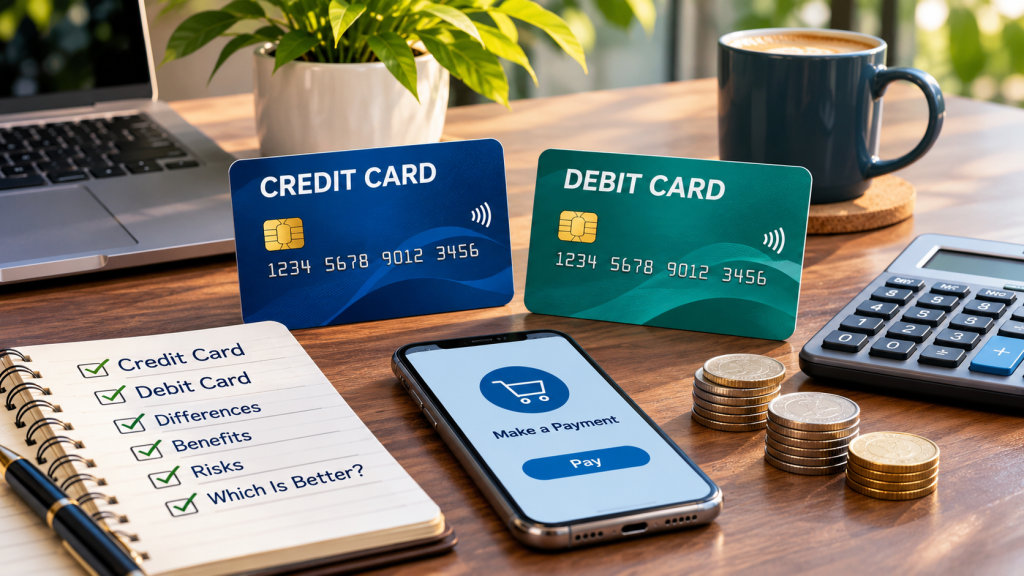


Credit cards and debit cards are two of the most commonly used payment methods around the world. Whether you are shopping online, paying restaurant bills, booking flights, or withdrawing cash, both cards make everyday transactions easier.
However, many people still do not understand the difference between a credit card and a debit card. Although they may look similar and work through the same payment networks, they operate differently.
A debit card allows you to spend money available in your linked bank account, while a credit card allows you to borrow money from a card issuer up to an approved credit limit and repay it later.
Understanding the difference between credit card vs debit card can help you make better financial decisions, avoid unnecessary debt, manage spending, and choose the right payment method.
In this guide, we will explain how both cards work, their benefits and disadvantages, fees, security considerations, and which option may be better for your financial needs in India, the USA, and the UK.
1. What Is a Debit Card?
A debit card is a payment card connected to your bank account. When you use it to make a purchase, the payment is generally deducted directly from your available account balance.
For example, suppose you have $500, £500, or ₹50,000 in your bank account. If you purchase something worth $100, £100, or ₹10,000, the amount is deducted from your account, subject to the bank’s transaction-processing rules.
Debit cards are commonly used for:
- Shopping in physical stores
- Online purchases
- Restaurant payments
- ATM cash withdrawals
- Paying utility bills
- Contactless payments
- Everyday banking transactions
Most debit cards are issued by banks when customers open eligible savings or current accounts.
How Does a Debit Card Work?
The process is relatively simple:
- You receive a debit card linked to your bank account.
- You use the card at a store, website, or payment terminal.
- The bank checks whether sufficient funds or an applicable overdraft facility are available.
- The transaction is authorised or declined.
- The transaction amount is deducted from your available balance, although final posting may take additional time.
Important: Some accounts offer overdraft facilities, which may allow spending beyond the available balance. Such facilities can involve interest and fees.
2. What Is a Credit Card?
A credit card is a payment card that allows you to borrow money from a bank or financial institution within an approved credit limit.
Unlike a debit card, the money does not normally come directly from your bank account when you make a purchase.
Instead, the card issuer pays the merchant, and you repay the amount according to your monthly billing statement and card agreement.
For example, imagine your credit card has an approved limit of $3,000, £3,000, or ₹3,00,000.
If you make purchases worth $500, £500, or ₹50,000, that amount becomes part of your outstanding credit card balance.
You must repay the amount by the payment due date.
How Does a Credit Card Work?
- You apply for a credit card with a bank or financial institution.
- The issuer evaluates your application and decides whether to approve it.
- If approved, you receive a credit limit.
- You use the card for eligible purchases.
- The issuer generates a monthly statement.
- You repay the outstanding balance according to the card terms.
If you repay the full statement balance by the due date, you can generally avoid purchase interest when the card offers an interest-free grace period and you meet its conditions.
However, carrying a balance may result in interest charges, and cash advances often have separate fees and interest rules.
3. Credit Card vs Debit Card: Key Differences
The biggest difference is where the money comes from.
A debit card uses money available in your bank account, whereas a credit card uses a borrowing facility provided by the issuer.
Here is a simple comparison:
| Feature | Credit Card | Debit Card |
|---|---|---|
| Money source | Borrowed funds | Your bank account |
| Spending limit | Approved credit limit | Available account balance |
| Repayment | Monthly bill | No monthly borrowing bill for ordinary purchases |
| Interest | May apply | Usually no purchase interest |
| Credit history | Can affect credit history | Usually does not build credit history |
| ATM withdrawals | Cash advance fees and interest may apply | Withdraws available bank funds |
| Rewards | May offer cashback or points | Depends on bank and card |
| Overspending risk | Higher risk of debt | Generally limited by available funds |
| Annual fees | May apply | Depends on account and card |
| Budget control | Requires repayment discipline | Can make spending easier to track |
The exact features depend on the bank, payment network, country, and card agreement.
4. Benefits of Using a Credit Card
Credit cards can be useful financial tools when used responsibly.
1. Helps Build Credit History
In countries such as India, the USA, and the UK, responsible credit card usage may help establish or improve your credit history, depending on how the issuer reports account information.
Paying bills on time and maintaining manageable balances can support a healthy credit profile.
2. Cashback and Reward Points
Some credit cards offer rewards such as:
- Cashback on eligible purchases
- Shopping discounts
- Travel rewards
- Airline miles
- Restaurant offers
- Reward points
However, rewards should not encourage unnecessary spending. Always compare annual fees, reward conditions, and redemption restrictions.
3. Convenient Online Shopping
Credit cards are widely accepted for online purchases, hotel bookings, subscriptions, and travel reservations.
Some issuers also offer transaction alerts and additional card-security features.
4. Short-Term Payment Flexibility
A credit card can provide temporary payment flexibility between purchases and the monthly payment due date.
This flexibility should not be confused with free long-term borrowing.
5. Purchase Protection and Other Benefits
Depending on the country, card network, issuer, and transaction, credit cards may offer dispute resolution, purchase protection, or other benefits.
For example, eligible UK credit card purchases between £100 and £30,000 may receive protection under Section 75 of the Consumer Credit Act, subject to its legal conditions.
5. Disadvantages of Credit Cards
Despite their benefits, credit cards also have disadvantages.
1. High Interest Charges
If you do not repay the required balance according to the card agreement, interest may accumulate.
Credit card borrowing can become expensive, particularly when you repeatedly carry outstanding balances.
2. Risk of Unnecessary Spending
Having access to an approved credit limit may encourage some people to purchase things they cannot comfortably afford.
3. Annual and Other Fees
Some credit cards charge annual fees, late-payment fees, foreign transaction fees, balance-transfer fees, or cash advance charges.
Read the card’s fee schedule before applying.
4. Missed Payments Can Affect Your Credit Profile
Late or missed credit card payments may affect your credit history and result in additional charges.
Set payment reminders or automatic payments where suitable.
6. Benefits of Using a Debit Card
Debit cards are popular because they provide convenient access to money already held in your bank account.
1. Helps Control Spending
A debit card generally limits your purchases to available funds or any agreed overdraft facility.
This can make it easier to avoid accumulating credit card debt.
2. No Regular Purchase Interest
Ordinary debit card purchases do not involve borrowing from the card issuer, so they generally do not attract credit card purchase interest.
However, account fees and overdraft charges may still apply.
3. Easy Access to Cash
Debit cards can be used at eligible ATMs to withdraw money from your linked account.
4. Suitable for Everyday Transactions
Debit cards are convenient for groceries, transport, shopping, dining, and regular household payments.
5. Simple Bank Account Management
Debit card transactions appear in your bank account activity, making it easier to monitor everyday spending.
7. Disadvantages of Debit Cards
Debit cards are useful, but they also have some limitations.
1. Limited Spending Capacity
You generally cannot make purchases beyond your available funds unless your bank provides an overdraft or similar facility.
2. May Not Build Credit History
Ordinary debit card transactions generally do not demonstrate borrowing and repayment behaviour to credit reporting agencies.
Therefore, using a debit card alone usually does not build a traditional credit history.
3. Direct Access to Bank Funds
If your debit card details are compromised and an unauthorised transaction occurs, money may leave your linked account.
Contact your bank immediately if you notice suspicious activity.
4. Fewer Credit-Based Rewards
Some debit cards offer cashback and rewards, but their benefits may differ from those available with credit cards.
8. Credit Card vs Debit Card: Which Is Better for Online Shopping?
Both payment cards can be used for online shopping, but they have different financial implications.
A credit card may provide useful payment flexibility and certain purchase-related protections. It can also make it easier to separate shopping transactions from your everyday bank balance.
A debit card, on the other hand, uses your available funds and can help you avoid borrowing for routine purchases.
Before paying online:
- Use trusted websites.
- Check the website address carefully.
- Avoid sharing your card details through suspicious links.
- Enable transaction notifications.
- Use secure payment authentication.
- Report unauthorised transactions immediately.
Do not assume that every credit card automatically offers better fraud protection than every debit card. Legal rights, dispute processes, and liability limits differ between countries and card agreements.
9. Credit Card vs Debit Card: Which Is Better for International Travel?
International travel involves additional considerations such as foreign exchange rates, transaction fees, ATM charges, and card acceptance.
A credit card may be convenient for hotel bookings, rental deposits, travel purchases, and unexpected expenses.
A debit card can provide direct access to your bank funds and may be useful for ATM withdrawals and everyday payments.
Before travelling, check:
- Foreign currency transaction fees
- Exchange rate markups
- International ATM withdrawal charges
- Card acceptance in your destination
- Emergency card replacement options
- International transaction settings
Some cards offer low or no foreign transaction fees, but these benefits depend on the issuer and account conditions.
Carrying a backup payment method is also a sensible precaution.
10. Credit Card vs Debit Card in India, USA and UK
Although the basic difference between credit cards and debit cards is similar worldwide, credit reporting systems, consumer protection laws, fees, and banking rules vary by country.
India
In India, credit cards are issued by banks and eligible financial institutions under the applicable Reserve Bank of India framework.
Credit card usage may influence your credit history with credit information companies such as CIBIL, depending on reporting and account activity.
Debit cards are linked to eligible savings or current accounts and can be used for ATM withdrawals, online purchases, and point-of-sale transactions.
Before choosing a card in India, compare:
- Annual and joining fees
- Interest rates and other charges
- Reward conditions
- International transaction fees
- Credit limit and eligibility
- Customer support and dispute procedures
You can read the latest applicable card-related directions on the Reserve Bank of India’s official website.
USA
In the United States, credit cards are commonly used for purchases, recurring payments, travel, and building credit history.
Credit card activity may be reported to major credit bureaus such as Experian, Equifax, and TransUnion.
Debit cards are generally linked to checking accounts and provide access to available bank funds.
Consumers should understand the applicable protections under laws such as the Truth in Lending Act and the Electronic Fund Transfer Act. The specific protections and liability rules depend on the transaction and circumstances.
Before choosing a card, compare:
- Annual percentage rate (APR)
- Annual fees
- Cashback and rewards
- Foreign transaction fees
- Credit reporting policies
- Fraud and dispute procedures
The Consumer Financial Protection Bureau provides useful educational resources about payment cards and consumer rights.
UK
In the United Kingdom, credit cards and debit cards are widely used for everyday purchases and online payments.
Credit card activity may affect your credit file with agencies such as Experian, Equifax, and TransUnion.
One important UK-specific benefit is Section 75 of the Consumer Credit Act. Eligible purchases costing more than £100 and up to £30,000 may receive additional legal protection when the statutory conditions are met.
Debit card payments may also benefit from chargeback arrangements, although chargeback is different from Section 75 and is not the same statutory protection.
Before choosing a card, compare:
- Annual fees
- Representative APR
- Foreign currency charges
- Cashback and rewards
- Credit eligibility
- Purchase protection
- Repayment conditions
MoneyHelper provides useful UK guidance on credit and debit card usage.
11. When Should You Use a Credit Card?
A credit card may be suitable when:
- You can repay the full statement balance on time.
- You want to establish or maintain a credit history.
- You understand the card’s interest rates and charges.
- You want eligible cashback or rewards.
- You need a convenient payment method for travel bookings.
- You understand the available purchase protections.
Avoid using a credit card for purchases you cannot realistically repay.
12. When Should You Use a Debit Card?
A debit card may be a better option when:
- You want to spend money already available in your account.
- You are trying to control your monthly expenses.
- You prefer to avoid credit card borrowing.
- You need to withdraw cash from an ATM.
- You want a simple payment method for everyday transactions.
- You do not want to manage monthly credit card repayments.
13. How to Choose the Right Card for Your Financial Needs
There is no single payment card that is best for everyone.
Your choice should depend on your income, spending habits, financial discipline, banking needs, and the benefits offered by your bank.
Consider these questions before choosing:
1. Can you repay a credit card bill in full?
If yes, a credit card may offer useful benefits. If not, a debit card may help you avoid expensive borrowing.
2. Do you want to build a credit history?
A credit card may help establish a repayment record if the issuer reports account activity to credit reporting agencies.
3. Do you travel frequently?
Compare international transaction fees, currency conversion rates, and travel-related benefits.
4. Do you prefer spending only your available money?
A debit card may be more suitable for this preference.
5. Have you compared the charges?
Always read the terms and conditions before selecting a card.
14. Smart Tips for Using Credit and Debit Cards Safely
Regardless of which card you choose, follow these precautions:
- Never share your PIN, password, or one-time authentication codes.
- Enable instant transaction notifications.
- Check your bank and card statements regularly.
- Avoid clicking suspicious payment links.
- Report lost or stolen cards immediately.
- Use secure websites for online transactions.
- Set appropriate transaction limits where available.
- Pay credit card bills on time.
- Review foreign transaction charges before travelling.
- Contact your bank immediately if you notice an unauthorised transaction.
Good payment habits can help reduce the risk of fraud and unnecessary financial losses.

Frequently Asked Questions
1. What is the main difference between a credit card and a debit card?
A credit card allows you to borrow money up to an approved limit and repay it later. A debit card uses money available in your linked bank account.
2. Is a credit card better than a debit card?
Neither is universally better. Credit cards may offer rewards and credit-building opportunities, while debit cards can help users spend within their available bank balance.
3. Does using a debit card improve your credit score?
Ordinary debit card transactions generally do not build traditional credit history because they do not involve borrowing and repayment.
4. Can I use a credit card for ATM withdrawals?
Yes, many credit cards allow cash advances, but these often involve additional fees and interest that may start immediately. Check your card agreement.
5. Can I use a debit card for online shopping?
Yes. Debit cards can be used on eligible online shopping websites and payment platforms, subject to bank settings and merchant acceptance.
6. Which card is safer for online payments?
Both can be used safely when proper security practices are followed. The actual protection depends on applicable laws, issuer policies, and how quickly suspicious transactions are reported.
7. Do credit cards charge interest every month?
Not necessarily. If your card has an interest-free grace period and you meet its conditions by paying the full statement balance on time, eligible purchases may not attract interest.
8. Can I have both a credit card and a debit card?
Yes. Many people use debit cards for everyday spending and credit cards for eligible purchases, travel, and other expenses they can repay comfortably.
9. Does a debit card have a spending limit?
Yes. The limit may depend on your available account balance, daily transaction limits, ATM withdrawal limits, and any overdraft facility.
10. Should beginners use credit cards?
Beginners can consider credit cards if they understand the fees, repayment rules, and borrowing risks. Starting with a manageable limit and paying the full statement balance on time can encourage responsible use.
Final Verdict: Credit Card vs Debit Card – Which One Should You Choose?
Credit cards and debit cards both offer convenient ways to make payments, but they serve different financial purposes.
A credit card can provide borrowing flexibility, rewards, and opportunities to build credit history when managed responsibly. However, unpaid balances and missed payments can lead to expensive interest and financial difficulties.
A debit card offers a straightforward way to spend money already available in your bank account. It can help with everyday budgeting, although account fees, overdrafts, and fraud risks still need attention.
For many people, having both cards can be useful. The key is to understand how each one works and use it according to your financial needs.
Remember: A credit card is not extra income. Borrow only what you can comfortably repay, and make informed financial decisions.
Financial Disclaimer: This article is for general educational purposes only and does not constitute personalised financial or legal advice. Credit card features, fees, interest rates, consumer protections, and regulations vary by country and provider. Always review the latest terms and conditions and consult official sources before making financial decisions.