
Managing money can be challenging when your income is limited and everyday expenses keep increasing. Rent, groceries, transportation, utility bills, insurance and debt payments can take up most of your paycheck. By the end of the month, you may have very little left to save.
The good news is that creating a budget does not require a high income. A realistic monthly budget can help you understand where your money goes, prioritise essential expenses and make better financial decisions.
Whether you work full-time, part-time, receive hourly wages or have an irregular income, a simple budget can help you manage your money more confidently.
In this guide, you will learn how to create a monthly budget on a low income in the USA, reduce unnecessary expenses, handle debt and start building emergency savings—even if you can only save a small amount.
1. What Is a Monthly Budget?
A monthly budget is a plan for how you will use the money you receive during a month.
It helps you compare your income with your expenses so you can decide how much to spend, save and use for debt payments.
A basic budget includes:
- Monthly take-home income
- Housing and utility expenses
- Food and grocery costs
- Transportation expenses
- Insurance and healthcare costs
- Debt payments
- Personal and household spending
- Savings and emergency funds
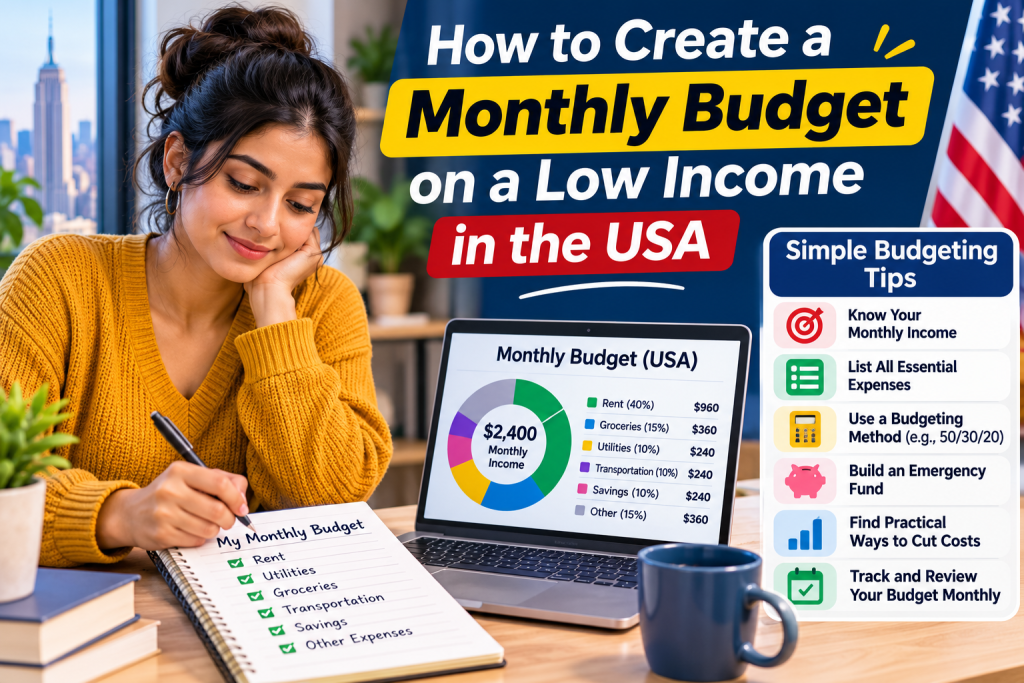
For example, if your monthly take-home income is $2,400 and your total expenses are $2,300, you have $100 remaining.
You can decide whether to put that amount into emergency savings, pay down debt or keep it available for an upcoming essential expense.
A budget is not about stopping every enjoyable purchase. It is about making sure your money covers your most important needs first.
2. Calculate Your Monthly Take-Home Income
The first step is to understand how much money you actually have available.
Do not create your budget using only your gross salary. Gross income is the amount you earn before taxes and other payroll deductions. Take-home pay is what reaches your bank account after deductions.
Include all reliable sources of income, such as:
- Full-time or part-time wages
- Overtime income you regularly receive
- Freelance or gig-work earnings
- Side-business income after relevant expenses
- Social Security or other benefits, if applicable
- Child support or other regular support payments
What if you get paid every week or every two weeks?
Many American workers receive weekly or biweekly paychecks rather than one monthly payment.
If your income changes from paycheck to paycheck, use your recent pay stubs and bank deposits to estimate a realistic monthly amount. For a variable-income budget, consider using a conservative estimate rather than assuming you will earn your best possible amount every month.
You can also plan your spending around the actual dates when money arrives. This helps prevent a situation where you have enough money for the month overall but not enough available when a bill is due.
3. List All Your Monthly Expenses
After calculating your income, write down everything you spend money on.
Review your bank statements, credit card statements, receipts and recent bills. Try to include both regular and occasional expenses.
Fixed expenses
These usually remain similar from month to month.
Examples include:
- Rent or mortgage payments
- Car payments
- Insurance premiums
- Internet plans
- Phone plans
- Minimum debt payments
Variable expenses
These can change depending on your usage and spending habits.
Examples include:
- Groceries
- Gasoline
- Electricity and water
- Public transportation
- Household supplies
- Clothing
- Dining out
- Entertainment
Occasional expenses
Some expenses do not arrive every month, but they still need to be included in your financial plan.
Examples include:
- Vehicle registration
- Annual insurance payments
- School supplies
- Medical expenses
- Holiday gifts
- Car maintenance
- Seasonal clothing
Estimate the monthly amount for these costs and set money aside gradually. This can help prevent an occasional bill from becoming a financial emergency.
4. Prioritise Essential Expenses First
When your income is limited, your budget should begin with the expenses necessary for your health, safety and daily life.
A practical priority order is:
- Housing and basic utilities
- Groceries and essential household items
- Transportation needed for work or essential activities
- Necessary healthcare and insurance
- Minimum required debt payments
- Emergency savings, if possible
- Non-essential shopping and entertainment
Your exact priorities may depend on your circumstances. For example, someone who needs a car to reach work may have to prioritise fuel and car insurance.
If your essential expenses are already higher than your income, cutting small entertainment costs may not solve the problem. You may need to explore lower-cost housing, assistance programs, changes to bill arrangements or additional income.
5. Try a Flexible Budgeting Rule Instead of Following 50/30/20 Strictly
The popular 50/30/20 budgeting rule divides after-tax income into three groups:
- 50% for needs
- 30% for wants
- 20% for savings and debt repayment
It can be a useful starting point, but it does not work for everyone.
If you live in an expensive city or earn a low income, rent and other essential costs may take up more than 50% of your income. That does not mean you have failed at budgeting.
Instead, create a budget based on your actual needs.
For example, you could:
- Cover essential bills first.
- Set aside a small amount for emergency savings when affordable.
- Pay required debt payments on time.
- Limit optional spending to what remains.
- Review the plan whenever income or expenses change.
A realistic budget that you can maintain is more useful than a perfect-looking percentage plan that does not match your life.
6. Example of a Monthly Budget on a $2,400 Income
Here is an illustrative monthly budget for a person living in the USA with $2,400 in take-home income.
| Expense category | Monthly amount |
|---|---|
| Rent | $900 |
| Utilities | $180 |
| Groceries | $300 |
| Transportation | $220 |
| Phone and internet | $100 |
| Insurance and medical costs | $120 |
| Debt payments | $180 |
| Emergency savings | $100 |
| Household and personal expenses | $150 |
| Miscellaneous expenses | $150 |
| Total | $2,400 |
This example uses the full $2,400 income. It does not mean these amounts will be suitable for every household.
Actual costs vary significantly by state, city, household size, rent, healthcare needs and transportation requirements.
If your rent is higher, you may need to adjust other categories or explore housing options. If your income is lower, start by protecting essential expenses rather than forcing yourself to save an unrealistic amount.
7. Reduce Grocery and Food Expenses
Groceries are one of the areas where some households may find opportunities to save money.
You do not need to compromise on nutrition to manage food costs more carefully.
Try these practical ideas:
Plan meals before shopping
Create a weekly meal plan based on what you already have at home. Make a shopping list and avoid buying items that are not needed.
Compare unit prices
A larger package is not always cheaper. Compare the price per ounce, pound or unit to identify better value.
Choose affordable food options
Beans, lentils, rice, oats, eggs, seasonal vegetables and frozen produce can be useful ingredients for affordable meals.
Reduce food waste
Store food correctly, freeze items before they spoil and use leftovers for another meal.
Limit restaurant and delivery spending
Eating out and food delivery can become expensive when used frequently. Setting a realistic monthly limit can help control these costs.
Check whether you qualify for food assistance
The Supplemental Nutrition Assistance Program (SNAP) may help eligible households pay for groceries.
Eligibility depends on applicable federal and state rules, household circumstances and other factors. You can learn about the program and find application information through the official USA.gov website.
8. Save Money on Housing and Utility Bills
Housing is often one of the largest expenses in an American household budget.
If rent takes up a large part of your income, consider whether there are practical ways to reduce housing costs.
Possible options include:
- Comparing rental prices in nearby areas.
- Considering a roommate if it is safe and suitable.
- Discussing a renewal or payment arrangement with your landlord.
- Checking whether you qualify for local rental assistance.
- Exploring affordable housing options in your area.
For utilities, consider:
- Turning off unused lights and electronics.
- Adjusting heating and cooling settings where practical.
- Comparing available internet and phone plans.
- Checking for eligible utility assistance programs.
- Contacting your provider before a missed payment to ask about payment arrangements.
Do not cancel essential insurance or make a major housing decision without considering the risks and total costs.
9. Control Transportation Costs
Transportation can be a major expense, particularly if you own a car.
Your budget should include more than the monthly car payment.
Remember to account for:
- Gasoline
- Auto insurance
- Vehicle maintenance
- Repairs
- Parking
- Registration
- Public transportation costs
If practical, compare the cost of driving with public transportation, carpooling or combining errands into fewer trips.
If you use a car for work, keep a small amount in your budget for maintenance. Ignoring routine maintenance can lead to larger repair expenses later.
10. Manage Credit Card Debt and Other Loans
Debt payments can make it difficult to save money on a low income.
Start by listing each debt, its balance, interest rate, minimum payment and due date.
Then consider these steps:
- Pay at least the required minimum on time whenever possible.
- Avoid adding new debt for non-essential purchases.
- Review your credit card interest rates and fees.
- Contact your lender if you are struggling to make payments.
- Consider directing extra money toward one debt at a time.
Two common debt repayment approaches are:
Debt snowball method: Focus on paying off the smallest balance first while maintaining minimum payments on other debts. This can provide motivation through early progress.
Debt avalanche method: Focus on the debt with the highest interest rate first while maintaining minimum payments on the others. This can reduce the total interest paid over time.
Choose the method that fits your financial situation and helps you remain consistent.
Be cautious of debt-relief companies that promise guaranteed results or ask for suspicious upfront fees. Research any service before sharing financial information.
11. Start an Emergency Fund, Even With Small Savings
An emergency fund is money kept aside for unexpected expenses, such as:
- Car repairs
- Medical bills
- Emergency travel
- A temporary loss of income
- Urgent home repairs
Without emergency savings, an unexpected expense may force you to use a credit card or take out another loan.
If you have a low income, you do not need to build a large emergency fund immediately.
Start with a small target that feels achievable. For example:
- First goal: $100
- Next goal: $250
- Later goal: $500
- Longer-term goal: One month of essential expenses
Over time, you can work toward a larger reserve based on your household needs and income stability.
Keep emergency savings somewhere accessible and separate from everyday spending money. Check the account’s fees, withdrawal conditions and deposit insurance status before choosing a savings account.
12. Use Automatic Savings When Possible
If your income is predictable and your essential bills are covered, automatic transfers can make saving easier.
For example, you might arrange to transfer $10 or $20 from each paycheck into a separate savings account.
Saving $20 every two weeks would add up to $520 over a year, before any interest, assuming you make all 26 transfers.
If your income is irregular, you may prefer to transfer money manually after receiving each payment and covering upcoming essentials.
Do not automate a transfer that could cause an overdraft or leave you unable to pay an essential bill.
13. Check Government Assistance Programs You May Qualify For
If your income is not enough to cover basic needs, budgeting alone may not solve the problem. You may be eligible for assistance depending on your state, household size, income and other circumstances.
Some programs and resources include:
SNAP – Food assistance
SNAP provides eligible households with benefits to help purchase food. Applications are handled through state or local agencies.
Official information: https://www.usa.gov/food-stamps
WIC – Support for women, infants and children
The Special Supplemental Nutrition Program for Women, Infants, and Children (WIC) provides eligible participants with nutrition assistance and related support.
Official information: https://www.fns.usda.gov/wic
LIHEAP – Energy assistance
The Low Income Home Energy Assistance Program may help eligible households with certain home energy costs. Availability and application procedures vary.
Official information: https://www.acf.hhs.gov/ocs/programs/liheap
Rental and other hardship assistance
You can explore available housing, utility and other assistance resources through the federal government’s hardship information page.
Official information: https://www.usa.gov/financial-hardship
Eligibility rules and program availability can change. Apply through official government channels and be cautious of websites that charge unnecessary fees to submit benefit applications.
14. Find Ways to Increase Your Income
Reducing expenses can help, but there may be a limit to how much you can cut.
If your essential expenses are already consuming most of your income, increasing earnings may be an important part of your plan.
Depending on your skills, schedule and circumstances, consider:
- Part-time work
- Freelance services
- Tutoring
- Weekend work
- Selling unused household items
- A small side business
- Training for better-paying opportunities
Before starting gig work or a side business, consider transportation, equipment, taxes, insurance and other costs. Focus on the amount you actually keep, not just the money you receive.
Avoid opportunities that require large upfront payments or promise guaranteed income.
15. Track Your Spending Every Week
A budget only works if you review it regularly.
You do not need expensive software to track your expenses. A notebook, spreadsheet or basic budgeting app can be enough.
Once a week:
- Review your bank and credit card transactions.
- Record cash purchases.
- Compare actual spending with your plan.
- Check upcoming bill due dates.
- Adjust categories if necessary.
At the end of the month, compare your planned expenses with what you actually spent.
If one category repeatedly exceeds its limit, update your budget instead of ignoring the problem.
You can also use the free budget worksheet from Consumer.gov to organise your income and expenses.
16. Common Budgeting Mistakes to Avoid
When creating a budget on a low income, avoid these common mistakes:
- Planning expenses using gross income instead of take-home pay.
- Forgetting occasional costs such as vehicle repairs or annual bills.
- Setting unrealistic savings targets.
- Ignoring small daily purchases.
- Missing debt payment due dates.
- Depending on credit cards for regular expenses.
- Cancelling important insurance without understanding the risks.
- Following a budgeting percentage that does not fit your actual costs.
- Forgetting to update the budget when income changes.
- Feeling discouraged when one month does not go according to plan.
A budget is a tool that you can adjust. It does not need to be perfect from the first month.
17. Frequently Asked Questions (FAQs)
Q1. How can I create a monthly budget on a low income in the USA?
Start by calculating your take-home income. List essential bills, groceries, transportation, debt payments and other expenses. Prioritise basic needs, set realistic spending limits and save a small amount when possible.
Q2. How do I budget on $2,000 a month?
Start by listing your actual essential costs, especially housing, utilities, food and transportation. Then account for debt payments and healthcare. If money remains, divide it between emergency savings and other priorities. The right budget depends on where you live and your household circumstances.
Q3. Is the 50/30/20 budget rule good for low-income households?
It can be a helpful starting point, but it may not work when essential expenses consume more than half of your income. A flexible budget based on your actual costs may be more practical.
Q4. How much should I save each month on a low income?
There is no single amount that works for everyone. If you can afford it, start with a small amount such as $5, $10 or $20 per paycheck. Cover essential expenses and avoid creating new debt just to meet a savings target.
Q5. How can I save money when I live paycheck to paycheck?
Track your spending, plan bills around payday, reduce avoidable expenses and check whether you qualify for assistance programs. If possible, begin with a small emergency savings goal.
Q6. What is the best budgeting method for people with irregular income?
A cash-flow budget can be useful. Track when money arrives and when bills are due. Build your spending plan around a conservative income estimate and prioritise essential expenses.
Q7. Can SNAP help low-income families in the USA?
Yes. SNAP provides food assistance to eligible households. Eligibility and benefit amounts depend on applicable rules and household circumstances. Apply through your state or local SNAP agency.
Q8. Should I pay off debt or save money first?
Try to keep up with required minimum debt payments and build a small emergency reserve if possible. After that, consider prioritising high-interest debt while continuing affordable savings contributions. Your circumstances may require a different balance.
Q9. What expenses should I include in a monthly budget?
Include rent or mortgage, utilities, groceries, transportation, insurance, healthcare, debt payments, phone, internet, household items, occasional expenses and savings.
Q10. Can I create a budget without using a budgeting app?
Yes. A notebook, spreadsheet or free budget worksheet can be enough. The important thing is to record income, track spending and review your plan regularly.
Conclusion
Creating a monthly budget on a low income in the USA can feel difficult, especially when essential expenses take up most of your paycheck. However, understanding your income, tracking spending and prioritising important bills can help you make more informed financial decisions.
Start with a realistic plan rather than trying to follow strict budgeting percentages. Reduce expenses where practical, manage debt carefully, explore assistance programs if you qualify and build emergency savings at a pace you can afford.
Remember, a successful budget is not about having a high income. It is about making a practical plan for the money you have and adjusting it as your circumstances change.
Disclaimer: This article is for educational purposes only and does not provide personalised financial, tax or legal advice. Government assistance eligibility, program rules and local costs vary. Verify current details through official U.S. government sources before making decisions.