

Unexpected expenses can happen at any time. You might suddenly lose your job, face an unexpected medical bill, need an urgent car repair, or deal with an expensive home repair.
Without savings, even a small financial emergency can force you to use a credit card, borrow money, or delay important payments.
That is why building an emergency fund is an important part of personal finance.
But how much emergency savings should you have in the USA? Is $1,000 enough, or should you save three to six months of expenses?
The right amount depends on your income, monthly expenses, job stability, family responsibilities, and financial situation.
In this guide, you will learn how to calculate your emergency fund, where to keep it, how to build it on a limited income, and when you should use it.
1. What Is an Emergency Fund?
An emergency fund is money set aside specifically for unexpected expenses and financial difficulties.
It is different from regular savings because it is meant to protect you when something unexpected happens.
For example, you may use an emergency fund for:
- Unexpected medical expenses.
- Sudden job loss or reduced income.
- Emergency car repairs.
- Essential home repairs.
- Urgent travel due to a family emergency.
- Unexpected insurance deductibles.
- Temporary loss of income due to illness or injury.
An emergency fund can help you manage these situations without depending entirely on credit cards or personal loans.
It is not meant for vacations, shopping, entertainment, or planned purchases.
2. How Much Emergency Savings Should You Have in the USA?
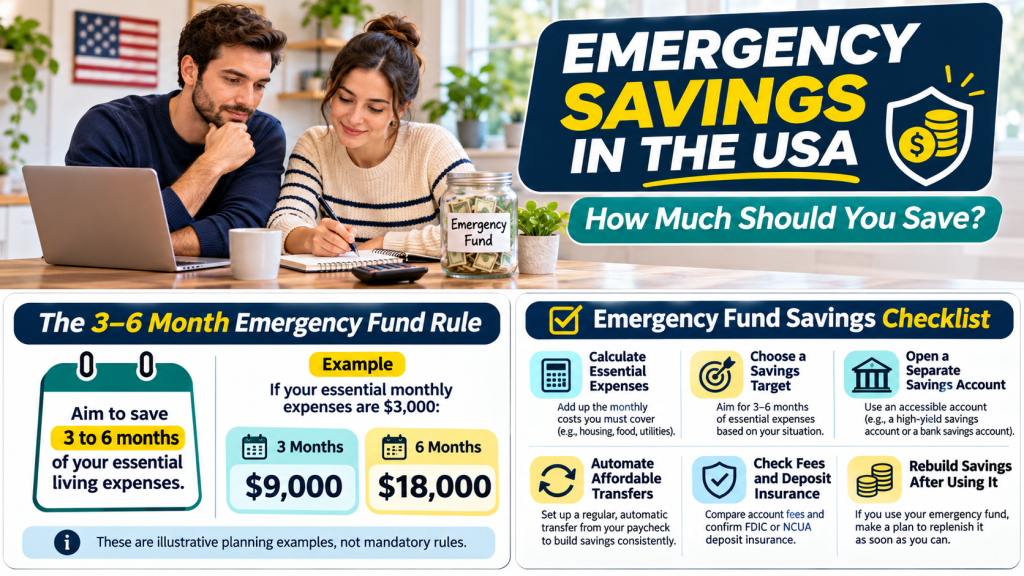
A commonly used financial guideline is to save three to six months of essential living expenses.
However, this is a guideline, not a fixed requirement. Some households may need more, while others may start with a smaller savings target.
Your emergency fund should be based on the money you need to cover essential expenses, not necessarily your full monthly income.
General Emergency Fund Targets
| Financial situation | Possible savings target |
|---|---|
| Stable income, fewer responsibilities | 3 months of essential expenses |
| Single-income household | 3–6 months |
| Family with children | 6 months or more |
| Self-employed or freelancer | 6–12 months |
| Irregular income | 6–12 months |
| High monthly financial responsibilities | 6 months or more |
These are planning suggestions, not universal financial rules. Choose a target that fits your circumstances.
Why Do People Recommend Three to Six Months?
Suppose you lose your job unexpectedly. You may need time to find another job, attend interviews, and manage household expenses.
An emergency fund can help cover essential costs during that period.
A larger reserve may be helpful if you have dependents, work in an unstable industry, or have irregular income.
3. How to Calculate Your Emergency Fund
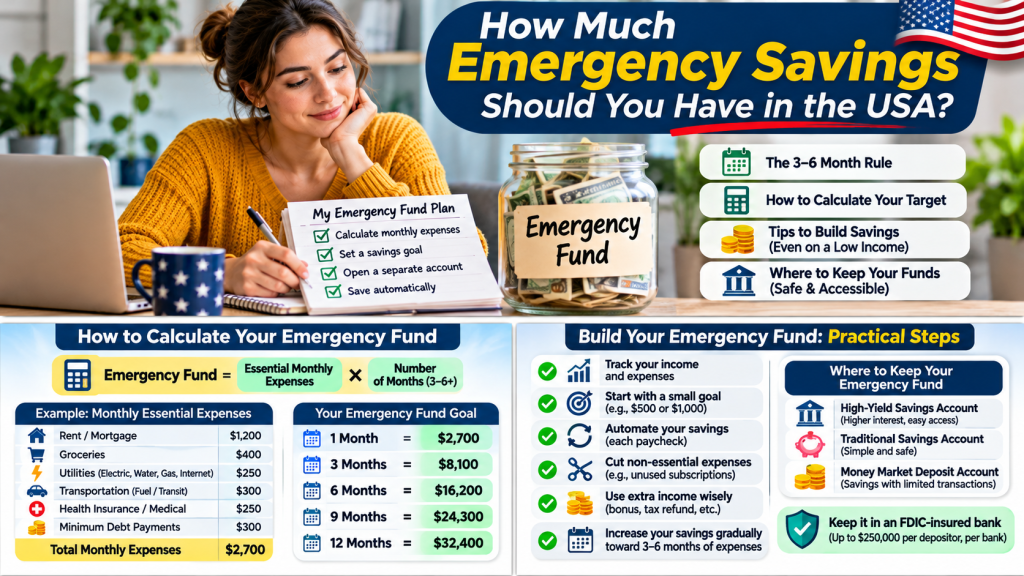
The easiest way to calculate your emergency savings target is to add up your essential monthly expenses.
Include expenses that you would still need to pay during a financial emergency.
Essential Monthly Expenses May Include:
- Rent or mortgage payments.
- Groceries and basic household supplies.
- Electricity, water, gas, and essential phone or internet service.
- Health insurance and essential medical costs.
- Transportation and fuel.
- Minimum debt payments.
- Childcare and necessary family expenses.
- Essential insurance premiums.
You may temporarily reduce non-essential spending, such as entertainment, restaurant visits, shopping, and subscriptions.
Emergency Fund Formula
Emergency Fund = Essential Monthly Expenses × Number of Months
For example, suppose your essential monthly expenses are $3,000.
| Emergency Fund Period | Savings Target |
|---|---|
| 1 month | $3,000 |
| 3 months | $9,000 |
| 6 months | $18,000 |
| 9 months | $27,000 |
| 12 months | $36,000 |
If your financial responsibilities are high or your income is unpredictable, a larger target may be useful.
4. Emergency Fund Examples for Different Monthly Budgets
Let’s look at three hypothetical households in the USA.
Example 1: Single Person
Suppose your essential monthly expenses are $2,000.
| Expense | Monthly Cost |
|---|---|
| Rent | $900 |
| Groceries | $300 |
| Utilities | $150 |
| Transportation | $200 |
| Insurance and medical costs | $200 |
| Minimum debt payments and other essentials | $250 |
| Total | $2,000 |
Your emergency savings target could be:
- 3 months: $6,000
- 6 months: $12,000
Example 2: Family of Three
Suppose a family has essential monthly expenses of $4,000.
- 3-month emergency fund: $12,000
- 6-month emergency fund: $24,000
- 9-month emergency fund: $36,000
A family with children may prefer a larger cushion because childcare, healthcare, and housing expenses can be difficult to reduce quickly.
Example 3: Freelancer or Self-Employed Person
Suppose your essential monthly expenses are $3,500 and your income changes from month to month.
You may decide to target six to twelve months of expenses.
- 6-month target: $21,000
- 9-month target: $31,500
- 12-month target: $42,000
This larger target can provide additional flexibility during periods when client payments or business income decrease.
5. Is $1,000 Enough for an Emergency Fund?
Saving $1,000 can be a useful first milestone, especially if you are starting with no emergency savings.
However, $1,000 may not cover several months of living expenses or a major emergency.
For example, it may help with a small car repair, an unexpected bill, or part of a medical expense, but it may not be enough to cover a prolonged loss of income.
A practical approach is to build your emergency fund in stages:
- First save $500.
- Increase it to $1,000.
- Work toward one month of essential expenses.
- Build up to three months.
- Continue toward six months or more if needed.
Do not feel discouraged if you cannot save thousands of dollars immediately. Consistent progress matters.
6. How Much Should You Save Each Month?
Your monthly savings amount depends on your income and existing expenses.
You do not need to save a large amount at once. Start with an amount that you can maintain regularly.
Example Monthly Savings Plan
Suppose your target is $6,000.
| Monthly Savings | Time to Reach $6,000 |
|---|---|
| $50 | 120 months |
| $100 | 60 months |
| $150 | 40 months |
| $200 | 30 months |
| $300 | 20 months |
| $500 | 12 months |
These estimates assume regular deposits and exclude interest earned.
Even saving $50 or $100 every month can help you build a financial cushion over time.
Make Saving Automatic
You can arrange an automatic transfer from your checking account to a separate savings account after receiving your paycheck.
This helps make saving a regular habit instead of something you do only when money is left over. Make sure the transfer amount will not cause an overdraft or leave too little for essential bills.
7. How to Build an Emergency Fund on a Low Income
Building savings on a limited income can be difficult, especially when rent, groceries, transportation, and bills take up most of your paycheck.
The goal is to begin with a realistic amount rather than waiting until you can save a large sum.
Here are practical ways to get started.
1. Track Your Spending
Write down your income and expenses for a month.
Identify where your money goes and look for expenses that can be reduced without affecting essential needs.
2. Start With a Small Goal
Your first target could be $250, $500, or $1,000.
A smaller goal can make the process feel more manageable.
3. Reduce Unnecessary Expenses
Review subscriptions, frequent food deliveries, impulse shopping, and unused services.
Redirect the money you save toward your emergency fund.
4. Save a Small Amount From Every Paycheck
Even a small automatic transfer can help build consistency.
For example, saving $25 from each weekly paycheck would add up to approximately $1,300 over a year, excluding interest.
5. Use Extra Income Wisely
If you receive a tax refund, work bonus, gift, or additional income, consider putting some of it into your emergency savings.
6. Avoid Using Savings for Non-Emergencies
Keep emergency savings separate from money used for entertainment, shopping, or planned purchases.
7. Increase Your Savings Gradually
If you receive a pay raise or reduce a monthly expense, consider increasing your automatic savings contribution.
The most important thing is to choose a realistic plan and continue following it.
8. Where Should You Keep Your Emergency Fund?
Your emergency fund should be safe, accessible, and separate from your everyday spending money.
You generally do not want to place your emergency savings in an investment that can lose value or become difficult to access when you need it.
Here are some options to consider.
1. High-Yield Savings Account
A high-yield savings account may offer a higher interest rate than a traditional savings account.
Potential benefits include:
- Interest earnings on your savings.
- Access to money when needed, subject to account terms.
- Separation from your everyday checking account.
- No need to take investment market risk.
Compare the APY, fees, minimum balance requirements, withdrawal rules, and account access options.
Interest rates can change, so do not assume that a high APY will remain the same.
2. Traditional Savings Account
A regular savings account at a bank or credit union can also be suitable.
It may offer convenient access if you already use the institution for your checking account.
Compare fees and interest rates before opening an account.
3. Money Market Deposit Account
Some banks offer money market deposit accounts that combine savings features with certain transaction options.
Check minimum balance requirements, withdrawal conditions, and fees.
Do not confuse a bank money market deposit account with a money market mutual fund. They are different financial products.
4. Keep a Small Amount of Cash
Keeping a small amount of cash at home may help during a temporary power outage or payment-system disruption.
However, cash can be lost, stolen, or damaged. It should not replace a secure savings account for your entire emergency fund.
9. Is Your Emergency Fund Safe in a US Bank?
If you keep your emergency savings in an FDIC-insured bank, eligible deposits are generally protected up to the standard limit of $250,000 per depositor, per insured bank, for each account ownership category.
Covered deposit accounts generally include:
- Savings accounts.
- Checking accounts.
- Money market deposit accounts.
- Certificates of deposit.
FDIC insurance does not cover stocks, bonds, mutual funds, or other investment products simply because you purchased them through a bank.
Before depositing your money, verify that the bank is FDIC-insured.
Credit unions have a separate federal deposit insurance system through the National Credit Union Administration (NCUA), subject to its rules and coverage limits.
10. When Should You Use Your Emergency Fund?
An emergency fund is meant for genuine financial needs that are unexpected and important.
Appropriate Reasons to Use It
- Losing your job or experiencing a significant income reduction.
- Urgent medical expenses.
- Essential car repairs needed to get to work.
- Emergency home repairs, such as a serious plumbing problem.
- Unexpected travel for a family emergency.
- Necessary expenses during a temporary disability or illness.
Expenses That Usually Do Not Qualify
- Vacations and holidays.
- New phones or expensive electronics.
- Regular shopping.
- Entertainment and dining out.
- Planned purchases.
- Routine monthly bills that are already included in your budget.
If you use your emergency fund, do not feel guilty. It exists to help you during difficult situations.
Once the emergency has passed, make a plan to rebuild the money.
11. Emergency Fund vs. Regular Savings
Although both involve saving money, they serve different purposes.
| Feature | Emergency Fund | Regular Savings |
|---|---|---|
| Main purpose | Unexpected financial needs | Planned financial goals |
| Examples | Medical bills, job loss, repairs | Vacation, car purchase, home deposit |
| Access | Should be readily accessible | Depends on the goal |
| Risk preference | Generally low risk | Depends on the goal and timeline |
| Spending rules | Use for genuine emergencies | Use for planned purchases |
Keeping these savings separate can help you avoid spending emergency money on non-essential purchases.
12. Common Emergency Fund Mistakes to Avoid
Building an emergency fund is useful, but certain mistakes can reduce its effectiveness.
1. Waiting Until You Have More Money
You do not need a large income to start. Begin with a manageable amount.
2. Investing All Your Emergency Savings
Stocks, cryptocurrency, and other market-linked investments can lose value. They may also be difficult to sell at the right time.
An emergency fund should generally be kept in accessible, low-risk accounts rather than investments exposed to market volatility.
3. Setting an Unrealistic Target
Trying to save $20,000 immediately can feel overwhelming.
Start with a smaller milestone and gradually increase your target.
4. Mixing Emergency Savings With Spending Money
Keeping your emergency fund in the same account you use for daily purchases may make it easier to spend accidentally.
Consider using a separate savings account.
5. Ignoring Bank Fees
Monthly maintenance fees or minimum balance requirements can reduce your savings.
Compare account terms before opening an account.
6. Forgetting to Rebuild Your Fund
If you use your emergency savings, create a plan to replenish the money after your financial situation becomes stable.
13. Emergency Fund Calculator: Find Your Savings Target
You can calculate your emergency savings target using your essential monthly expenses and the number of months you want to cover.
For example:
- Essential expenses: $2,500 per month.
- Target period: 6 months.
- Emergency fund goal: $15,000.
Formula: Essential monthly expenses × Target months = Emergency fund goal.
Use this simple formula to estimate your own target. Remember that the result is a planning goal, not a required amount. You can start with a smaller milestone and build toward it over time.
14. Frequently Asked Questions (FAQs)
1. How much emergency savings should I have in the USA?
A common starting guideline is three to six months of essential living expenses. Your ideal target may be higher or lower depending on your income stability, family responsibilities, and financial obligations.
2. Is $1,000 enough for an emergency fund?
It can be a useful first savings milestone, but it may not cover several months of expenses. Gradually work toward one month of essential expenses and then a larger reserve.
3. Should I save three months or six months of expenses?
Three months may be a reasonable initial target for someone with stable income and fewer financial responsibilities. Six months or more may be useful for households with dependents, irregular income, or greater financial uncertainty.
4. Where should I keep my emergency savings?
A separate, accessible savings account is often a practical choice. Compare high-yield savings accounts, traditional savings accounts, and money market deposit accounts, paying attention to fees, access, and deposit insurance.
5. Should I invest my emergency fund in stocks?
Generally, no. Stocks can lose value, especially over short periods. Emergency savings should usually be kept in low-risk and accessible accounts.
6. Can I use a credit card instead of an emergency fund?
A credit card may help with certain urgent purchases, but it does not replace savings. Interest and fees can make borrowing expensive if you cannot repay the balance quickly.
7. How long does it take to build an emergency fund?
It depends on your savings goal and monthly contributions. For example, saving $200 per month would take 30 months to reach $6,000, excluding interest.
8. Is a high-yield savings account good for an emergency fund?
It may be suitable if it offers competitive interest, convenient access, reasonable fees, and appropriate deposit insurance. Check the account conditions before opening it.
9. Should I pay off debt or build an emergency fund first?
The right balance depends on your interest rates, minimum payments, and financial stability. Many people start with a small emergency reserve while keeping up with required debt payments, then work on high-interest debt and expand their emergency savings.
10. What should I do after using my emergency fund?
Once the emergency has passed, review your budget and start rebuilding the money gradually. You can begin with small automatic transfers and increase them when your finances allow.
Conclusion
An emergency fund is one of the most useful tools for building financial security in the USA. It can help you handle unexpected expenses, manage periods of unemployment, and reduce your dependence on high-interest borrowing.
A common guideline is to save three to six months of essential living expenses, but your target should reflect your personal financial situation, income stability, family responsibilities, and monthly obligations.
Start with a small goal, save consistently, and keep your money in a safe and accessible account. You do not have to build your entire emergency fund in one month.
The most important step is to start today and gradually increase your savings as your financial situation improves. Even small contributions can make a meaningful difference over time.
Remember, an emergency fund is not just money sitting in a savings account. It is financial protection that can help you face unexpected situations with greater confidence and peace of mind.
Your Next Step
Take five minutes today to calculate your essential monthly expenses. Set your first emergency savings goal at $500 or $1,000, open a separate savings account if needed, and schedule a small automatic transfer from your next paycheck. Start with what you can afford and increase your contributions gradually.
Disclaimer: This article is for general educational purposes only and does not constitute financial, investment, or tax advice. Savings account rates, fees, withdrawal conditions, and deposit insurance coverage depend on the financial institution and applicable rules. Always review the account terms before choosing where to keep your emergency savings.